event
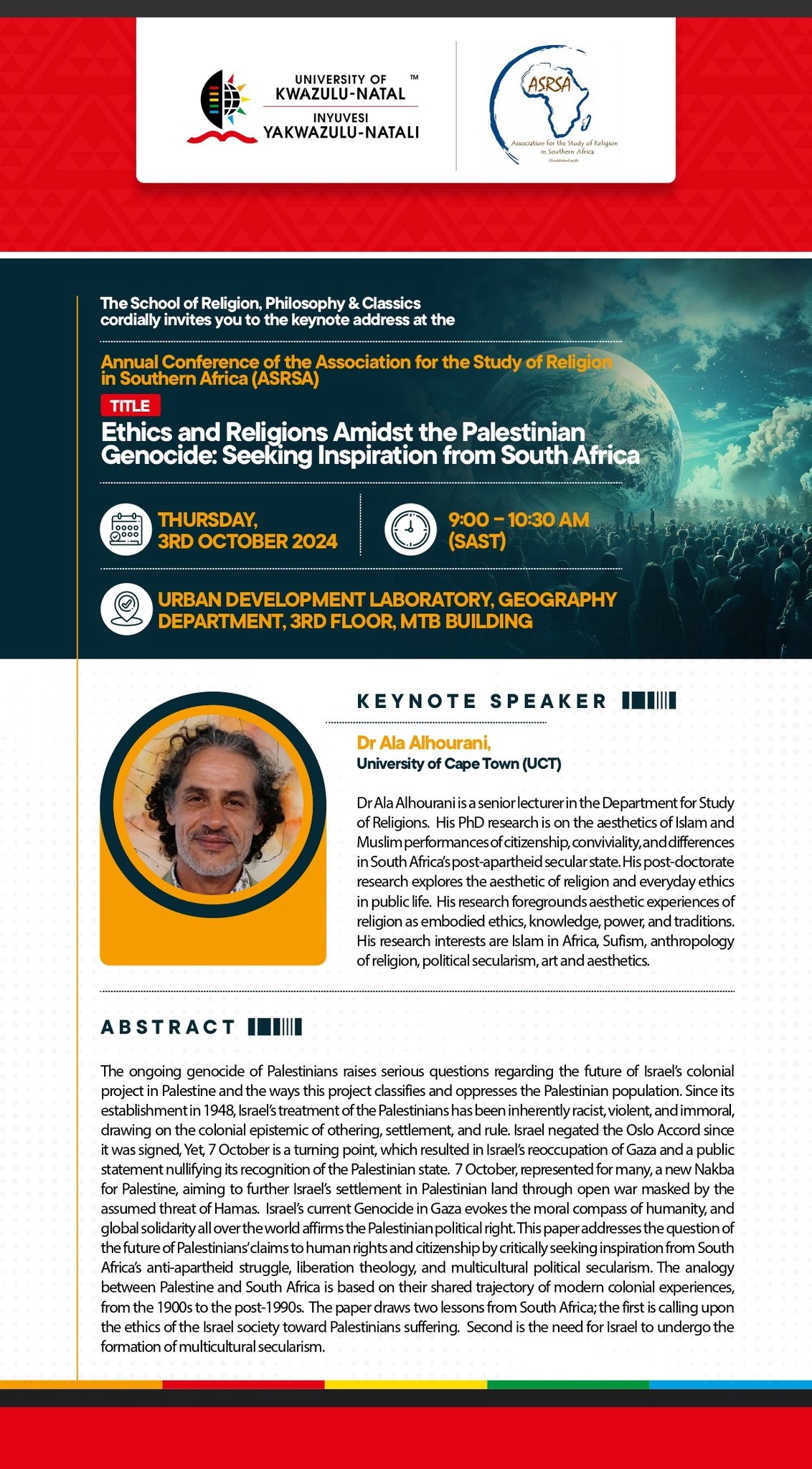
Key note adress: Ethics and Religions Amidst the Palestinian Genocide: Seeking Inspiration from South Africa
3 October 2024


This key note address is open to the public, and the Zoom link for this session is provided below.
• Topic: ASRSA Congress 2024 - Keynote Address - Dr Ala Alhourani (UCT)
• Time: Oct 3, 2024, 09:00 AM Johannesburg
• Join Zoom Meeting: Join Here
Meeting ID: 825 5044 1944
Passcode: 594111
Ethics and Religions Amidst the Palestinian Genocide: Seeking Inspiration from South Africa
The ongoing genocide of Palestinians raises serious questions regarding the future of Israel’s colonial project in Palestine and the ways this project classifies and oppresses the Palestinian population. Since its establishment in 1948, Israel’s treatment of the Palestinians has been inherently racist, violent, and immoral, drawing on the colonial epistemic of othering, settlement, and rule. Israel negated the Oslo Accord since it was signed, Yet, 7 October is a turning point, which resulted in Israel’s reoccupation of Gaza and a public statement nullifying its recognition of the Palestinian state. 7 October, represented for many, a new Nakba for Palestine, aiming to further Israel’s settlement in Palestinian land through open war masked by the assumed threat of Hamas. Israel’s current Genocide in Gaza evokes the moral compass of humanity, and global solidarity all over the world affirms the Palestinian political right. This paper addresses the question of the future of Palestinians’ claims to human rights and citizenship by critically seeking inspiration from South Africa’s anti-apartheid struggle, liberation theology, and multicultural political secularism. The analogy between Palestine and South Africa is based on their shared trajectory of modern colonial experiences, from the 1900s to the post-1990s. The paper draws two lessons from South Africa; the first is calling upon the ethics of the Israel society toward Palestinians suffering. Second is the need for Israel to undergo the formation of multicultural secularism.
See attached poster for more details