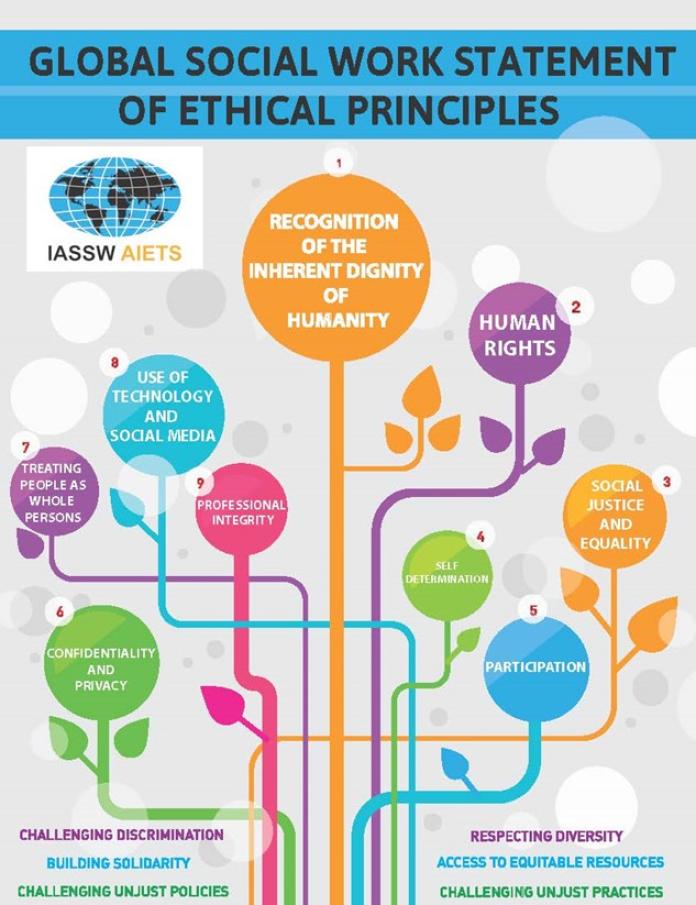
This Statement of Ethical Principles (hereafter referred to as Statement) is designed to facilitate social workers aspirations towards the highest possible standards of ethical practice, through processes of constant debate, self-reflection, willingness to deal with ambiguities, and to engage in ethically acceptable processes of decision-making to achieve ethical outcomes. Each of the principles in this Statement must be read in relation to each other and not separately.
This Statement makes an explicit commitment to value the people with whom social workers engage. Implicit in our acceptance of this Statement as social work educators, students, researchers, and practitioners is our commitment to uphold the core values and principles of the social work profession as set out in this Statement. A Statement such as this works best when it reflects the moral impulse on the part of the social worker, with a commitment to doing no harm, social justice, recognition of the inherent dignity of humanity and to the universal and inalienable rights of people.
Recognizing the embodied vulnerability of ourselves and, more particularly of the people whom we engage with or work on behalf of, this Statement is designed to ensure multiple levels of accountability towards: the individuals, families, groups, and communities that we engage with; ourselves; the organizations that we work in; and the broader societal contexts within which social work education, practice and research is located.
We recognize a need for a fundamental conceptual shift from situating human dignity primarily within the context of autonomy to recognizing the inter-subjectivity and inter-relatedness of human dignity and human rights. Far from being autonomous and independent beings as constructed by liberal theory, as human beings we are all embedded in societies and dependent on their socio-political, economic and cultural structures and conventions. Vulnerability is a universal part of the human condition. This does not negate the agency that people have in liberating themselves on personal and political levels, and the responsibility of socio-political, economic, and cultural systems in ensuring development and wellbeing.
Social workers recognize the political dimension of the profession as a consequence of the power and authority conferred on them by the State to take action with or on behalf of people, within the boundaries of the profession’s ethical principles
Social work as a profession is dynamic, critical, and engaged with people and their multiple environments. There are an array of values and ethical principles which inform us as social workers. This reality is recognized in the 2014 Global Definition of Social Work, which is layered, and encourages regional and national amplifications. Likewise, this Statement may be amplified and/or adapted at national and/or regional levels, as long as it is in accordance with the intention and spirit of this Statement.
Social work employer organizations, and education and research institutions must work towards the provision of infrastructural arrangements, and developmental opportunities to facilitate the achievement of ethical imperatives. It is not only social workers who must ensure ethical practices; organizations must fulfil their obligations in supporting ethical practices3.
This Statement takes as its point of departure the 2014 Global Definition of Social Work, which reads as:
Social work is a practice-based profession and an academic discipline that facilitates social change and development, social cohesion, and the empowerment and liberation of people. Principles of social justice, human rights, collective responsibility, and respect for diversities are central to social work. Underpinned by theories of social work, social sciences, humanities and Indigenous knowledges, social work engages people and structures to address life challenges and enhance wellbeing.
Principles
- Recognition of the Inherent Dignity of Humanity
1.1 Recognizing the inherent dignity of all human beings, social workers work towards empathetic relationships and making being for the Other (people who social workers work with or on behalf of) one of the foundations of ethical practice, where the social worker accords the unique Other that priority assigned to the Self. The idea is to treat all people as they want to be treated and as we would like to be treated.
1.2 Social workers demonstrate respect for the inherent dignity and worth of all human beings, in attitude, word and deed. This calls for differentiation between unconditional positive regard for persons and people’s attitudes, behaviours and/or socio-political and cultural contexts that may be deemed to be in need of change. While we respect persons, we challenge beliefs and actions of those persons where they may devalue or stigmatise themselves or other persons.
1.3 Social workers appreciate that the need for such differentiation elucidated in 1.2 calls for critically reflexive practice. As social workers we (as do the people whom we engage with) bring to the working relationship our histories, pains and joys, values, and our religious, spiritual, and cultural orientations. Critical reflection on how the personal influences the professional and vice versa must be the foundation of everyday ethical practice.
1.4 While recognizing the strengths and inherent dignity that all human beings possess, social workers acknowledge the embodied vulnerability of ourselves and the people with whom we work. Tuning into, acknowledging, and dealing with vulnerabilities is constitutive of strengths, and are sources of growth, development, and human flourishing.
- Promoting Human Rights
2.1 Social workers embrace and promote the fundamental and inalienable rights of all human beings, as reflected in human rights instruments and conventions, such as the Universal Declaration of Human Rights; the Convention on the Rights of the Child; the Convention on the Elimination of All Forms of Discrimination against Women; the International Covenant on Economic and Cultural Rights; the International Covenant on Civil and Political Rights; the Convention on the Elimination of all Forms of Racial Discrimination; the Convention on the Rights of Persons with Disabilities; the Convention relating to the Status of Refugees; UN Declaration on the Rights of Indigenous Peoples; the International Convention on the Protection of the Rights of All Migrant Workers and Members of Their Families and the International Labour Standards.
2.2. Social workers respect and defend the human rights principle of indivisibility, and promote all civil, political, economic, social, cultural, and environmental rights.
2.3 Recognizing that culture sometimes serves as a disguise to violate human rights, social workers serve as cultural mediators to enable consensus building, find an appropriate balance between competing human rights, and to advocate for the rights of marginalized, stigmatized, excluded, exploited, and oppressed individuals and groups of persons.
2.4 Social workers recognize that human rights need to coexist alongside collective responsibility, understanding that individual human rights can only be realized on a day-to-day basis if people take responsibility for each other and the environment, and if they work towards creating reciprocal relationships within communities.
2.5 Social workers provide people with information regarding their rights, and support people’s efforts to access their rights.
2.6 Social workers recognize the State as a key actor in the defense, promotion, and fulfillment of human rights.
- Promoting Social Justice
Social workers promote social justice, in relation to society generally, and in relation to the people whom they work with. This means:
3.1 Challenging Discrimination and Institutional Oppression
a) Social workers challenge discrimination, which includes but is not limited to: physical and/or mental abilities, capacity, age, culture, gender identity, sexual orientation, race, ethnicity, language, religion, spiritual beliefs, political opinions, socio-economic status, poverty, class, family structure, relationship status, and nationality (or lack thereof).
b) Social workers recognize how ideology, laws, policies, regulations, customs, or practices may create inequalities and prevent members of certain groups from equitable treatment.
c) Social workers work against institutionalized discrimination and oppression in all its forms.
3.2 Respect for Diversity
a) Social workers work towards strengthening inclusive communities that respect the ethnic and cultural diversity of societies, taking account of individual, family, group and community differences.
b) Social workers recognize that respect for, and acceptance of diversity must not be used to stretch the boundaries of moral relativism, to the point where the rights of some groups of persons, including the right to life (e.g. of women and sexual, ethnic,
and religious minorities) are violated. Social workers problematize and challenge those cultural practices that limit the full enjoyment of human rights.
c) Social workers recognize that constructing and dealing with socio-economic concerns as cultural issues often deny or minimize underlying structural factors that contribute to psychosocial challenges.
3.3 Access to Equitable Resources
a) Social workers advocate and work towards access and the equitable distribution of resources and wealth, recognizing that gross inequality combined with poverty constitute threats to human development.
b) Social workers support people’s right to sustainable income, which must be provided through decent work and/or universal social security.
3.4 Challenging Unjust Policies and Practices
a) Social workers work to bring to the attention of their employers, policy makers, politicians and the general public, situations where policies and resources are inadequate or where policies and practices are oppressive, unfair, or harmful. In doing so, social workers must not be penalized.
b) Social workers must be aware of situations that might threaten their own safety and security and they must make judicious choices in such circumstances. Social workers are not compelled to act when they would put themselves at risk.
c) Global bodies such as the IASSW and IFSW, in collaboration with social workers’ employers and/or national professional/statutory organizations, have an obligation to protect and defend social workers who are threatened in the line of duty, because of their opinions or when they draw attention to injustice.
3.5 Building Solidarity
Social workers actively work in communities and with their colleagues, within and outside of the profession, to build networks of solidarity to work towards transformational change and inclusive and responsible societies.
- Promoting the Right to Self-determination
4.1 Social workers recognize people as capable and self-determining.
4.2 Social workers respect and promote people’s rights to make their own choices and decisions, provided this does not threaten the rights and legitimate interests of others.
4.3 Social workers recognize that while individuals are self-determining in that they have the freedom to think - perhaps a most fundamental freedom - which cannot be taken away, the freedom to think does not guarantee the exercise of self-determination.
4.4 Social workers recognize that the taken-for-granted assumption of the right to self-determination in many contexts denies the often oppressive, marginalizing, exploitative, violent, and exclusionary socio-cultural, economic and political determinants of human development and functioning.
4.5 Social workers acknowledge the realities of people, whose self-determination is often curtailed on account of various factors, including the control functions that social workers exercise in fields such as child protection and welfare, criminal justice, disability, and mental health.
4.6 Social workers recognize that the agency of individuals intersect with structural conditions, and that the ideal of self-determination requires resources like good education, decent employment, access to health care, secure and stable housing, safety and security, adequate sanitation, clean water, pollution free environments, and access to information.
4.7 Social workers recognize that dominant socio-political and cultural discourses and practices contribute to many taken-for-granted assumptions and entrapments of thinking, which manifest in the normalization and naturalization of a range of prejudices, oppressions, marginalizations, exploitation, violence, and exclusions.
4.8 Social workers recognize that developing strategies to heighten critical consciousness that challenge and change taken-for-granted assumptions for ourselves and the people whom we engage with, forms the basis of everyday ethical, anti-oppressive practice.
- Promoting the Right to Participation
5.1 Social workers work towards building the self-esteem, and the capabilities of people, resourcing people to participate fully on their societies, and promoting their full involvement and participation in decisions and actions that affect their lives.
5.2 Social workers contribute to the creation of meaningful spaces and processes for people’s participation in the formulation of policies.
5.3 Social workers promote the inclusion of people who are excluded from participating or benefiting from resources due to the various criteria reflected in 3.1 a.
- Respect for Confidentiality and Privacy
6.1 Social workers respect and work in accordance with people’s rights to confidentiality and privacy.
6.2 Such rights to confidentiality and privacy might be breached when there is risk of harm to the self or to others.
6.3 Social workers recognize that a person’s right to confidentiality and privacy is restricted in certain statutory settings.
6.4 Social workers inform the people that they work with about such limits to confidentiality and privacy.
6.5 In some cultural contexts, characterized by we-centered, communitarian living, social workers respect and abide by the people’s right and choice to shared confidentiality, in so far as this does not infringe on the rights of individuals.
7 Treating People as Whole Persons
7.1 Social workers recognize the biological, psychological, social, cultural, and spiritual dimensions of people’s lives, and understand and treat all people as whole persons. Such recognition is used to formulate holistic assessments and interventions, with the full participation of people, organizations, and communities that social workers engage with.
7.2 Social workers collaborate with members of inter-disciplinary teams to achieve holistic, favourable results.
8. Ethical Use of Technology and Social Media
8.1 The ethical principles elucidated in this Statement apply to all contexts of SW practice, education, and research, whether it involves direct face-to-face contact or use of digital technology and social media.
8.2 Social workers recognize that the use of digital technology and social media may pose particular threats to the principles of confidentiality and privacy and must take the necessary precautions to guard against this. Informed consent must make such possible limits to confidentiality and privacy clear.
8.3 Social workers appreciate that verifying the identity of users of online services, including their ages and geographic locations may pose a challenge e.g. with being registered and/or licensed to practice in one location, when online users are located outside of the jurisdiction, or the difficulty of ensuring that the person is of majority age to provide informed consent. Social workers need to discuss the pragmatic and ethical implications of issues such as these with their registration and/or licensing boards.
8.4 Social workers recognize the potential pitfalls of asynchronous communication, and of the unverifiable identities of persons that they are working with, for example when suicidal or homicidal intentions, child sexual abuse or domestic violence are disclosed. Online counselling does not preclude the social workers duty to report, as per national statutory requirements, and to protect the person or others from potential harm or danger.
8.5 In using group-based e-technology services social workers ensure that they abide by the principle of inclusivity, and that no person is excluded from participation through deliberate omission.
8.6 Social workers do not post pictures of people that they work with without their consent, and they must not post pictures of children without the consent of their parents or legal guardians.
8.7 With regard to social work education, as reflected in 6.4 of the Global Standards for Social Work Education and Training, educators must ensure high quality of the educational programme whatever the mode of delivery. In the case of distance, mixed-mode, decentralised and/or Internet-based teaching, mechanisms for locally-based instruction and supervision should be put in place, especially with regard to the fieldwork component of the programme.
8.8 It is the responsibility of the social worker to provide proof of ethical practice, irrespective of the mode of practice.
9. Professional Integrity
9.1 It is the responsibility of the national associations and organizations to develop and regularly update their own codes of ethics or ethical guidelines, to be consistent with this Statement, considering local situations. It is also the responsibility of national organizations to inform social workers and schools of social work about this Statement of Ethical Principles and their own ethical guidelines. Social workers should act in accordance with the current ethical code or guidelines in their country.
9.2 Social workers must hold the required qualifications, and develop and maintain the required skills and competencies to do their job.
9.3 Social workers support peace and non-violence. Social workers may work alongside military personnel for humanitarian purposes and work towards peace building and reconstruction. Social workers operating within a military or peacekeeping context must always support the dignity and agency of people as their primary focus. Social workers must not allow their knowledge and skills to be used for inhumane purposes, such as torture, military surveillance, terrorism, or conversion therapy and they should not use weapons in their professional or personal capacities against people.
9.4 Social workers must act with integrity. This includes not abusing their positions of power and relationships of trust with people that they engage with; they recognize the boundaries between personal and professional life, and do not abuse their positions for personal material benefit or gain.
9.5 Social workers recognize that the giving and receiving of small gifts is a part of the social work and cultural experience in some cultures and countries. In such situations this should be referenced in the country’s code of ethics.
9.6 Social workers and their employers recognize the need to take steps to care for themselves professionally and personally to prevent burnout and to enhance working relationships and outcomes.
9.7 Social workers acknowledge that they are accountable for their actions to the people they work with, their colleagues, their employers, the professional associations, and local, national, and international laws and conventions, and that these accountabilities may conflict, which must be negotiated to minimize harm to all persons. Decisions should always be informed by empirical evidence, practice wisdom, and ethical, legal, and cultural considerations. Social workers must be prepared to be transparent about the reasons for their choices.
9.8 Social workers, and their employing bodies, work to create conditions in their workplace environments and in their countries, where the principles of this Statement and those of their own national codes are discussed, evaluated, and upheld. Social workers and their employing bodies foster and engage in debate to facilitate ethically informed decisions.