DIE FLEDERMAUS

Johann Strauss II

23rd - 26th October 2025


Opera meets high fashion in Cape Town this October as Opera UCT stages Johann Strauss II’s beloved operetta Die Fledermaus, in a bold, jazz-club-inspired setting that fuses haute couture, comedy and musical brilliance. Coinciding with Strauss’s 200th birthday and World Opera Day, this playful and provocative production promises glamour, laughter, and unforgettable music.

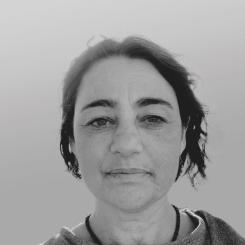
Directed by Cape Town veteran Christine Crouse, with set design by Allegra Bernacchione and costumes by celebrated fashion designer, Gavin Rajah.

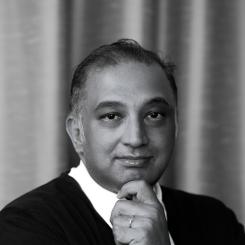
Jeremy Silver conducts the Opera UCT cast and chorus, along with the Cape Town Philharmonic Orchestra.

At the Pam Golding Theatre at The Baxter from 23rd to 26thOctober.

Bookings available through Webtickets and the Baxter Box office.

Book now

PRICE

From R100 to R500
Under 18s FREE but please book tickets early!

VENUE
Pam Golding Theatre at The Baxter

RUNNING TIME
2 hours 30 minutes (including interval)

LANGUAGE
The opera is sung in German, with dialogue in English and captions displayed in English and isiXhosa.

ACT ONE
At the Eisensteins’


Gabriel von Eisenstein, a hot-headed and jealous husband, has been sentenced to eight days in prison for insulting a public official. While he prepares to serve his time, his wife Rosalinde entertains the attentions of her former admirer, Alfred. Meanwhile, the maid Adele schemes her way out of household duties so she can attend a lavish party hosted by Prince Orlofsky.

Dr. Falke, still smarting from an old prank in which Eisenstein once sent him walking through town dressed as a bat, seizes the chance for revenge. He convinces Eisenstein to delay his prison sentence for just one night and join him in disguise at Orlofsky’s ball.

As Adele and Eisenstein slip away to the festivities, the prison governor Frank arrives at Eisenstein’s house, and promptly arrests Alfred, mistaking him for Gabriel.

ACT TWO
At Prince Orlofsky’s Ball


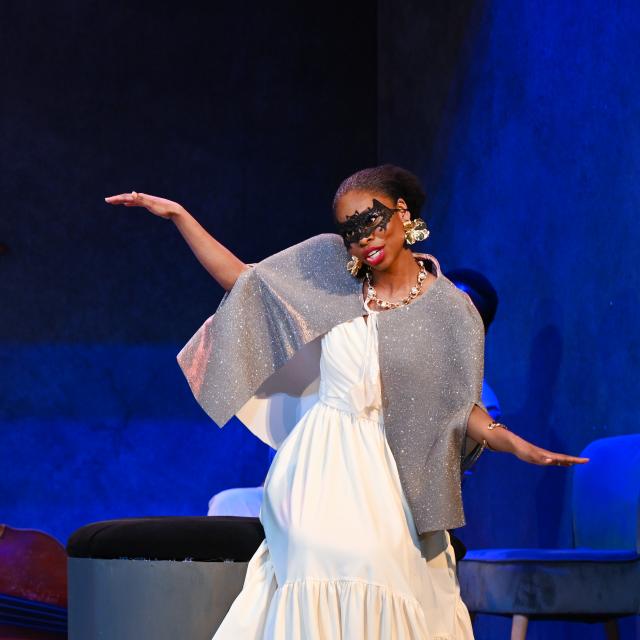
The eccentric and world-weary Prince Orlofsky is hosting one of his famously extravagant parties, where everyone is urged to indulge in champagne and mischief. Adele, disguised in one of her mistress’s gowns, astonishes the guests with her wit and charm, insisting she is an actress. Eisenstein arrives under the name “Marquis Renard”, unaware that Rosalinde has also come to the ball in disguise, masked as a Hungarian countess.

Falke carefully orchestrates the evening to entrap his unsuspecting friend. Rosalinde, determined to catch her husband in his infidelity, allows him to flirt with her, without revealing her true identity. When Eisenstein gallantly offers her his pocket watch as a token of affection, Rosalinde seizes it as proof of his betrayal.

The ball whirls on in a haze of champagne, laughter, and mistaken identities, until the revelry gives way to morning and the reckoning that awaits at the prison.

ACT THREE
At the Prison

The following day, confusion reigns. Governor Frank, who has also enjoyed himself a little too freely at the ball, returns to his post only to discover a tangle of mistaken arrests and missing prisoners. Eisenstein finally arrives to serve his sentence, but is shocked to find Alfred already locked up in his place.

When Rosalinde confronts him with the pocket watch, Eisenstein’s double life is exposed. At the height of the chaos, Falke reveals his grand prank: the entire escapade has been his carefully planned revenge for the old “bat” humiliation.

In the end, the laughter proves infectious, and with champagne to smooth over wounded pride, all are reconciled.

Characters

Gabriel von Eisenstein              

Rosalinde - Eisenstein's wife                

Adele - Rosalinde's maid        

Ida - Adele's sister      

Alfred - a singer

Dr Falke - a notary      

Dr Blind - a lawyer       

Frank - a prison governor        

Prince Orlofsky - a Russian prince   

Frosch - a jailer

This Production

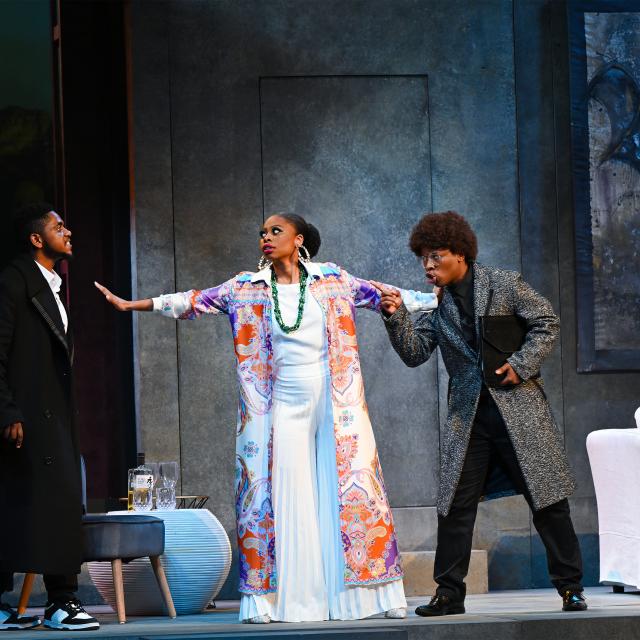
Dr. Falke plots revenge against his friend Gabriel von Eisenstein for playing a prank on him years before. Falke’s clever plan plays out at a magnificent party organised by Prince Orlofsky, where things quickly get out of hand with erotic mix-ups, conspiracies, intrigues and a large portion of Schadenfreude.

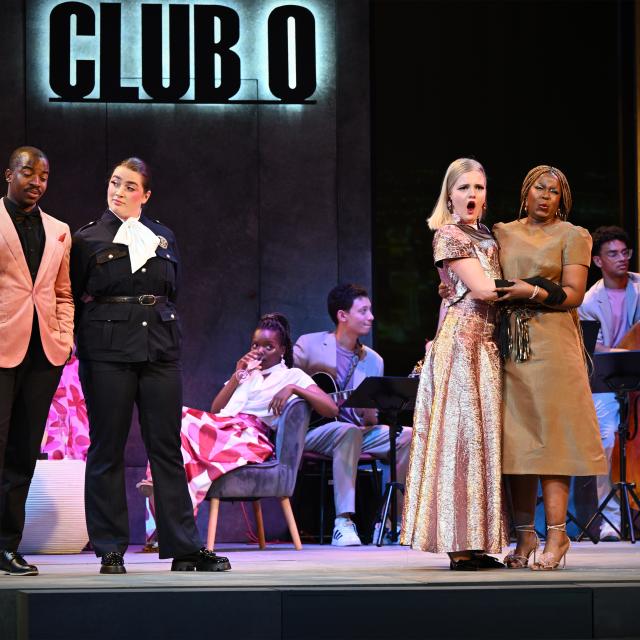
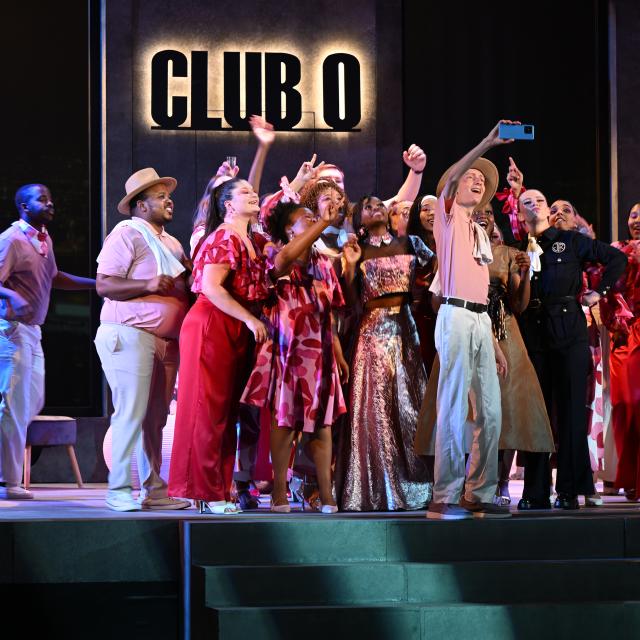
Our staging locates the party in a Cape Town jazz club, preserving the charm, glamour and humour of the original setting while portraying characters that we feel we recognise  and know.

Remote video URL
Preview image for the video remote "The cast at the Wiener Staatsoper sings 'Im Feuerstrom der Reben' from DIE FLEDERMAUS".


What's the music like?

The music of Die Fledermaus sparkles with wit, elegance, and irresistible charm. Johann Strauss II’s score overflows with effervescent dance rhythms and soaring melodies that capture the spirit of high society and hidden mischief. From high-spirited dances to moments of tender romance, every note dances with infectious energy and Viennese sophistication. It’s a celebration of joy, laughter, and the irresistible rhythm of life.

More about the composer

Johann Strauss II was an Austrian composer of light music, particularly dance music and operettas as well as a violinist. He composed over 500 waltzes, polkas, quadrilles, and other types of dance music, as well as several operettas and a ballet. In his lifetime, he was known as "The Waltz King", and was largely responsible for the popularity of the waltz in the 19th century.

The start of his career was not easy.  His father, who was also a well-known musician, wished him to follow a non-musical profession, so he set out as a bank clerk. However he studied the violin in secret, and in 1844 conducted his own dance band at a Viennese restaurant. In 1849, when the elder Strauss died, Johann combined his orchestra with his father’s and went on a tour that included Russia (1865–66) and England (1869), winning great popularity. In 1870 he decided to spend more time writing music.

For many years, the music of Strauss was dismissed as “lightweight” and not to be taken seriously. Yet it was widely admired at the time by such serious composers as Brahms, Wagner, Tchaikovsky and Richard Strauss (no relation). Luckily, time has treated Johann Strauss well, and a large amount of his prodigious musical output is frequently played around the world.

Johann Strauss

Did you know?

  • Die Fledermaus, the crown jewel of Viennese operetta, is an adaptation of a French play, Le Reveillon by Henri Meilhac and Ludovic Halévy.  The many plays of Meilhac and Halévy have been largely forgotten, but the writers are still celebrated as the librettists of Bizet's Carmen and of several of Offenbach’s operettas.

  • “Die Fledermaus” (“The Bat”) is Eisenstein’s friend Dr. Falke’s nickname. He once went to a costume ball dressed as a bat, only to be abandoned drunk in the street by Eisenstein. His “revenge” (the subtitle of the opera: Die Rache der Fledermaus) drives the whole plot.

  • Champagne is practically a character!  The operetta even includes a Champagne Chorus”  where the characters sing an ode to bubbles as the universal solution to all problems - social, emotional, and moral.

  • Strauss composed Die Fledermaus in less than six weeks! Ironically, it premiered during an economic depression in Vienna, when the public was anxious and broke. Yet it was exactly the escapist delight people needed.

  • Prince Orlofsky is one of opera’s most famous “trouser roles.” It is written for a mezzo-soprano playing a male Russian aristocrat - eternally bored, androgynous, and wealthy enough to do anything. The gender play in Orlofsky’s character has made the role a queer icon in many modern interpretations.

  • Die Fledermaus is performed almost every year at the Vienna State Opera on December 31. It has become as essential to Viennese New Year’s Eve as the Blue Danube Waltz - a glittering toast to joy, irony, and renewal.

  • Behind all the laughter and champagne, Die Fledermaus gently mocks the hypocrisy of bourgeois respectability in 19th-century Vienna. Everyone disguises themselves, flirts out of class, and lies.  Yet the following morning, society resets. It’s light-hearted on the surface but sharply subversive underneath.

  • Films inspired by Die Fledermaus include a silent film adaptation from 1923; Waltz Time, a British film adaptation (1933); and Oh... Rosalinda! based on the operetta but changing the characters and plot (1959).

  • The overture was used to great comic effect in the Tom & Jerry cartoon Can't Stop Conducting.