
DKIS, in collaboration with the University of Cape Town Libraries, warmly invite you to a hybrid book launch
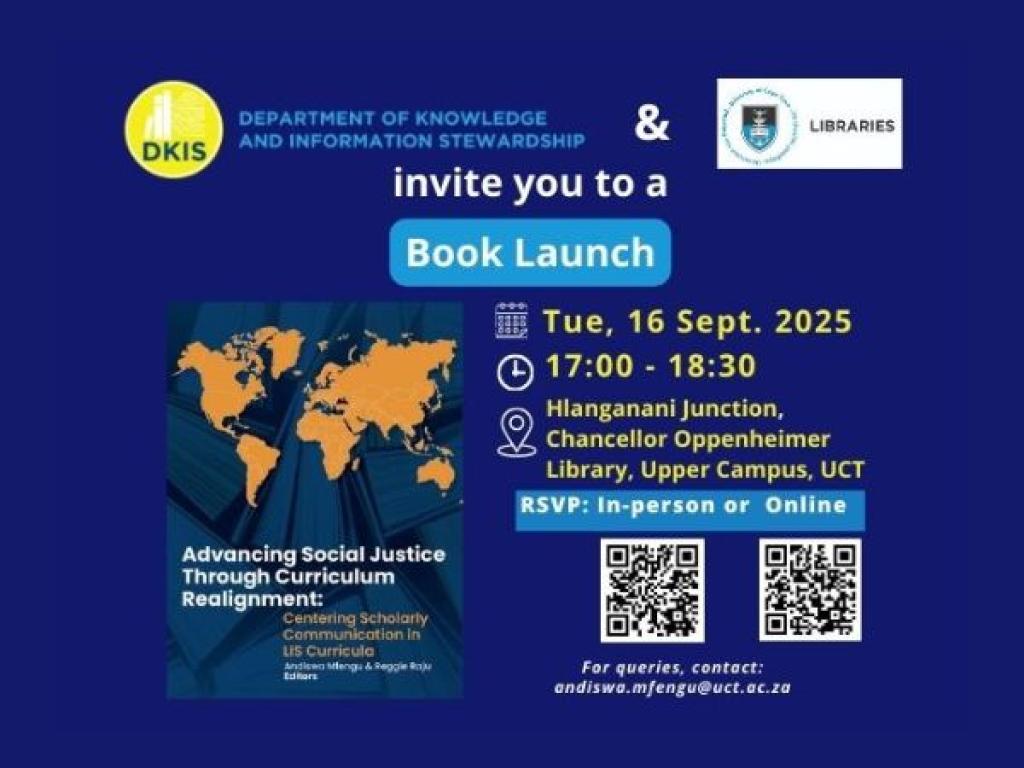
The Department of Knowledge and Information Stewardship, in collaboration with the University of Cape Town Libraries, warmly invite you to a hybrid book launch - Advancing Social Justice Through Curriculum Realignment: Centering Scholarly Communication in LIS Curricula, edited by Dr Andiswa Mfengu & Dr Reggie Raju.
Date: 16 September 2025
Time: 17h00-18h30
Venue: Hlanganani Junction, Chancellor Oppenheimer Library, Upper Campus, University of Cape Town
RSVP:
In-person attendance: https://forms.office.com/r/tnBH1R6ZyL (for catering purposes, RSVP by 12 September 2025)
To join remotely: https://uct-za.zoom.us/meeting/register/0SuRm6g0R6OY4ZKb1QA4HQ
About the book
This collection of essays is drawn from the rich discourse which took place during a Library and Information Science (LIS) education segment of the 2nd Global Summit on Diamond Open Access held at the University of Cape Town, South Africa. This scholarly conference was hosted by the University’s Department of Knowledge and Information Stewardship (DKIS) with the theme Advancing Social Justice Through Curriculum Realignment: Centering Scholarly Communication in LIS Curricula. While the broader summit explored the systemic challenges of scholarly publishing, this focused forum brought together LIS educators, practitioners, and students to engage in one of the core goals of the summit, that is, developing capacity through centering scholarly communication in LIS curricula. This goal emphasises the need to reimagine LIS education to prepare the profession.
This compilation of 19 essays by 23 authors demonstrates the intent by the editors to be as inclusive as possible, drawing views from across Africa, Latin America, Europe, North America and Australasia. The contributors reflect a diverse range of professional and scholarly experiences, offering regionally grounded and globally relevant insights into the future of scholarly communication in LIS education. A further point of inclusion is multilingual engagements captured in this collection of essays. It has been written in English, Spanish, Portuguese and SeTswana, a departure from mainstream English medium only. Moreover, to accommodate Englishes of the world, the essays adopt variations in the English language and style.