
When the World Was - A book for children and adults written and illustrated by Pippa Skotnes

In the beginning before time began, the world was alive with possibilities. Animals were people, people could command the wind and the rain, and the sun had the power of speech. Many languages were spoken and stories, carried by the breath of those who spoke them, floated on the wind. But then things changed. This book, set in southern Africa, tells a story of wonder and loss, and the promise of redemption.
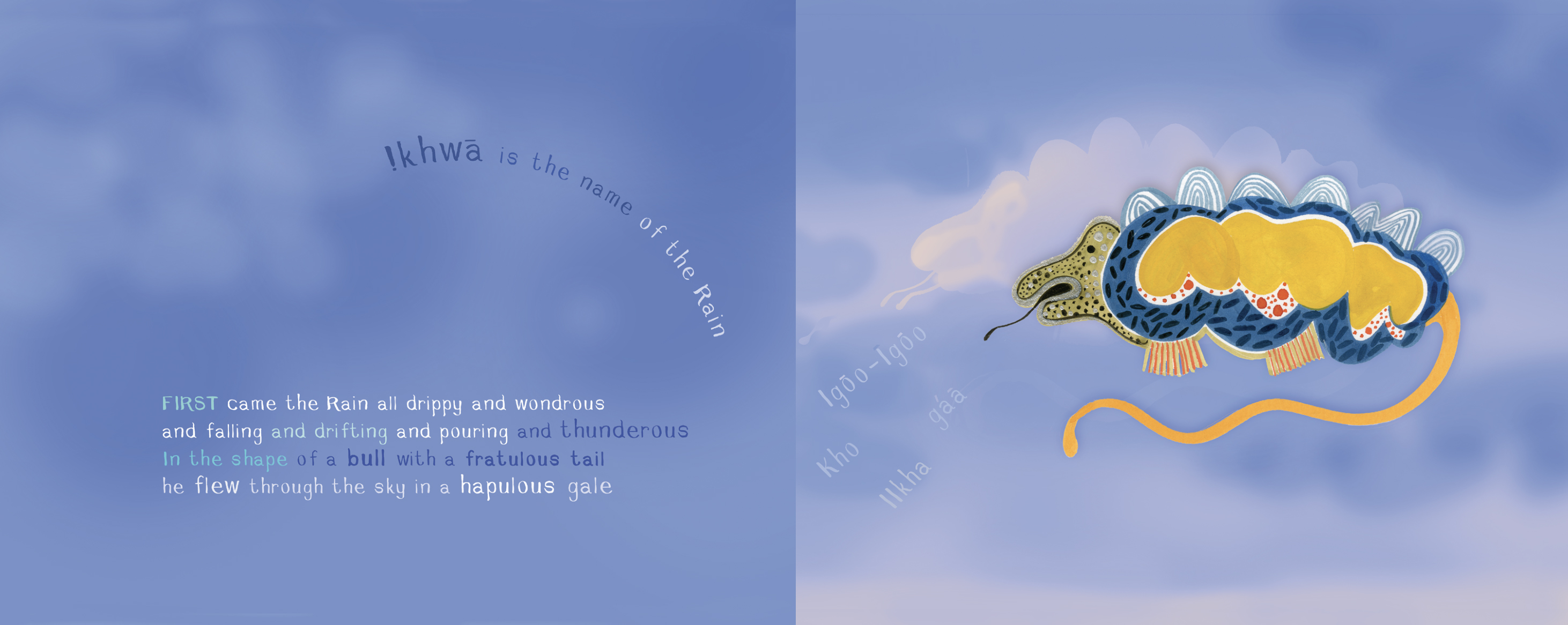
Before people owned animals, and before the arrival of farmers and Europeans, many different languages were spoken in the area of land we call southern Africa. These languages expressed ideas about the wind, the rain, celestial bodies and animals that suggested all things were powerful and could affect the destiny of humankind. Stories began with breath and were said to float on the wind. The wind was once a man who lived in a hole in a mountain. Hill tops were places where people made engravings and watched the passing herds of springbok. The rain bull, whose legs could be seen in the distant sky when a storm approached, could bring thunder and lightning or a gentle she-Rain that soaked the dry earth and filled the waterholes.
The language spoken over much of the central interior of South Africa was ǀxam, and it was recorded in Cape Town in the 1870s by Wilhelm Bleek and Lucy Lloyd with the participation of their main language instructors ǁkabbo, ǀhanǂkass'o and Dia!kwain. ǀxam is classified by linguists as belonging to the !ui branch of the Tuu family of languages which include N!ng, Nǀuu, Seroa, !xóõ and ǁxegwi and their regional versions. Today these languages, and others we know nothing about, have all died with only one remaining speaker (at the time of writing) of Nǀuu.
When the World Was draws on the stories told to Bleek and Lloyd in ǀxam and recorded in 138 notebooks, as well as a manuscript dictionary of about 40 000 entries. In making this book I have been thinking about how the loss of languages is always accompanied by a loss of biodiversity and the plundering of the land. Where once there were huge herds of antelope, including eland, hartebeest and quagga, as well as elephant, aardvark, hyena, leopard, lion and wild dogs, now there are mostly sheep and their mortal foes the caracals and the black-backed jackals. Once, the springbok were said to be like the waters of the sea, they came in such huge numbers, and people could feel their presence as a tapping in their bodies. Once baboons were people who sat on their haunches, and lions were those who walked on hair. Once all animals were people, as were the sun and moon, and stories were carried on the wind.


When travellers, herders and farmers came to the country, there was no longer any room for those who had always lived in all the fertile places. Their languages died, and with them their understanding of the land and the place of all who lived in it. No more stories were enacted around the campfire. The animals died too and some species, such as the quagga and the Cape lion, became extinct as land was taken for sheep and cattle. It is the gift of the archive that Bleek, Lloyd and their instructors assembled that the stories of the ǀxam survive in their own language. It is not too late to tell them, and to try to hear the words the people themselves once spoke.


Languages like ǀxam have many more speech sounds than most other languages. !xóõ for instance has about 161 speech sounds, of which 130 are consonants, 28 vowels and 3 tones. English, by contrast, has only around 44 speech sounds.
Click consonants are represented as ǀ for dental, ǁ for lateral, ʘ for bilabial, ǃ for alveolar and ǂ for palatal.

'When the World Was' launched in stores on Saturday, 10th May 2025.