Reflecting on the Technology-Facilitated Gender-Based Violence: A Decolonial Feminist Symposium
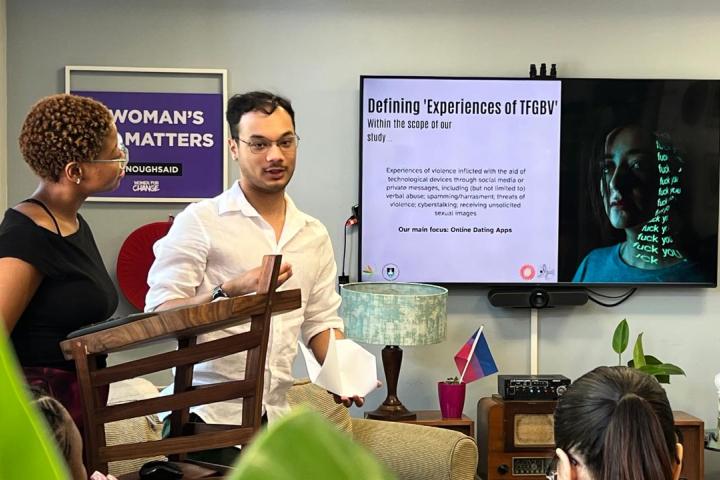
The Hub for Decolonial Feminist Psychologies in Africa, under the directorship of Professors Floretta Boonzaier and Shose Kessi, recently hosted a symposium titled Technology-Facilitated Gender-Based Violence: A Decolonial Feminist Symposium. The event formed part of ongoing research funded by the Association for Progressive Communication and the Feminist Internet Research Network (FIRN).
The symposium offered a critical platform to share emerging research findings and reflections on the growing phenomenon of technology-facilitated gender-based violence (TFGBV) in South Africa. The rise of digital technologies and online communication has created new forms of harm, making this field of inquiry both urgent and underexplored.
Opening remarks were delivered by the Dean of Humanities, Professor Shose Kessi, followed by Professor Floretta Boonzaier, who introduced the Hub and the broader decolonial feminist project on technology-facilitated gender-based violence. The event brought together researchers and scholars whose work explores how technology intersects with gender, race, and power in online spaces.
Doctoral Research Fellow Aphiwe Mhlangulana presented findings from her ongoing PhD project, Black African Women Journalists’ and Bloggers’ Experiences of Technology-Facilitated Gender-Based Violence. Her study highlights how online abuse directed at Black women journalists and bloggers is shaped by intersecting identity markers such as race and gender, drawing attention to the silencing and erasure that occur in digital spaces.
Lilitha Hole and Mikhael Adams presented insights from their completed Honours project, Exploration of Black South African Women’s and Gender Non-conforming Persons’ Experiences of Technology-Facilitated Gender-Based Violence on Online Dating Apps. Their research illuminated how online dating platforms reproduce patterns of offline harm, revealing themes of normalised online violence, racialised dehumanisation, self-policing, and the offline implications of online abuse.
Further contributions included Joel Omuron, who presented on his Masters proposal, Masculinist discourse on GBV in South Africa: A social media discourse analysis that looks to observe how masculinist discourse on social media platforms reproduces gender-based violence in online and offline spaces, and Kajal Carr, who facilitated the closing reflections. Collectively, the discussions underscored the importance of a decolonial feminist lens in understanding how technology-mediated violence operates within broader structures of inequality.
The symposium emphasised the significance of creating academic and public awareness around technology-facilitated gender-based violence, particularly as it affects marginalised communities. Further, the symposium aimed to draw attention to the innumerable effects of this form of violence on survivors and their families. Lastly, the research by Aphiwe, Lilitha, Mikhael and Joel seek to draw a link between the continuing violence from general society (gender-based violence) to the violence that takes place on online spaces, where both TFGBV and GBV are motivated by sexist and patriarchal ideas. By centring the voices and experiences of Black women and gender non-conforming persons, the Hub continues to advance critical research that challenges dominant narratives, calls for transformative approaches to digital justice and collaborates with the participants to challenge systems of oppression and to motivate for safer spaces for both Black women and gender non-conforming persons.