
Collected tales from Sub-Saharan Africa and Madagascar translated into Spanish
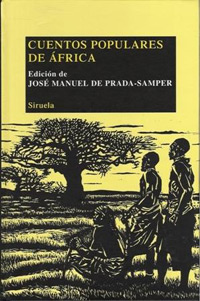
'For practical reasons, most of the tales have been taken from 19th century sources now in the public domain, mostly in English,' says De Prada, 'but 12 of the stories come from sources in Spanish, both published and unpublished. Some were collected and translated by Spanish scholars in different parts of Africa. Others come from the doctoral theses or publications of African researchers who studied at Spanish universities.'
A few stories, most of them !xun, were contributed by Marlene Winberg, who completed her Masters thesis with distinction in association with the APC research initiative. A small sample of her vast collection of San oral literature, some of these stories appear in print for the first time.
There are also two /xam stories from the Bleek and Lloyd Collection that appear for the first time in this collection.
The stories cover a wide variety of genres; myths, wonder tales and epics, among others.
'The book tries to offer a balanced representation of the main cultural areas of Africa south of the Sahara, although I recognize that there is a certain bias in favour of the southern part of the continent, and within that area, in favour of the Khoisan peoples,' says De Prada, who is, himself, a gifted story-teller capable of holding an audience rapt for hours at a stretch.
The anthology is aimed at the general reader but it is in no way a children's book. Some of the stories deal quite explicitly with sex and other bodily matters. 'It was not may aim to offer a sanitized view of African traditions,' says De Prada.
The book is divided in nine sections. The first section, 'Stories and storytellers', focuses on narratives that deal with the very act of storytelling. One of them is the myth of the origin of the Nvet, the epic tradition of the Fang people of Gabon and Equatorial Guinea. This story explains that the tales of the Nvet singers come from the world of the dead, and that some of the first practitioners of this art sacrificed their own mothers in order to have a repertory.
The second section, 'Griots and epics', offers samples of four epic traditions from different areas of Africa, including a large segment of a version of the Djerma-Songay epic of Askia Mamar translated directly into Spanish by Safiatou Amadou, a member of an aristocratic family of Niger that had griots attached to it.
The third section, 'Origins', is devoted to myths of creation, four of them from different San traditions of Southern Africa, including Qing's version of the Eland creation story collected by JM Orpen in 1873.
The fourth section, 'Tricksters and rascals', features tales of characters such as the Mantis of the /xam of South Africa and the Spider (Ananse) of the Ashanti of West Africa. One Hare story of the VaNdau of Zimbabwe and Mozambique was collected by Franz Boas in 1919 from Kamba Simango, a Mozambican who was studying at Teacher's College, in New York.
The fifth section, 'Between animals and peoples', is a sample of animal tales from all over the continent. One of them, The chimpanzee and the people, from the Bangala of Congo, Gabon and the Democratic Republic of Congo, probably reflects the sense of dispossession of the peoples exploited by King Leopold of Belgium and his minions.
The sixth section, 'Courtships and marriages', includes stories about the relationship between men and women. One of the best stories, The giant and jealous husband, is a gem of !xun oral literature, and was collected by Winberg. This is the first time it appears in print.
The stories of the seventh section, 'The border between the worlds', have to do with the intersections between the visible and the invisible, the real and the unreal. One of the best stories is News from Zululand, a Xhosa version of the British defeat at Isandlwana. A missionary from Tembuland sent the story to Lucy Lloyd just three months after the battle took place. Not long afterwards, Lloyd published the tale, in Xhosa and English, in the Folklore Journal, a short-lived, but high-quality publication that she edited.
The eighth section, 'Human woes', gathers a handful of tales that deal with infertility, the war among the sexes and the fear of death, among other subjects. Especially interesting is the cycle of tales about Arawailo, a mythical queen of Somalia during whose reign, so the story goes, men were castrated and women ran the country.
The ninth and last section, 'Transformations and rebirths', includes Ukcombekcantsini, a Zulu tale collected by Henry Callaway in the 1850s from a woman called Lydia Ukasetemba and considered by Harold Scheub and others as a classic of Zulu oral literature.
'Working on this anthology has been quite stimulating, and I have learned a lot in the process,' says its understated editor. 'It has helped me to realise that some themes that I thought were exclusive of the Khoisan peoples (like that of the water/rain animal) are actually quite widespread in the African continent.'
'Some of the public-domain sources from which I have taken stories were also used by earlier anthologists such as Paul Radin, WH Whiteley and others and it has been instructive to compare my selections with theirs,' he says.