
Ndebele boldly affirms a 'multicultural hegemony' over 'purity of identity'
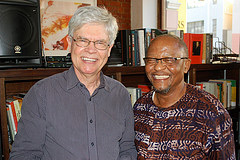
Professor Njabulo Ndebele with Derek Attridge, co-editor of the Cambridge History of South African Literature at the volume's well-attended launch
Professor Njabulo Ndebele delivered a rousing opening address at the recent launch of the Cambridge History of South African Literature in which he urged 'a futuristic focus on interconnections and interconnectedness'. APC online presents a transcript of his spoken words
To begin at the beginning, I held the book in my hands. I say this against the background that, as someone shamelessly fascinated by technology, I easily fell for the Kindle, and got hooked to it. But then here was The Cambridge History of South African Literature in my hands. I admit to loving it too. I thought I saw in my hands the endurance of the book as it has lived its remarkable history.
It may seem like I was caught in a moment of choice: the book or the Kindle. It is a false choice really. What faced me were options and the conveniences that modern life will throw in our way. Now I have in my 8.5 ounces of Kindle all the collected works of Shakespeare and more; next I have the fond heaviness of the Cambridge History of South African literature. The only one in my hand, and the real sense it gave me of the human, intellectual work that went into it; the remarkable people who came together to bring it into being at a most interesting point in the history of South Africa. In the Kindle, I feel grateful for service: convenience and availability. In the book I am grateful for the sheer weight of extraordinary human effort and its affirmation.
At the end of it all, in the Kindle and in the book I was able to witness in a very light manner the heavy dramas of disruption and continuity in history; of disconnection, reconnections or new connections; of limitations in choice, followed by moments of plenitude and sometimes confusing, even disempowering choice. As if that was not enough, there was one more hurdle to jump: anguish from the resonances of implication.
Did I make the right choice? How soon can I know? When will the discomforts of the choice made begin to yield expected positive results? What about the scale of disturbance along the way? Whenever there is a moment of relief, and the light of understanding breaks out, we may be wise enough to appreciate our capacity for resilience in living with the unknown until we know.
This is the mix of thoughts and more that came to my mind immediately after I had read the last sentence of David Attwell and Derek Attridge's introduction to this book that they have edited. This where they say: 'It is our hope that The Cambridge History of South African Literature will serve a useful purpose as the most fully representative collective of historical scholarship on the country's extensive literary production yet to have been published.'
That is when I lifted my eyes from the book to stare at the ceiling, just as someone had said readers will do when they come to the end of something they have been reading and which has hit them.
For a start, one editor stands at the edge of a well, while another is balanced on a ridge. What move will each make? How do they arrive at a consensus on joint action given the different yet potentially precarious choice each has to make, one about the well, and another about the ridge? Of course, I am not aware that their names may have presented this quandary to them: I merely spotted there a metaphor for the complexity that faced them and which they then began to grapple with.
Let me confess that the book came too late for me to read everything in it. The future of reading pleasure still waits. So, I have a view from a selection from each of the six parts, and from scanning through several chapters navigating the entire book with the aid of my own past acquaintance with a historical overview. The overview of the editors is a feat of the imagination. It lets you see the undulating waves of sensibility in the South African human fabric as it unfolds through time. They point you to moments or spikes in the graph of defining moments. These spikes may yield some summative comforts that result in plateaus of apparent stability.
And then there follow dips of distress. Historically, these dips tell us that there are limits to summative comforts. Hidden fissures may contain simmering convulsions such that stable environments may offer false comforts. Indeed, some of the fissures will explode, resulting in breakdowns in common understandings, which can be both chaotic and formative.
Such events tell of the history of violence and declining options among conquered peoples, forcing them to place an incrementally high value in memories of what they have been, as they are forced to accommodate ways of living that will never take them back to where they have been. The conquered begin to construct archives of memory from which they will recall the reason they have to keep resisting.
We get to recall too that conquerors have never had their way all the time. Now, even within the ambit of their victory, they have had to negotiate; and then they may have had have to resort to force and destruction again, and that the more they did so, the more they stared at hypocrisies in their actions that threatened to devalue the manner in which they paraded the dreams behind the conquest that the conquered had to believe for their own good.
The terrain of this book is about how the conquerors and the conquered have lived together over three centuries in a fateful interaction. But this story of conquerors and the conquered often hides a simmering fissure: that among the conquered themselves, there are conquerors and the conquered. This particular fissure explodes from time to time.
Life between theses sets and subsets of humanity in Southern Africa reached a summative moment in 1994. It was a spike that plateaued momentarily. There are many of us today who think we are caught in dip of distress, and are very well asking: where within the chaos are there formative possibilities?
Overall, it is a history of fatal interactions, of social successes and tragedies experienced differentially, but nevertheless shared in some way. It is a story of fatal attractions. Although much has been shared, the fact of that sharing has seldom, if ever, been shared as the source of a possible understanding of nationhood. Yet, there can be no doubt about one thing: no one, not any group of people, in this part of the world since 1652, maybe even before, can claim never to have been profoundly affected by others who were not a part of them; and that through time in all the affected, conqueror and conquered, the internal sense of self opened up spaces within to accommodate the impact of others, and that those others became integrated into a new sense of self. But it is a sense of self seldom if ever acknowledged and once acknowledged, understood.
And this is the point of my observations tonight. For over three hundred years South Africans have interacted. They have come from all over the continent of Africa; they have come from beyond, from Europe, Asia, and the Americas. And if they have been born here, or have lived here since they were babies, not a single one of them can claim purity of identity. Even the knowledge that there are several languages around you that you do not speak, or read, or understand represents a knowledge or lack of it about others in your environment that affects your sense of self. They enter your life and live inside of you despite yourself.
So, for over a century or more, there is a part of you, if you are a South African, that you have seldom or never acknowledged. At most, it is that part of you, which instead of acknowledging, you assail almost instinctively. The outward manifestation of it, the physical other, that is immaterially inside of you, but you insist on keeping it out there. It goes by names of race, tribe, language, class, colour. Each time you invoke them, you do two things: first you name the other, outside of yourself; second, you do not name the other inside of you.
So, a part of the sensibility of the human fabric in South African history over time is the layered structure of self-denial shared by all South Africans. This self-denial can be postulated as the one shared feature of the South African identity. So now you can have a new black organisation in the 21st century in an overwhelmingly black majority country: the Black Business Council. Really? What about the white business council deep inside the black? Dichotomies made false by uninterrupted interaction in history, hiding intimate interaction, are recalled continuously in the public domain as self-explanatory. They deny to the public domain, depth of understanding, which remains an area of simplification, narrowness, and lack of depth, all replayed daily.
Not too long ago, I was engaged in a brief consultancy by a performing arts public institution to work with them to develop an approach to their indigenous arts programme. Little did I suspect what a remarkable personal journey it was going to be. After a great deal of reflection based on the data that emerged from interviews and documents, I came to a conclusion I found difficult to ignore. I have already stated it and will repeat it in different words. It is that very few, if any of us in South Africa, who belong to various 'races' or ethnic groups, or language groups, or cultural groups, can claim group purity of language, culture, custom, religion, ornament, art, fashion, schooling, in a manner that has not been influenced by, or itself influenced, others. There have been various degrees of influence, in some cases involving absorption of influencessuch that they are no longer recognised as having been borrowed.
One can then speculate that the majority experience of South Africans is more likely multi-cultural. But it is a multi-cultural reality whose potential to be a formative common identity is most probably kept at bay by a fear of loss of purity which has in fact long been lost, but is always imaged back into reality. The energising dream is of getting it back. The dream of purity is pitted against the pragmatism of interaction, whatever the extent of power relations between the interacting human sets.
So, who is the indigenous South African? The indigenous South African is a remarkable being: he or she, having long lost their purity, is another South African. Some have more than one South African in them. If they live in Gauteng, they may have up to six or seven other South Africans in them. In other provinces they may have up to four functional South Africans in them. That is why the historical fact of exposure to multi-cultural experiences and runaway intermarriage, may have become one of the defining features of the indigeneity of most South Africans. In other words multicultural experience might be a key feature of the indigeneity of South Africans, and one that, if not well recognised or understood, may even be continuously resisted.
If the indigenous in South Africa has evolved into a fundamentally multi-cultural phenomenon, then the exclusive quest for discrete experiences of indigeneity, while understood, will tend to be disintegrative, whereas South African history, despite its pains, may be found to reveal strong integrative tendencies. These integrative tendencies might be a psycho-social fact, but may be experienced as a political inconvenience. If such integrative tendencies do make us feel vulnerable, and if all of us are vulnerable in this manner, then none of us are vulnerable if we are bold enough to recognise and acknowledge shared vulnerability as the very source of new sense of collective security, and a source of renewal.
But as I make this point I want to acknowledge that shared vulnerability may not be experienced in the same way. The sense of threat would not be shared equally. That is why it would be foolhardy to wish away imagined purity, the psycho-social reality we are born into in the home, as a founding reality for most of us. It is a reality that may require some continuing acknowledgement albeit something we should strive to experience as porous, exporting and importing value, without necessarily denying its own value as a legacy.
The disposition I foresee is one that enables us to recognise and acknowledge the historical reality of constituent cultural phenomena that can feed into an ever evolving, emergent multicultural public experience, but then looks for 'laws' or emergent tendencies that constitute an integrated public experience, offering new nourishment for a new sense of the future. The cultures of our birth, whatever these are, are given a new lease on life without becoming a constrictive, exclusive concern. Perhaps there lie the springs of a deep intellectual renewal playing itself out in public life, where even the very notion of freedom is acquiring new definitions that are not strongly contested because they are laced with political colour.
For example, that we no longer understand freedom the same way is patent. Freedom for others is no longer about the future, but about maintaining in the present an incorrigible public past; for others it is about a public lifestyle of high consumption while talking as a communist on behalf of the poor, and pretending to wipe out a problematic public contradiction through a persistently forthright public assertion; for others, it is about reviewing the powers of the Constitutional Court and other arms of justice, which have consistently found against their public incompetence, with the intention to make such incompetence the bar against which new laws can be made, thus standardising incompetence. For others freedom is about circumscribing with media tribunals the freedom of others to write about the corrupt, such that laws, not public arguments, set the value of discussion. It does not take much to see in these processes the shameless drama of obscenity that will result in a progressive devaluation of the public intellectual space where value ascription comes from a self-serving political agency rather than from a genuine public engagement drawn from the deeper historical interactions that can ground public discourse in emergent common value.
It is useful to remember that, since 1652, the imported and invasive western culture assumed greater dominance over the entire Southern African landscape, suppressing and even exterminating other cultures. But this dominance has always been contested, and the contestation has never ended. It is this dominance with its pervasive and continuous sense of threat that has largely prevented a futuristic focus on interconnections and interconnectedness. Often it seems as if the deterioration of the quality of public interaction draws its legitimacy from an intention to correct a difficult history. And there lies the nub of the matter: the intention seems itself grounded in the negation it seeks to overcome.
It is in this connection that a black majority in power in contemporary South Africa must be called upon to become bolder in postulating a multicultural hegemony which ascribes a political legitimacy to a cultural process that does not deny the formative elements of various forms of western historical impositions, some of which cannot be removed without serious catastrophe. But those impositions are also open to their own limitations as well as to the enormous potential of the black, multicultural aspiration to supply new content and historic leadership with the imagination to explore and articulate more self-consciously the cross-cutting, universal, multicultural forms of a defining indigeneity that has been in the making for over three centuries. The essence of it is psycho-social rather than political.
I have selected some parts of the introduction to this remarkable book, which carry the argument and express the imagination. 'Several literary traditions, oral and written, have fed into the complex array of verbal productions chartered in this volume, at time influencing or infiltrating one another, and at other times ignoring or challenging one another.'
In his book, The History of Indian Literature, Sisir Kumar Das 'argues convincingly that the language-literature equation, valuable though it is, is not a sufficient condition for understanding literary history in a multilingual society. If the defining element in a national literature is said to be not just the relationships between languages and their literatures, but the relationships between people and their forms of expression, then the need to embrace multilingualism becomes obvious.'
'Communally defined traditions do travel across the language barriers in fiction; Shakespearean tragedy shows up in radio drama in isiZulu; praise poetry migrates into imperial romance; the Anglo-American lyric enters Soweto poetry, etc. The list could be endlessly extended. These connections are not those of the private study but of colonial modernity's encounters in places like the mission school classroom, the colonial kitchen, the political meeting, the frontier courtroom, the shebeen, the apartheid jail, the rehearsal room, the radio studio, the suburban writers' group, the editorial desks of dozens of arts magazines and publishers. Admittedly, the precise itineraries of these generic migrations are difficult to trace but such is the nature of the culture and the work that it demands of literary historians.'
Lastly, Stephen Gray: "'The [South Africa] writer is always forced into a position of having to negotiate between extremes in crossing the language-colour barrier; he or she can only be a syncretist and hybridizer'; 'the basic act of writing is of carrying the information across one or other socio-political barrier, literally of "trading"'; 'trading of literary forms - like the lullaby, the praise-poem, the elegy, and the letter - is shown to be a part of the continuing business of a shared literary system that is bigger than the sum of its parts.' In this view, translation is 'more than the technical transposition of a work from one language to another. It is an act of unblocking channels of communication to insist on the reciprocity of human feelings... the arrangement of the work foregrounds translation as a major, life-sustaining activity.'"
To conclude, I want to recall the unfinished revolution in South African literature. The innovative work that took place in the last twenty years before the death of apartheid in 1994, and which saw the hegemony of the English Department in South African universities challenged, and which promised to give new life to the study of literature and culture in South African in the new country, was never really delivered to the new country. This book promises to reopen that page and to restart the work and bring that process to completion.
For a start, the conceptual argument is made with power and imagination. Then the broad contours of the history of South African literature are laid out once more, supported by a body of work and scholars active in the field that have been deployed across several countries and continents and universities. Such an extensive deployment going with the suggestion of a conceptual coherence which yet keeps the doors open, thus successfully affirming the book's own methodology without prescribing it, make for a historic publication.
We may yet see a discipline of South African literature informed by an approach to the multicultural human fabric of South African society as the driving energy towards a formative yet permissive identity, one that coheres without framing, and which while still elusive is yet, grounded in its multicultural indigeneity, and continues to call out loudly to be lived.
This book is a tribute to all those that thought it through, those who gave of their minds to write for it, and those who will read it in schools, universities and public libraries, and who will spread its intellectual presence in our public lives well into the future.