
Hoffmann's exhibition critiquing racial stereotyping opens in Berlin
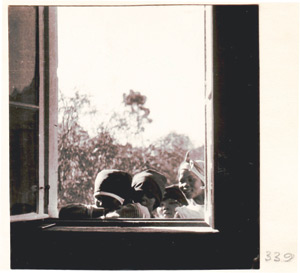
One of Hans Lichtenecker's photographs, entitled Zaungäste, or 'onlookers', held by the Namibian Scientific Society in Windhoek
In 1931, Hans Lichtenecker set out to produce images of Namibia's indigenous people with the aim of creating an 'archive of races'. Scientifically justifying his bid to document Namibian 'races', he produced life-casts and skin colour samples, took photographs and made voice recordings on wax cylinders.
The casts and photographs now form part of the collection of the National Museum in Windhoek, and the Namibian Scientific Society, while the Phonogram Archives in Berlin, Germany, retain the recorded voices. Whereas many collections of anthropometric material are stored in museums worldwide, the distinctive feature of this collection is the existence of voice recordings in which the people who were cast and measured comment on the anthropometric praxis they had to endure.
Based on her research, Anette Hoffmann curated an exhibition that stages the archived voices, together with art works, video interviews, and images of Lichtenecker's collection. What We See criticises racial stereotyping by interrogating these distorted 'scientifically generated' images.
The exhibition was produced in Cape Town, and opened at the Slave Lodge in February 2009. From there it traveled to Basel, Wien, Osnabrück and opened on 15 May in Berlin.
The workshop, Listening to Colonial Archives, at the Humboldt University in Berlin, organized by Britta Lange, Regina Sarreiter and Anette Hoffmann (as well as several film screenings, and a panel discussion), and the publication Was Wir Sehen. Bilder, Stimmen, Rauschen. Zur Kritik anthropometrischen Sammelns (Hoffmann/Lange/Sarreiter: Basler Afrika Bibliographien, Basel 2012) accompanies the exhibition in Berlin.