
Ncube graduates with groundbreaking research into the politics of colonial healthcare
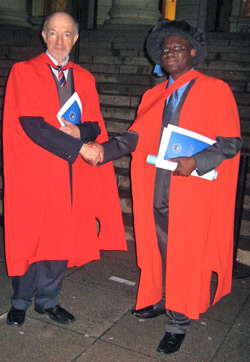
Dr Glen Ncube with his doctoral supervisor, Prof Howard Phillips
APC Post-Doctoral Fellow Glen Ncube graduated last week with a PhD in Historical Studies exploring the tensions between medical innovation and colonialism in rural Rhodesia.
Having grown up in rural Zimbabwe, Ncube's line of research was close to his heart, as his focus was the Ndanga Medical Unit at Fort Victoria, a 'unique experiment in community-oriented curative health care' in Southern Rhodesia between 1930 and 1960.
He shared the stage with 11 other doctoral graduates from the Faculty of Humanities, and his citation caught the attention of those present, including honorary doctoral recipient Professor David Sanders, who has, for a long time, worked on Zimbabwean healthcare issues.
After graduating with a BA (Hons) in Economic History in 2002 and an MA in Economic History in 2005, Ncube's two-year lecturing stint at the University of Zimbabwe was terminated by the economic and political meltdown in Zimbabwe. Maternal connections to South Africa and a supervisor with a strong track record in the field of socio-medical history (in the person of Professor Howard Phillips) drew him to UCT, where he completed his PhD in Historical Studies.
'Ncube's protagonists include Irish doctor Dr Robert Askins and Dr James Kennedy, who had attempted to set up rural health care systems in rural Rhodesia akin to what Askins had seen pioneered in Gloucestershire in the UK,' reads a recent report in UCT's Monday Paper.
'Current interpretations of those early experiments in social health care in Rhodesia typically fall into two camps, explains Ncube. There are those who hail it as pioneering medical innovation; in contrast, others condemn it as decidedly racist and insensitive to the needs of the locals. Like others, Ncube was looking for a middle ground. "I wanted to see if there was a tension between this biomedical vanguard on the one hand, and the broader ambitions of the colonial medical system and the colonial state on the other," he says.'
It was this ideological tug-of-war between progressive medical programmes developed by particular individuals and institutions versus interventions by the colonial, racist state that fuelled Ncube's research. 'The consequences of those early days would be felt for decades,' he says, adding that the aim of his thesis was to 'take the historiography of colonial medicine beyond the polarising and increasingly unproductive debates that have depicted colonial medicine as either a pernicious sword of empire or a benign force for good.'