
Listening, sharing and learning in the Upper Karoo
APC research fellow and storyteller of wide repute, JOSÉ MANUEL DE PRADA, shares his notes from a recent field trip to the Northern Cape
1911: One hundred years ago
Anthropologist and philologist Dorothea Bleek visited the home territory of her father and aunt's informants in 1910 and 1911. She managed to photograph people, some of them naked, she collected a list of words and some genealogical information, she even made some wax-cylinder recordings with an Ediphone, but she failed to get what her father and aunt would have considered the greatest price to be derived from such an encounter: stories.
Eighteen years later, in an article published in a learned journal, Dorothea wrote that if she couldn't collect any stories in Prieska it was because they were 'dead, killed by a life of service among strangers and the breaking up of families'.
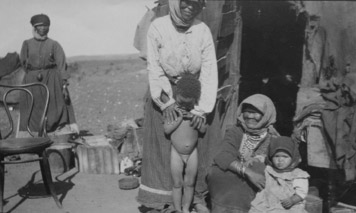
For the next 80 years this categorical assertion, which has the finality of an official death-certificate, was to loom large on those that were interested in any capacity in the culture and traditions of the |xam. I myself had some doubts as to the veracity of the statement, and attributed Dorothea's failure to record a single story to the fact that she had not succeeded in gaining the confidence of her informants, in part because she had spent too little time in the places visited, but largely because she had been digging graves and, in general, had not been very tactful in her dealings with the |xam. (Dorothea Bleek dug /xam burials on behalf of the South African Museum. Apparently, from what one can deduce from her notebooks, she did it quite openly, and even asked the people about the whereabouts of the graves!)
Yet even considering this, I doubted very much that a hundred years later there were many traditional stories to be collected in the area, although I hoped to be able at least to record personal histories and generational memories. With the help of my travel companion, Neil Rusch, who has a fair knowledge of Afrikaans, I conducted a handful of interviews in October 2006, in the course of a 10-day field trip to Bushmanland. I talked with both farmers and labourers, but all the interviews were quite unsatisfactory because, like Dorothea in 1910-1911, I was also learning as I went, and, also like Dorothea, I had not yet realised that in rural worlds, be they in Europe or southern Africa, it takes a lot of time to convince people that your interest in their stories and lives does not necessarily pose a threat to them.
2011: A year ago, dancing and storytelling in Brandvlei
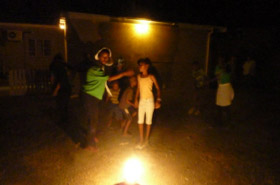
In March 2011, with the support of UCT's Centre for Curating the Archive, I undertook another fieldtrip to the Upper Karoo, my sixth one, this time aimed at documenting the late summer rains and their effect in the landscape. Neil Rusch was again with me, and also my wife, Helena, for whom this was the second visit to the area. I took my recording equipment with me because I felt it was worth the effort to resume the project of collecting the oral histories of the present inhabitants of the area, both of Khoisan and European descent. We arrived in Brandvlei, in what the |xam called the Grass Country, on 5 March. The owner of the guesthouse in which we were staying, knowing of our interest in the rock art of the area, suggested that we engage a group of reel dancers from the nearby township, insisting in that they would offer us an authentic Bushman ceremony. We were quite sceptical about this, but still it seemed to us that this was a good way to establish contact with the locals, and an opportunity to document what seemed like one of their folk traditions.
The reel dance experience was to prove a crucial moment of the field trip. Although we didn't know it then, the people that came to dance in the backyard of the guesthouse were mostly members of a single extended family, the Van Zyls. The experience of the reel dance was really extraordinary. The Van Zyls are excellent musicians, and many aspects of the dance, some of which could very well go back to the |xam healing dance, attracted our attention. The boys who danced had hats with big feathers on them. The women and girls had aprons and headdresses like those worn by Dutch women well into the 19th century. When I asked Neil if he had any idea of the reason for this he suggested that it could be a form of parodying the farmers, especially as one of the movements of the dance, performed with gusto by all participants, was called 'the baboon', and consisted of mimicking the gestures of these apes while feeding.
A few weeks later, while discussing with archaeologist Simon Hall during one of the APC morning teas the rock art of the Cederberg and other areas that shows farmers with their wagons and guns, it dawned on me that there is a possible connection between this kind of ritualised parodying and this late manifestation of the rock art tradition, which is also present in the Upper Karoo in the form of engravings that show famers in full dress, both male and female, in some cases with their arms akimbo. It is an image present in the visual arts of tribal peoples all over the world, for whom this gesture symbolises the arrogance of the white invaders who bossed them around in their own land. The symbolic importance of aprons and other garments for many Khoisan peoples, shown both in the rock art and in the stories and ethnographies, also came up during that conversation with Simon.
But returning to the reel dance on 5 March, at one point some of the dancers asked one of the elder women to tell a story, and that person obliged. The story told by the lady in question turned out to be a rhyme that Neil found it difficult even to paraphrase for me, but since the lady had been singled out by her own people as a good storyteller, at the end of the dancing we asked her if she would mind our recording her within the next day or two. Magdalena, as that was her name, readily agreed. It looked as if by sheer luck we were going to obtain what we were looking for sooner than anticipated.
We met Magdalena Beukes and her sister Katriena Swartz two days later, after a successful recording session at a nearby farm during which, also by sheer luck, unforeseen circumstances contributed to our gaining quite quickly the confidence of our informants, an elderly couple who told us personal narratives and stories about the Water Snake and other similar creatures.
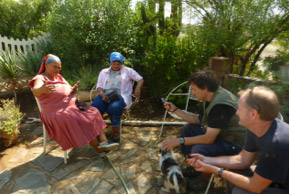
The recording session in Brandvlei took place in the garden of the house of a local doctor for whom Magdalena was then house sitting. I began by asking the sisters about their personal background, although they were no doubt aware of my interest in stories of a more recreational kind and had already stated that they knew many ghosts stories. After telling about their childhood in the Hantams, and about the storytelling abilities of their father, Katriena proceeded to tell us a ghost story. It was quite engaging, but it didn't feel especially Khoisan, although some of those she told afterwards did include motifs that are present mostly in the narratives of the Khoi and the Bushmen.
After the spook tales, Magdalena, who until then had let her sister do most of the telling announced, 'Now I want to tell a piece about the lion. Yes, about the Ouma and the lion.' This was a story about a family that decides to abandon the old Ouma at the house in which they have been living and move elsewhere, because the woman is so lazy that her bottom has become stuck to the floor of the house and she cannot move at all. She is left with a lad (klonkie), who eventually, by magic means, attracts a lion to the house. The lad escapes, but the Ouma, stuck to the ground as she is, cannot get away, although she gets such a fright when the lion enters the house that, in her effort to flee, her torso breaks from the rest of the body and ends up hanging from the rafters of the house.
Up to here I had the impression that Magadalena was telling us a tall tale in the 'shaggy dog' tradition. But she then proceeded to explain that the lion, after eating the old woman, went after the lad, who, to keep the lion from getting him, opened a magic bottle (one of five he had) and threw its contents behind him. The bottle was full of little thorns (duwweltjies) that kept the lion busy until he managed to get rid of them and resumed the chase. The mention of the duwweltjies (the thorns of a plant of the genus Tribulus, also called in English 'devil's claw') woke me up to the fact that Magdalena was telling us a story of which, until that very moment, we only knew the four variants told in the 19th century to Wilhelm Bleek and Lucy Lloyd by ||kabbo, Dia!kwain, !kweitɘn ta ||kɘn and ≠giri-sse. There, before us, a hundred years after Dorothea Bleek's unsatisfactory experiences in Prieska Location, was the living proof that her tidings of the demise of the |xam storytelling tradition were quite premature, as, of course, were the tidings of the demise of the |xam themselves.
April 2012: Return to the Karoo
In April this year, a long-planned and awaited new field trip to the Upper Karoo took place. This time the sole objective of the trip was to record oral narratives, in video whenever possible, and to verify if the findings of the previous year in Brandvlei could be duplicated elsewhere in the area, or if the Van Zyl family was an exception and we could only expect to find in the future other such isolated clusters of people who, for one reason or another, had clung to at least part of their traditional knowledge.
This time my wife and I went with our friend Gaelen Pinnock, a talented photographer, and Helena Bruwer, who was our Afrikaans interpreter. The places visited were Brandvlei, Swartkop and Vanwyksvlei. A summary of the whole trip would be too long to include here, so I will give a sketch of three episodes, one for each of the places.
Brandvlei, 13 April
As we did last year, we begin in Brandvlei by arranging with the Van Zyls another reel dance performance. The following day, Magdalena and her brother, Klaas van Zyl, come to our guesthouse to tell stories, which we record on video.
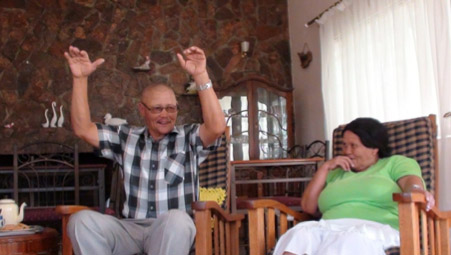
Klaas has a reputation as the best storyteller among the Van Zyl brothers, and we see that it is well deserved. One of the gems he shares with us is the story of a blind farm labourer who owns a white horse that is very faithful to him, and which he has trained very carefully. One day, the baas asks the old man to take his horse and join him and his friends in a lion hunt. But his real intention is to abandon his worker in the veld, so that the lions can eat him, because he is now old and of no use as a worker on the farm. The old man does as he is told, and rides with the others for a long while, until they all stop and the baas orders him to dismount. Once he does so the others quickly spur their horses and head off. But when the old man realises what is happening he whistles and the faithful horse returns to him, just when a lion is advancing towards him. The man orders the horse to ride towards the baas and his friends. But after a short while he makes him stop, so that the lion can get closer, and when it is about to charge he again spurs the horse to go ahead. He does this several times, and meanwhile two lionesses have joined the first lion in its chase. Finally the old labourer reaches the others, who are surprised to see him, but before they realise what is happening the man hits the horse with his sjambok and makes him gallop at top speed, putting distance between him and the lions, that then jump over the hunters and devour them. When the old blind labourer arrives alone at the farm, the wife of the baas asks him: 'Where are your master and the others?' And the blind old man answers: 'They are all dead. The lions killed them!'
For Klaas, this story is about the inscrutable workings of divine providence. Maybe, but for me this and other similar stories he and others tell us show how, in an extraordinary reversal, the newly settled |xam transformed their nemesis into an ambiguous force that very often could be on their side.
Swartkop, 16 to 18 April
This tiny settlement near Verneukpan is absolutely unique. The adobe houses that form this dorpie, none of which has electricity, are spread over a wide area, around what used to be a school (closed not long ago for lack of pupils) and a somewhat dilapidated church. We stay here for several days, at the invitation of Magda Martiz, the extraordinary woman who runs the local kontantwinkel and who has allowed us to camp outside the kitchen attached to the shop. Never before in my life - not even on previous trips to these so appropriately named Cape Thirstlands - have I been so conscious of how much we take for granted the comforts of running water.
The history of the settlement, as reconstructed from official documents by Magda, tells us that it came to be in the late 19th century, when the government gave plots of land to poor whites. Yet the inhabitants of the adobe houses know a part of the story that is not in the documents: It was a 'Coloured' man called Hendrik Moolman, who found (or knew about) a waterhole here, who was the real founder of the settlement. When the whites learned about this, they came and expelled Hendrik and his people, or took away from them the waterhole and the land. In 1949, when the National Party government divided into farms what had previously been common grazing lands, the white inhabitants of Swartkop got better plots and moved elsewhere, so the settlement became once again 'Coloured'.
In spite of Magda's encouragement and support, fieldwork here starts with some difficulty. The syndrome that plagued Dorothea in 1910 to 1911 - 'I don't know any stories' - is plaguing us here. However, knowing that in two days' time the soup kitchen organised by Magda will be taking place, we encourage the people to bring their children along, promising that we will tell them stories. (Our offer to do so on the spot is met only by displays of shyness on the part of the little ones.)
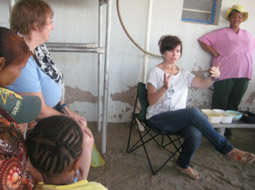
And indeed on the day the food is distributed (in front of the kitchen where we have set up our tents) the children are there and so are many of the elders. Helena tells in English (and Helena Bruwer translates into Afrikaans) the story of how the god, Ganesh, cheated his brother, Kartikeya, of the two girls he wanted to marry. Helena has a migraine, but she tells the story very well.
From this afternoon on, the fieldwork goes smoothly. Two days after this, while recording several women sitting in front of one of their houses, Helena is asked to tell a story by one of the ladies, who feels she has been talking a lot, making up for the stubborn silence of some of the other women. The storyteller obliges, and again translated by the other Helena, tells us a Bella Coola myth from British Columbia. In it, Mink falls in love with a beautiful Cloud, who finally accepts his advances, not before warning him that they are too different for the affair to prosper. Mink spends a wonderful night embracing his lover, but in the morning a sudden breeze dissolves the Cloud and reduces it to little shreds, and, although Mink tries desperately to hold on to them, the wind has pushed the Cloud towards the ocean and he ends up falling into the sea. 'You were right,' he says to the Cloud. 'You and I are too different!' We all listen with pleasure as Helena unravels the story of Meerkat and the Cloud, and laugh when, at the end, the poor Meerkat falls into the waterhole and says to the Cloud that she was absolutely right: they are too different. The amazingly beautiful cloud formations visible at this very moment on the horizon, as the sun is about to set, lend additional credibility to Helena's transformation of the coastal and richly forested setting of the Bella Coola myth to the fauna and landscape of the Karoo.
Vanwyksvlei
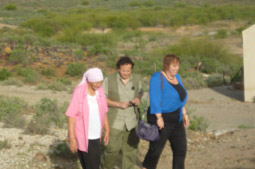
She tells us that when the dam dries, the snake moves towards the west, into the nearby Kareeberg, which we can see in the distance, to live in the many permanent springs that exist there. She herself has seen the Water Snake travelling towards the mountains in the form of a long cloud that quickly advanced towards its new home. 'This is not a story,' she tells us. 'I have seen it with my own eyes.' I don't have the slightest doubt that she has, but a few days later, as if to corroborate Ouma Sophia's story, while walking towards my flat in Vredehoek Avenue, Cape Town, I see a long but compact cloud, coiled over Table Mountain like an gigantic snake, its head resting over Devil's Peak. ||ku-!kais. I think then of those early inhabitants of the soil I'm treading, and of their mostly forgotten wisdom.