
'The real danger is in not knowing that we don't know'
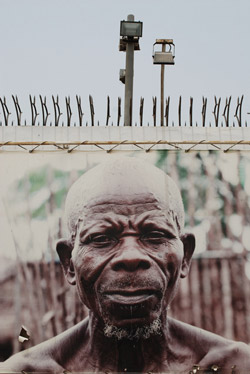
Detail of an outdoor banner promoting tourism in Senegal, in the ferry harbour to Goree Island
IMAGE: BRENTON MAART
In June, BRENTON MAART presented a paper at the Archives of post-independent Africa and its Diaspora Conference. Here, he reflects on some of the arguments that surfaced during those epic three days on Goree Island in Senegal
I love conclusions, not because I'm lazy or expedient, but because at the end of it all my friends Biddi and Karen (aka Built like a dress) composed songs and performed them - shamelessly incongruous, suddenly impromptu and brashly uninvited - in ignoble public places to crowds whose numbers were delimited by, say, the size of the balcony or the capacity of the car. A verse from one of my favourites goes:'...Calling for the waiter, they leave politics till later, as another day goes by... Post-modern man, has a shower that runs backward, leaves him dry...'
A second reason I embrace, where possible, the chance to cut to the quick, is because a fridge magnet I remember from years ago urged the following: 'Life is uncertain. Eat dessert first.'
So, in celebration of the generous gift of hindsight, this report begins with the presentation by Percy Hintzen (Florida International University/University of California, Berkeley, USA), which brought to a close the conference on Archives of post-independent Africa and its Diaspora. Hintzen's summary of the pitfalls that beset the field of contemporary archival practice demonstrated that the hazards lurk neither in 'knowing that you don't know', nor in 'not knowing that you do know'. Instead, he warned, the deadliest snare (that mine in the maze) is found in the condition of 'not knowing that you don't know'.
One way to circumvent this danger is to call in three of the world's leaders as conference conveners. The Council for the Development of Social Science Research in Africa (Codesria), founded in 1973 and based in Senegal, is a non-governmental organization best described by a skim through their academic journal publication list - Africa Development; Identity, Culture and Politics; The African Anthropologist; Method(e)s: African Review of Social Science Methodology, African Sociological Review, African Journal of International Affairs, Africa Review of Books, Africa Media Review, Journal of Higher Education in Africa, and Afro-Arab Selections for Social Sciences - guided in form and content by research programmes, conferences and networks.
Their outputs, along with an extensive book publication list, stimulate scholarship that insists - against the protestations of international studies of Africa - that 'there is no fatality about the condition'. In his opening address at the conference, Codesria's Ebrima Sall underlined the importance of African scholars positing questions, designing research and formulating conclusions. It is the lived experience of African scholars of African modernities that will allow for a new form of critical understanding - generated as much by academic scholarship as by affect - of the particular and contextual relationships between the state of the archives, the situation of the countries, the variable conditions within the continent and its loaded affairs with the rest of the world.
The other two convening bodies were the African Studies Centre, founded in 1947 at Leiden University, and the African Studies Multi-Campus Research Group, founded in 2008 at the numerous campuses of the University of California. Together they represent three continents which themselves were (and continue to be) participants in the disruptions that defined (and continue to define) the pre-colonial, colonial, post-colonial and independence periods of African countries. Today, these three territories are shaped as much by their entangled histories as by their contemporary Diasporas.
The conference, hosted on the former Senegalese slave island of Goree from 20 to 22 June 2012, brought together theorists and practitioners to examine archives of seemingly different forms, times and places, which collectively describe a dynamic terrain in continual flux.
Curatorial readings of interdependence created surprisingly new understandings that question the flow of influence and power, redirect complicity and challenge dogmatic binaries established during the parallel growth of modernities. More importantly, the compound views presented by case studies came together in an attempt to understand the histories of the archival sectors, map their contemporary shapes and plot their forward trajectories. Finally, the conference facilitated a working network that uses hypothesis and analysis as a stimulus for productive archival activism.
A conference on archives requires presentations from a divergent range of hitherto traditionally unrelated disciplines. Five themes provided structural cohesion. Often, however, themes crossed over into each other, thus revealing a sector that has been one of the forerunners in the development of a contemporary methodology that is part science and part humanities, part factual and part interpretative, part irrefutable and part conjecture, part documentary and part fiction, part rhetorical and part substantive, part public and part civic, part summative and part formative, part contemplative and part performative, part ethereal and part tangible, part analogue and part digital.
In short, the conference was a case study in the application of a methodology that traverses within and across disciplines to provide readings of archives that, five years ago, would not have been possible. This was a potentially incoherent and discordant amalgam of instruments, which, through careful curation, was conducted into a high-drama opera by the clear and simple power of that motif called imagination.
The avaricious demarcation (the 'founding'), so loved by Western hegemony, locates the origin of the theme of Administering the archive with the preservation of bureaucratic government archives (beginning, of course, with colonial records). Fortunately Anaïs Wion, (Centre d'Etudes des Mondes Africains & Centre National de la Recherche Scientifique, France), in Electronic Publication of Ethiopian Manuscript Archives: Methods and Issues of an Electronic Management, noted the early use of archives in the service of laws, policies and traditions.
This theme also looked forward from colonialism as its point zero to include more recent archives of social, union and other movements, records of private organisations, genealogical maps, personal and family 'tin-trunks' of manuscripts, religious texts and their commentaries: documents that move beyond the textual.
Audio records, too, started to resonate in this theme, as did the cognitive potential of the visual (through photographs and other forms of imagery), thus partially, and thankfully, displacing the disproportionate emphasis on what James Elkins terms 'those beautiful, dry and distant texts'. (The next step would be a theme that explores more expansively the sensual properties of the archive, and their potentially generative role in constructing new understandings.)
A political concern in administering the archive is the shift from analogue to digital, where the privatisation of information clashes directly with the utopian ideals of open access. Although Sylvester Ogbechie (University of California, Santa Barbara, US) appreciates the value of curating the digital archive as a process of intellectual synthesis, his paper, titled Archiving Africa Across the Digital Divide: The Ezechime Archive Project, interpreted the digitisation of archives as a replication of an earlier colonial paradigm. His analysis of this 'new scramble for Africa' postulated as to the value of African cultural knowledge (produced in Africa using African resources, or extracted from Africa for processing elsewhere) within a global economy, how international digitisation of African archives convert this value into economic currency, and why the benefits of these processes do not accrue within the continent itself.
Francis Garaba (University of KwaZulu-Natal, SA) emphasised this anxiety when he asked of the digitised archive: 'Who shows it? Who vets the information? Who has access?' His paper, titled The Digital Revolution and its Implications on Liberation Struggle Archives, envisaged the digitisation of African archives and their subsequent use by Western scholars as acts of neo-colonial capitalism.
In antithesis to the archive as a traditionally inanimate repository, presentations on the theme Performing the Archive drew attention to how contemporary live performances are able to personify the past and present these to a contemporary audience with immediacy, relevance and advocacy. Case studies of music, dance, theatre and arts festivals showed how this embodiment of the archive is put to political use by shifting colonial stereotypes to the benefit of nationalist post-colonialities.
It is especially in its capacity to subvert the tropes of ethnography that performance is central in enacting, and understanding, the conversations that arise through the Diaspora. Mirjam de Bruijn (African Studies Centre, Leiden, The Netherlands), in her report on the research by Walter Gam Nkwi (University of Buea, Cameroon), titled The status of Memory in Family Photo Albums in the Bamenda Grassfields of Cameroon, described how personal photographic archives were transformed through nuanced, sensitive reading and mediation via the making of a film into an analysis of the aspirations of mobility. Of the range of curatorial methodologies applied here, one of the more powerful was the role of affect in creating new readings, meanings and understandings. Of special interest was the manner in which the research directed a possible future for the physical object, a future that continues to define a path quite different to that of the digital highway.
Performance case studies led into the power shifts that define post-independence and its public statements. Here attention was focused on the built edifice or monument, which functions as an emblem of nationalist identities in an era in which heritage has become a product. Presentations on the theme, Spatialisation of the Archive, addressed the irony of packaging the social imperative of liberation movements for capitalist consumption. In an extreme example, Olutayo Adesina (University of Ibadan, Nigeria), in Archival Documents and the Gatekeepers in the Twenty-first Century: Reconfiguring Nigeria's National Archives, drew similarities between Nigerian and South African national archives, with their removal of support and destruction of records. In the case of Nigeria, however, the trend is toward the creation of a black-market situation through the commercialisation of archival practice and privatisation of records. The consequence is that working with Nigerian records is becoming too costly an undertaking for scholars, precipitating a move toward research that does not require the use of these commercial archives.
In both colonial and post-independence regimes, traditional forms of video and audio played pivotal roles in political power plays and shifts. Their initial and often short-lived deployment in propaganda put to use the sector's greatest asset: that of the seemingly one-way flow, where information generated and disseminated by the group in power reached an audience rendered as passive consumers without the means to register their critiques.
This scenario also came to define the early stages of the digital era. More recently however, enhanced digital functionality - with its proliferation of user-friendly social media - challenges this unidirectional flow of power. Now, the means to choose, generate, selectively reproduce, alter and redistribute mass media broadcasts results in a practice that is often beyond the control of the state.
It is this public ownership of rhetoric (optimistically called the democratisation of media) that was explored by scholars within the theme Post-independence media formations. In his paper, titled Is Google Good for African History?, Jonathan Cole (University of California, Berkeley, US), outlined the technical realities where digital archives can be applied as both a tool of the state and a threat to the state, a notion that Peter Bloom (University of California, US), highlighted in his opening address, noting that ideologies create archives and, reciprocally, archives themselves create ideologies.
As the field of archival practice advanced into new terrain, explorers who started their investigations at state-administered, centralised archives went in search of alternative repositories. The first port of call yielded abundant treasures within individual government departments, supplemented by the holdings of non-governmental organisations ('surrogates of the state'), and also private corporations and foundations. Although many of these archives were located within the colonised territory itself, others were formed and/or located outside of national borders, becoming important in studies of Diasporas. The dispersal of archives, along with the inherent temporal and dynamic nature of the archive, highlighted an important reality: gaps were inevitable. Simply put, building a complete archive is an impossible task.
This is what the fifth and final conference theme, Archival absences and surrogate collections of the African state, interrogated, with case studies that invented novel methodologies to make sense of ruptures in the archival body. The first of two very different approaches extended on the traditional practice by using available archival fragments (what was there) to fill the gaps (what was not there), in a bid to construct a more complete and coherent narrative. By using tools of historiography and anthropology (and more recently 'anthro-history'), these studies relied on extrapolation.
Certain projects applied a scientific logic to formulate and test hypotheses, a method akin to conjecture and refutation. Here, proof is never absolute, and the narrative is continually refined and channeled towards the realm of the increasingly probable (the possible). Eventually, this scientific approach reaches a tipping point where no further claims may be generated. It is here where a more unorthodox approach is taken up, with the application of a contemporary literary technique, one that merges the documentary (evidence) with fictional construction (invention).
This practice, termed 'documentary fiction' or 'fictional documentary', extends archival fragments to close the gaps with a narrative approaching the realm of the plausible (the believable). This blurring of genres signals an influential new direction in archival narrative construction, one that celebrates a rare tool in the scholar's inventory: that of productive imagination.
Both of these approaches - the scientific and the fictional - use the fragment as material to fill the gaps. In Shadow Archives and the Contingencies of Postcolonial History Writing: Kwame Nkrumah's Ghana, 1957-1966, Jean Allman (Washington University, USA) discussed the challenges of working with archives of the colony and the post-colony not located within the nation state itself, and highlighted the limiting effects of the 'illusion of the national archive'. One way around this difficulty was to follow the threads of a number of 'shadow archives' in collections across the globe, a process marked by dislocation, dispersion and a lack of cohesion.
An initial frustration later matured into a more productive question as to the possibilities of how the lack of a national archive could lead to the writing of a new history.
From another perspective, Allman's work may also be read as an approach that negates the importance of the fragment. Instead, her study may point to an invitation to focus on archival fissures as a new, as yet unexplored, body of material. These absences may then be read - not in their traditionally linear relationship to fragments - but as an independent archive with its own structure, history and function. Allman's project is not an attempt to read between the lines, nor is it the identification of a palimpsest (both of which would continue to posit the fragment narrative as the dominant discourse). By denying these 'missing pieces' their traditionally abject status, Allman may be generating a radical methodology, one that endeavors to decipher, incredulously, an archive of absence.
· Brenton Maart's paper was titled The historical biography of the Mthatha archive, and its contemporary relationship with the Nelson Mandela Museum. It describes the irony of the displacement of the Mthatha archives - an invaluable collection spanning more than one hundred years of South African history - from its historic home in the Bhunga Building (today the premises of the Nelson Mandela Museum) into a 'temporary' structure where its records are rapidly disintegrating into tatters and ruins. He would like to acknowledge the generous support of the University of Cape Town's Conference and Travel Grant, and the National Research Council's Archive and Public Culture Initiative.