
New Herwitz book due for release by Columbia University Press next month
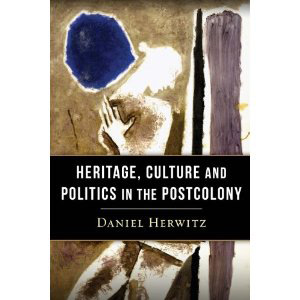
'The act of remaking one's history into a heritage, a conscientiously crafted narrative placed over the past, is a thriving industry in almost every postcolonial culture,' asserts Herwitz, who is director of the University of Michigan's Institute for the Humanities. 'This is surprising, given the tainted role of heritage in so much of colonialism's history. Yet the postcolonial state, like its European predecessor of the eighteenth and nineteenth centuries, deploys heritage institutions and instruments, museums, courts of law, and universities to empower itself with unity, longevity, exaltation of value, origin, and destiny.'
Herwitz theorises that postcolonies practice 'live action heritage', constantly reimagining and rebranding their own heritages toward a variety of political and aesthetic ends.
As an honorary research associate of the Archive & Public Culture initiative, he participated in several workshops at UCT, where he presented chapters of this book, while it was still in development. In the South African chapters, he unpacks this country's controversial and robust confrontations with the colonial and apartheid past.
'Heritage, Culture, and Politics in the Postcolony explores the double life of heritage in the making of modern political identities - as both the fixed capital of national hegemony and the fluid currency of novel visions and claims,' writes Comaroff. 'The book may evoke an aura of timeless homage, but heritage is also a riff in real time. In this acute exploration of its recent, postcolonial iterations, Daniel Herwitz shows that while its role remains much the same, its substance is constantly, ingeniously changing.'
Herwitz's most recent book is The Star as Icon: Celebrity in the Age of Mass Consumption, which was named a Choice Outstanding Academic Title. He is also the author, with Lydia Goehr, of The Don Giovanni Moment: Essays on the Legacy of an Opera and the editor, with Michael Kelly, of Action, Art, History: Engagements with Arthur C. Danto.
From 1996 to 2002, he served as chair in philosophy at the University of Natal, Durban, and was embroiled in the South African political transition, which led to his book Race and Reconciliation: Essays from the New South Africa. Long involved with modern Indian art, his 1987 book, Husain, won the country's National Book Award.
'Bringing the eye of a philosopher, the pen of an essayist, and the experience of a public intellectual to the study of heritage, Daniel Herwitz reveals the febrile pitch at which heritage is staked,' reads a statement by Columbia University Press.