
An eye for childhood
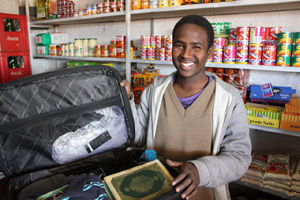
Shaafi Mohammed with his clothes and his Qur'an in the Somali shop where he works in Mamelodi
PICTURE: SATSIRI WINBERG
Marlene Winberg
'Archive Fever', as Jacques Derrida describes it, epitomises the infectious desire to locate and possess origins. For scholarship in the humanities, the 'archival turn' proves to have much in common with the study of childhood. Both have been there all along: the repositories of our cultural and personal pasts. In many ways, for each of us, childhood is the archive, a treasure box of the formative and the forgotten. Yet, until the last few decades, both our archives and our childhoods have remained largely under-theorised sites of origin.
When I came across this statement by Sanchez-Eppler made during a Melon Research Seminar at the Stanford Humanities Centre, entitled In the archives of childhood, I was struck by its resonance with my own views on what happens when we deem children worthy of being placed centre stage in reading the archive. How may this shift of focus help us to think about the intersection between archival practice and childhood studies? Who else has been thinking along these lines, or shall I say, 'against the archival grain' (Stoler, 2009) with regard to childhood and archives?
This short review introduces The Journal for the History of Childhood and Youth, a founding platform for this newly emerging field of scholarship. I include a look at a Nepalese non-government organisation and a South African institution both devoted to the field of childhood studies.
An eye for childhood changes what we see
In explaining the reasons for launching The Journal for the History of Childhood and Youth, co-founder Sanchez-Eppler puts forward ideas about how history impacts on the young, and how ideas about young people influence national, political and cultural history. Her seminar asks what happens to our understanding of culture once we acknowledge children as historical actors, recognising them as participants in the making of social and cultural meaning. She argues that age, just as much as class, gender or race, 'provides a salient category for analysis and that attention to age changes not just what we see, but the questions we ask and our very methods of interpretation' (2011). She explores various ways in which we inhabit our relation to the past and theorises the ties between archival work, library and museum collections, memory and the personal past that is childhood.
This journal (JHCY) was thus launched to explore the development of childhood and youth cultures and the experiences of the young in diverse times and places. It embraces a wide range of historical methodologies as well as scholarship in other disciplines that share a historical focus, and publishes articles based on empirical research and essays that places contemporary issues of childhood and youth in historical contexts.
Reading childhood in Chinese photographs
In one of eight volumes to date, the JHCY published a collection of essays held together by the notion that ignorance of childhood history and experiences creates gaps and silences in our reading and understanding of history. Laura Wagler's essay on her participatory research with Chinese students at the University of Peking in Beijing, China looks at how the history and memory contained in her students' personal family photographs may provide them with 'a bridge to the divide that the Cultural Revolution created between generations' (Wagler, 2009).
Her students collected photographs from their families and created memory collages as a departure point for exploring their personal histories by analysing and researching the contexts in which children appeared in the photographs. This work unearthed previously silent, personal histories within specific families and enabled the telling of stories about the dislocation, depression, starvation, loss of possessions and livelihood, as well as forced or arranged teenage marriages. Typical to many adults who have survived traumatic childhoods, the Chinese parents who appeared as children in the family photos, had not, until that point in time, disclosed their histories to their children, hoping for a more prosperous future without the burden of their own recent memories.
Wagler and her students' work in recalling childhood memories brought forth questions of how children learn and carry complex histories that they were never told. Generational divides and the notion that divisions and silences are, in themselves, articulations of China's national history proved central to the work these photographs did as a reading of China's more recent history.
Reading childhood in archival records
Jack Lord (Lord, 2009) provides an insightful critique of how Western conceptions of childhood have influenced African historiography. His archival research into juvenile court records and the creative use of archival documents chronicles the impact that child labour and education have had on families in the late Gold Coast or modern-day Ghana, and shows how the experiences of children have been misconstrued by historians whose ideological viewpoints have distorted and romanticised the realities of childhood histories in Ghana.
Jessica Nelson (Nelson, 2009) illustrates the innovative use of archival records in another context, period and place, as she assessed the ambitions and hopes of children in 18th-century Bijon, France. Nelson used the entry registers of institutions for abandoned and orphaned children to show how state control over the poor had a direct relationship with the goals set by families and their children during this period and the ways in which they imagined their futures.
In the context of the Archive & Public Culture research initiative, my examination and use (Winberg, 2011) of archival documents from Namibia and Cape Town, South Africa during the 1870s, introduced a new perspective on childhood in pre-colonial Namibia during the 19th century and, more specifically, the !kun children's part of the 19th century Bleek and Lloyd collection (See: http://www.cca.uct.ac.za/reading_room/?lid=356). It enabled the reconstruction of aspects of childhood in pre-colonial Namibia and of the role Namibian children played in the indentured labour economy in the Cape colony during that period. As a result, the family and childhood histories of both the children and the linguist, Lucy Lloyd, who made this collection of drawings, paintings and stories, could be examined from perspectives that paid attention to how childhoods shape personal world views, as well as our reading of archival documents.
Contemporary childhood documents: The child sex trade in Nepal
For the past decade, the non-governmental organisation, Maiti Nepal, has provided a safe home for girl survivors of the sex trade between Nepal, India and neighbouring countries. This organisation pursues the perpetrators in order to bring them to court. This process has resulted in the oral and written testimonies. The girls' personal stories of childhood marriages and rescue missions from brothels have found their way into the official court records of this country, thus leaving distinct traces of contemporary childhood in these archives.
These histories are collected and archived by Maiti Nepal and The World's Children's Prize Foundation in Sweden and, as a result, the children's stories have become part of a global movement against child labour and the sex trade. Lawyers, journalists and activists are now able to use this material as an instrument of justice, with children as actors and writers of childhood history.
This process has highlighted the difficulties of researching contemporary children's experiences, the need for developing child-centred methodologies and the sensitivities involved in adult mediation of such stories. Although one would hope that future readers of this growing collection would pay close attention to how adults mediate the children's stories as they are being documented, these records nevertheless reflect actual and realistic events in any one of the children's time lines and record significant parts of contemporary childhood history.
Contemporary childhoods and the South African Constitution
Closer to home, Professor Ann Skelton from the University of Pretoria and the Child Law Centre, is a pivotal scholar in a national movement of lawyers and advocates who have theorised and interpreted the intersection between newly emerging childhoods, the South African Constitution and the Child Justice Act of 2010.
Skelton's litigation centres on using the law to bring the plight of an individual child to court in order to support hundreds of other children who are in similar positions of vulnerability by setting a legal precedent in judgment against a defendant. (Future cases are then settled out of court.) One example of such a juvenile court record lodged in the Constitutional Court archive, is that of Shaafi Mohammed, a 15-year-old Somalian boy, who fled from his home in Mogadishu, Somalia, after it was bombed in September 2012. Upon arrival in South Africa, he was arrested several times for being without legal documents. His case was taken up by Skelton and lodged in the Constitutional Court of South Africa. The outcome was that Shaafi Mohamed's tenure in South Africa was legalised and the right to go to a local school, secured.
Contemporary stories like this one are entering the childhood archives of South Africa with the defendant in many cases being the South African government. Organs of state, officials and employees find it challenging to come to terms with the country's Constitution and the concept of children's rights across borders.
In a patriarchal society, where children are not seen as decision-makers and adult perspectives on childhood have only just begun to make way for the notion of children as actors of history, children are deeply entangled in questions of politics, power, resources and morality. Yet, according to Sanchez-Eppler, almost all political campaigns of the 20th century have found it productive to flaunt childhood, taking 'advantage of the rhetorical force of youth and the utility of children in legitimising and sustaining political movements' (Sanchez-Eppler 2011).
Generational bias in archival practice
In this short review I have cited a few examples of a newly emerging discourse in the intersection between studies in childhood, memory, archive, culture, justice and history. These are among a growing number of empirical studies that interrogate the generational bias present in archival practices, while exploring shared questions in different contexts.
What happens when we acknowledge children as active agents of history and attempt to discern their traces on the surface of memory, as well as the material records of history? How may this shift in paradigm and practice change the ways in which we hold the past? How is childhood a primary site of origin in our 'infectious desire to locate and possess origins'?