
Harris seminar deconstructs archive-memory nexus
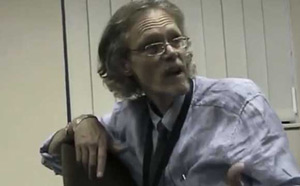
On 4 October 2012, the Archive & Public Culture initiative launched its summer seminar series with an insightful paper by Verne Harris, which destabilised the rigid boundary often drawn between archive and memory.
Harris, who has been Nelson Mandela's archivist since 2004 and is currently the Head of Memory Programming at the Nelson Mandela Foundation's Centre of Memory, argued that 'in both popular and professional discourses the concepts of "archive" and "memory" tend to be held in an uncomfortable relation of separation'. The 'archive' is normally linked with 'notions of stability, durability and evidence', while memory is associated with 'fluidity, transience and narrativity'.
Extending his longstanding engagement with Jacques Derrida's work with insights drawn from Paul Ricoeur, Harris posited that archive and memory should be regarded as 'genres of the trace'. The boundary between the two should be regarded as a matter of process - 'as a process of invagination'. As fragments that subsist on personal or institutional processes of deeming and redeeming, archive and memory fold into, and inflect each other. Peppered with illuminating personal, familial and work-related anecdotes, Harris's paper generated interesting debate around the notions of 'trace', 'fragrant', 'ephemera' and the apparatus of deeming, all of which are fundamental aspects of archive and memory.
As an illustration of one case of deeming without professional or disciplinary authority, Harris cited the high profile case of 'fragments' or 'ephemera' about Nelson Mandela's prison years, collected and preserved by the prison warder, Jack Swart. Simple notes about the type of breakfast Mandela ate and other housekeeping issues were collected and deemed worthy by Swart and today fulfill the generic law of archive and its attendant memory. As he creatively explicated these issues, Harris offered a subtle and informed warning about the fragility of both archive and memory - a characteristic, which, ironically, makes them priceless.
His illuminating paper was forerunner to a diversity of forthcoming papers. The following papers will be presented during the last quarter of 2012:
- 11 October 2012: Love and Fieldwork: The Wanderjahreof Winifred Tucker, 1912-1913 by Andrew Bank
- 18 October 2012: Picturing Colonial Medicine: Perspectives on Patient Photography by Glen Ncube
- 25 October 2012: Archaeologies of Archive: Can We Learn to Speak 'Artefact'? by Sven Ouzman
- 1 November 2012: China, Oriental Despotism and Empirical Knowledge: Complicating the Theoretical Models of the European Enlightenment by Ashley Millar
- 15 November 2012: 'We Shall Be Back': Self-Archiving, Subjectivity and the Contestation of Postcolonial Marginality by Dishon Kweya
- 22 November 2012: 'Assignment Africa': Donald Swanson's Colonial Imaginary on Film from 1947 to 1954 by Jacqueline Maingard.
Papers to be presented on 8 and 29 November 2012 will be confirmed in due course.