
Workshop explores Hoffmann Collection of Northern Sotho Cultural Heritage
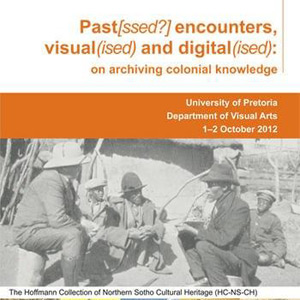
Titled Past(ssed?) encounters, visual(ised) and digital(ised): On archiving colonial knowledge, the main purpose of the workshop was to present preliminary results of a project on missionary Carl Hoffmann’s Collection of Northern Sotho Cultural Heritage by a team led by Annekie Joubert of the Institute for Asian and African Studies at Humboldt University in Berlin, together with Lize Kriel of the University of Pretoria.
During his career as a missionary in Southern Africa from the 1890s until his death in the early 1960s, Hoffmann produced a vast collection of documents ranging from personal and official correspondence, sketches and photographs, popular articles in magazines, and scientific articles (in German, Afrikaans and English) to biographies, folktales, manuals and text books in the ‘Northern Sotho’ dialect, which were used in schools and by African Lutheran church congregations in the region.
Throughout his work, Hoffmann attempted to capture the knowledge systems of the African communities amongst whom he worked for a European audience. Through an agreement initiated by Joubert between Hoffmann’s descendants, the Church Archive Centre in Berlin, and UNISA Library, the Hoffmann material will be housed at the UNISA Library Archives in Pretoria and will be made accessible to researchers in digital form.
Organised as a part of the events of the German-South African Year of Science and sponsored by the German Federal Ministry of Education and Research (BMBF), the workshop attracted more than 40 scholars and archivists from South Africa and Germany.
Some of the discussions concerned proposed translation across three languages and annotation by experts of selections of the Hoffmann material for publication. The work involves specialist translations in German and the ‘Northern Sotho’ dialect. During the discussions, the category ‘Northern Sotho’ was the subject of critical attention.
A number of scholars engaged in research on the archiving of colonial knowledge in South Africa and scholars from elsewhere in Africa also gave presentations. In his paper, We shall be back: Self-archiving and contestation of postcolonial marginality, Kweya drew attention to the ways in which archival material is engaged by local historians. The task of wrapping-up and drawing conclusions from the proceedings of the workshop fell to Hamilton, who drew attention to the significance of understanding the making of the collection and its refashioning over time.