
Time-Space-Continue
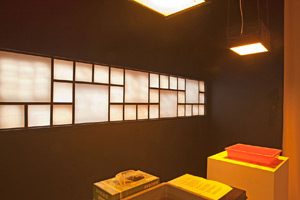
George Mahashe, Dithugula tša Malefokane: Seeing other people's stories, telling tall tales, Installation, part of the exhibition, Imperfect Librarian, March 2012
By Clare Butcher
Between 1935 and 1940, the artist Marcel Duchamp (made infamous by his moustaching of the Mona Lisa) created the boîte-en-valise or box-in-a-suitcase, which housed 69 painted reproductions of his own work - a mini-monographic exhibition if you will. Motivated by the necessity of trans-Atlantic travel between France and the United States during this period, Duchamp made 20 editions of these portable shows of 'copied' work.
But it wasn't only about the logistical expediency afforded by a little suitcase-cum-portfolio, and though I'm not going to attempt to decipher the artist's complex personal intentions, Duchamp's set of boîte-en-valise challenges notions of authenticity in art in that these portmanteaux were, in fact, new works masquerading as reproductions (and multiple versions thereof). These easily-transportable 'things' are intriguing because they are capable of travelling through a space that extends far beyond the Paris-New York line, and come to us across time as well. There is one sitting in the Johannesburg Art Gallery collection, I believe.
Duchamp was engaging in a creative action that could be called historiographic - in that he was placing himself in the telling of an historical narrative. That narrative, of course, was his own life's work. And it is this historiographic mode that has been used of late to describe the practices of many historically, or dare I say, archivally-oriented artists who seek, like Duchamp, to reflect their own complicity in the narrating of historical 'facts'. I say 'facts' as indeed their veracity, their authenticity, is called into question by the very modes of multiplication, reproduction and versioning in which they are offered. But I get ahead of myself.
This year has seen a number of artistic contributions to the life and discourse of the Archive & Public Culture research group - projects that have taken seriously the embodied, conceptual and temporal make-up of history and its frameworks. And before reporting on some of the end-of-year manifestations of these projects, I would like to share the framework I use to understand just how these sorts of artistic contributions stand as rigorous and often transgressive research.
The retrospective (but contemporary) art work we're discussing has, despite Duchamp's legacy and that of other conceptual artists from the 1940s to 70s, only taken a turn, known as the Archival Turn, in the last decade. Theorist and art critic Hal Foster wrote a seminal piece in 2004, entitled 'The Archival Impulse', in which he described the motivations and methodology of artists working to both expose as well as conserve 'facts' about the past in the present.
He says: 'In the first instance archival artists seek to make historical information, often lost or displaced, physically present. To this end they elaborate on the found image, object, and text, and favour the installation format as they do so. (Frequently they use its nonhierarchical spatiality to advantage