
Contestation and lobbying in the archival sector
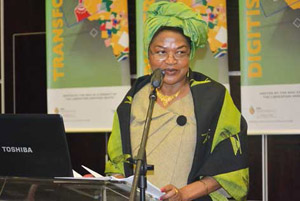
ANC National Chairperson Baleka Mbete addresses the International Conference on Liberation Archives in East London
PHOTO: IRVINE MAKUYANA
By Mbongiseni Buthelezi
Do archives matter? If they do, why do they matter? And to whom do they matter?
The Archival Platform has repeatedly made a case this year that archives matter for the past, the present and the future. They matter for talking about, rethinking and imagining the past; they matter for holding people, especially public office bearers, to account in the present for actions they took in the past and are taking in the present; and they matter for figuring out how we've got where we are today in order to be able to think our way forward into the future. Moreover, they'll matter for future generations looking back at decisions taken in their past that'll affect their lives.
Several events have taken place over the past few months that have offered a real opportunity to raise the public profile of archives. Some were more successful than others, and looking back over the year, it's impossible not to lament the missed opportunities. Nevertheless, we at the Archival Platform have been encouraged by how some of the events we attended signalled the start of greater things to come in the archival sector.
The biggest opening for serious debate on how the archival sector has fared in the last two decades was provided by the conference organised by the National Heritage Council (NHC) on 31 October to 2 November in East London. Originally called Archives Deepening Democracy, the title of the conference was changed to An International Conference on Liberation Archives scheduled as it was to coincide with this year's centenary celebrations of the African National Congress (ANC). It brought together archivists, scholars and activists with government officials, traditional leaders and politicians to look back over the past since the transition to democracy and assess what the role and place of archives has been in public deliberation, as well as chart a way forward for the more effective use of archives.
In the end though, the conference was shambolic. Lasting close to a year and a half, the long process of its incubation involved a reference group from around the country on which the Archival Platform was represented, and which was severely undermined by the resulting event. The reference group had proposed building up to the conference through a series of workshops that surfaced all the key issues which the conference would tackle.
One was held in Qunu on 17 and 18 July to coincide with Mandela Day (http://www.archivalplatform.org/news/entry/legacies_and_the_state/).
Another was a conversation in celebration of Women's Day at the University of Johannesburg between former Prime Minister of Ireland Mary Robinson, former Mozambican Minister of Education Graça Machel, and former Chairperson of the Independent Electoral Commission Brigalia Bam.
KwaZulu-Natal added a colloquium to the list following on from Qunu, which was held on 9 and 10 October (http://www.archivalplatform.org/blog/entry/archives_in_the_public/).
Out of these colloquia was meant to emerge the international conference. The reference group had proposed panels that would focus, among other issues, on:
- the history and status of the broad-based liberation archive;
- silenced, disavowed, neglected or vulnerable archives;
- access to information and the records of government; and
- archives, social cohesion and the exercise of active citizenship.
However, the conference started going awry when it was advertised in the newspapers in June 2012 as a conference on liberation archives rather than one on archives deepening democracy. In one fell swoop all the consultations about a conference to tackle issues beyond a narrow focus on liberation and its usually attendant trumpeting of the role of one political party, were swept aside in favour of the singular focus. The organisation of the conference went from bad to worse when, after being advertised for 17-19 September, the dates were changed to 31 October to 2 November.
Because the Archival Platform's website had carried the original call for abstracts, we fielded a lot of questions about the conference when people who had submitted paper proposals did not hear anything further about the conference from the organisers.
In the end, when the conference did finally take place, it generated a useful profile for archives in the public domain. The chairperson of the ANC, Baleka Mbete, who opened the conference, was interviewed on various television and radio stations, as was Sonwabile Mancotywa, the chief executive of the NHC.
But what was clear from the discussions in some of the sessions was that most people understand archives to be about the past. They are largely seen as records that can play a useful role in conveying to younger people in our society, as well as future generations, what sacrifices were made to liberate South Africans from apartheid.
The point we have been trying to drive, and which we foregrounded again in the Archival Platform's panel at the conference, is that the records of the state are about the present and the future. Record keeping is crucial in the present for active citizens to be able to hold officials to account. This point was largely lost in the drumbeat praising liberation heroes and the contestation by a delegation of Pan-Africanist Congress veterans of the singular ANC-centred narrative.
Similarly, at the colloquium in KwaZulu-Natal, which was perhaps the most successful of all the events leading up to the conference in foregrounding archives, the point about the records of the state was largely sidelined. The focus revolved around how oral history can be put to use in entering into the archives voices of (mainly) black South Africans that were excluded and occluded under colonialism and apartheid.
It is clear that there is a lot more to be done to raise consciousness on why records matter in the present and for the future. The stakes are high for all of us as citizens. Much work has been done by organisations like the South African History Archive in terms of calling government to account based on the Promotion of Access to Information Act; the Nelson Mandela Centre of Memory promoting dialogue for social justice through the archive; and Gay and Lesbian Memory in Action. Yet a lot more remains to be done to promote the importance of archives in the present and for the future. It has been a good year in some ways despite the many missed opportunities. We hope it will get better from here.