
Seeing is believing

If the past two months passed like a quick illuminating burst of magnesium powder mixed with potassium chlorate, they were marked by two indelible visual moments on the exhibition calendar. Two formidable APC research fellows in Fine Art both staged exhibitions expressly aimed at unsettling staid, numb ways of seeing and reintroducing a sensory vitality to the moment of perception. They achieved this in radically divergent ways.
The first was Andrew Putter's eagerly awaited Masters exhibition, Native Work, a contemporary - and decidedly post-colonial, post-apartheid - artistic response to Alfred Martin Duggan-Cronin's life-long project to photograph black southern Africans.
This being a Masters presentation rather than an exhibition per se, the run was criminally short, but luckily for followers of his unfolding oeuvre, Putter has plans to exhibit it again publicly and commercially in the future.
'Cognizant of the dangers inherent in Duggan-Cronin's colonial, ethnographic approach to making images, Native work nevertheless recognises an impulse of tenderness running through his project,' writes Putter in an article about his project published recently in the journal, Kronos: Southern African histories. 'By trusting this impulse in Duggan-Cronin's photographs, Native life attempts to provoke another way of reading these images, and to use them in the making of new work motivated by the desire for social solidarity, a desire which emerges as a particular kind of historical possibility in the aftermath of apartheid.'
By exploring his own complex feelings towards an ideologically tainted but aesthetically compelling visual archive, he courageously enters the fraught terrain of ethnographic representation to wrestle with himself about his personal implicatedness as an artist and a white South African in this troubled visual legacy. The result is breathtakingly serene and harmonious. Yet the composure of the images is not without its finely balanced internal tensions.
The series of black and white reinterpreted 'ethnographic' portraits of contemporary black Capetonians in 'tribal' or 'traditional' costume is accompanied, if not offset by a second colour series, for which the sitters chose what they wished to wear based on how they see themselves.'To prevent the 'ethnographic' portraits being seen alone - without the contextualizing, unsettling influence of the colour photographs - the work will only be available for acquisition as an entire series, with the stipulation that the thirty-eight portraits must always be seen together (or possibly in part, but only if a model is represented in both a colour and a black-and-white portrait),' writes Putter.
The exhibition constitutes one was one of those rare instances in which it becomes unmistakably clear to the viewer that that the primacy of authorial intention has everything to do with the subtle alchemy that determines the meaning and affective power of images. In this case, the immense respect and tenderness that went into the making of the photographs registers visually as a kind of auratic quality of dignity that shines through each and every portrait.
The exactitude and replication in the scale and framing of the images mediates their reception as multiples, a mode associated with a long and troubling tradition of tribal representation, in which individual traits are subsumedby typological features and aspects of adornment. A compelling dialectical tension is established between the individual primacy and nuanced subtlety of each person's outward appearance, and the typological format of the show, which recalls, and at the same time repudiates, exhibitions like the recent Iqholo le Afrika: A Centenary Celebration of the Life and Work of Barbara Tyrrell at the Iziko South African National Gallery, which featured over 150 of her highly decorative and accurate visual recordings of southern African costume.
In this sense, Putter's achievement is subtle and rare - a bold extension of his ongoing project in which he makes use of visual traces from the past to construct images of how we might live together in the future. His Flora Capensis series explored the historical possibility of a novel, hybrid culture that might have emerged from a different kind of relationship between the Khoekhoe and the Dutch. Inspired by the place-name 'Hottentots Holland', the series began with the question: what if the 'Hottentots' and the Hollanders had liked each other?
In his African Hospitality series he focused on the 'Wild Coast' of South Africa in a series of fictional portraits of European castaways who survived shipwrecks in the 15th and 16th century and formed deep ties of affinity with their African hosts. Many of the adornments (both African and European) that appear on the models in these portraits were sourced from important collections, and the choices of hairstyles, fabrics, flowers and plants were the result of research, collaboration and consultation with experts. Similarly, his approach to the costuming of the sitters for the black and white portraits in this Native Work series was 'in the spirit of', rather than a rigid adherence to 'tradition'. 'For these sitters, African 'tradition' is an on-going dimension of their day-to-day life, a complex modulation of the present in terms of the past - part invention, part memory. In keeping with the continuing variation of tradition - as something always changing, never fixed,' writes Putter of the people he came to know through seeking them out for this series.
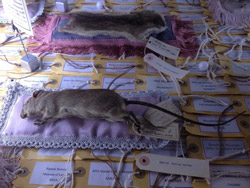
'The rat, an urban creature abhorred within the anthropocentric city, has been largely excluded from presentation in museums of natural history. This, despite rodents making up 40% of the total mammalian diversity, and Rattus being the largest mammalian genus, consisting of more than 60 species,' read the brochure to the exhibition, which explores and questions human kind's schizophrenic relationship with rats. On the one hand we find them abhorrent and worthy only of traps and poison, on the other they are depicted in animated films, like Rattatouile and Flushed Away, as cute anthropomorphic characters who have tastes and feelings, just like us.
Their unnerving proximity to humans was highlighted by UCT Zoologist Justin O'Riain, whose current research concerns the behavioural and spatial ecology of mammals with an emphasis on deriving sustainable solutions for wildlife populations in conflict with humans throughout Southern Africa.
'The edifices of our success as humans are cities, and cities are the most wonderful places for rats to live,' said O'Riain in his opening address. 'They've got hard structures, nooks and crannies, but most of all they've got an abundance of food. So we created the perfect environments for rats to live in and then we went to war with them for living in them, and we are still engaged in that warfare with them.'
'Rats share so many parallels with the 'higher' mammals such as ourselves. Their success is linked to our success. They are social like us. They have very good mothers, like us. And yet they fall so low in terms of how we rate and value wildlife. I learnt from going through Fritha's exhibition to relook at my relationship with the rat,' he said. 'I regard them as one of the ultimate success stories. While jackals and caraculs and baboons have survived in the face of human onslaught, rats have thrived. And of course the solution is not to escalate the conflict, but to clean up our act. It is only our excesses and how we manage our excess waste that has resulted in conflict with the rat. We should celebrate the rat as a mirror reflection of ourselves.'
Rather than a discrete display limited to a single room within the museum, R-A-T is a dispersed intervention, 'furtively making its way into disused corners and cabinets'. This distribution introduces the rat in relation to ranging themes, forming a meta-narrative of connections while suggesting manners in which museum display impacts on our understanding of species.
At the opening of the exhibition, Langerman revealed that the format of exhibition had been largely inspired by a particular vexing vistor's response to her previous exhibition. 'At the opening to the exhibition that I curated three years ago, I noted one particular visitor response when I was setting up that exhibition. Someone asked, "What does this mean?" The question was directed at the unlabelled object and set out to address this supposed lack of labelling. This exhibition [R-A-T] is comprised almost entirely of labels in different forms, but it is no more revealing of meaning than my prior exhibition. However, what this visitor question really does point to is the belief that the museum is able to offer fixed ideas about the natural world and that, in the presentation of specimens and labels, there is a stability of meaning. Of course this is entirely flawed.'
Langerman's opening comments perfectly captured the radicalism of her vision as a curator, and her desire to interrogate and destabilise established protocols around museum display that affirm rigid hierarchies and taxonomies in our reception and understanding of the natural world. Her favoured mode is catalysed instead by 'the recent rejection by some evolutionary biologists of the visual analogy of the evolutionary tree in favour of a web of life, and how this critical shift could influence display and the experience of natural history museums'.
'Langerman's exhibitions challenge the conventional waywe do natural history exhibitions by presenting knowledge as a network of associations rather than in a hierarchical mode, said CEO of Iziko Museums South Africa, Rooksana Omar. 'Her approach fits in well with the way I see the future development of exhibitions in the SA Museum, where elements of natural history, social history and art are contained.'
Omar added that in the near future, the museum's permanent exhibits would be thematically rather than taxonomically based. 'We will be endeavouring to break down conventional barriers - for instance, there is currently a sharp dividing line between marine and terrestrial environments whereas there is the potential to cross over these different environments. An exhibition on "symbiosis and parrotism" could consider examples from marine, fresh water and terrestrial systems, as well as considering this topic as it is understood in human relationships.'
Omar elaborated on an exciting new building project that will be initiated at the museum in 2013 and completed in about three years time. This project will see the opening up of a whole new wing of the museum for public access. 'One of the major objectives of the project is to open up the collections block to researchers and visitors so that they can see our collections and understand more about the research that backs up our exhibitions,' she said.
'In the new research block, we will take an unashamedly systematic and taxonomic approach to our displays, providing more space in the rest of the museum for the kinds of cross-cutting, thematic displays of the sort that Langerman favours. Without doubt, her earlier exhibition, Subtle Thresholds, has contributed towards thinking differently about the way we do our exhibitions, and I have no doubt that R-A-T will have an equal importance in determining our future plans for exhibitions at Iziko SA Museum.'