
In the Tracks of Qing and Orpen
By John Wright and José M de Prada-Samper
In December 1873, a young Bushman named Qing served as a guide for several days to a force of police and levies from the Cape Colony that was making its way up the Senqu (Orange) river in the heart of the Maluti mountains in what is now Lesotho. The force was under the overall command of Inspector James Grant; in charge of the levies was Joseph Orpen, who had recently been appointed as British Resident in Nomansland (part of what is now East Griqualand).
The force was one of several parties of armed men that had been sent out from Natal and the Cape to track down and capture Langalibalele kaMthimkhulu. He was chief of a group of Hlubi in Natal who had fallen foul of the colonial authorities and had fled across the Drakensberg or uKhahlamba mountains to seek refuge in the newly annexed British colony of Basutoland.
The encounter that took place between Qing and Orpen on this occasion has become famous in the annals of southern African rock art studies (though not, it seems, elsewhere in our intellectual history). In the course of their march through the broken country of the Senqu valley, Qing showed Orpen the large and richly painted rock shelters now known as Melikane (Medikane) Shelter and Sehonghong Shelter, together with a third smaller one, possibly the one known as Pitsaneng Shelter.
For reasons that still need to be fully established, Orpen was interested enough to draw copies of some of the paintings, and to record in some detail what Qing told him through interpreters about their meanings and how they related to myths recounted among surviving communities of Bushmen in the Malutis. At the end of the expedition, after his return to his headquarters at Gatberg near what is now Ugie village (at the foot of the Drakensberg in the Eastern Cape), Orpen seems to have wasted no time in writing up an account of what he had heard from Qing. He sent it off, together with copies of certain of the paintings, to Cape Town for publication in the Cape Monthly Magazine (CMM), the colony's leading intellectual journal.
The editor, John Noble, sent it for perusal to Dr Wilhelm Bleek, who had become well known in the city for his researches into the languages, customs and beliefs of the |xam Bushmen of the northern Cape. Orpen's article, with comments on it by Bleek, and illustrated with images of selected paintings, was published in the CMM in July 1874 under the title, 'A glimpse into the mythology of the Maluti Bushmen'.

View from Melikane Shelter, looking north-east across the Melikane river. This landscape is a potentially rich archive of information for historically minded geologists, geographers, ecologists and botanists, as well as archaeologists, historians, anthropologists and folklorists.
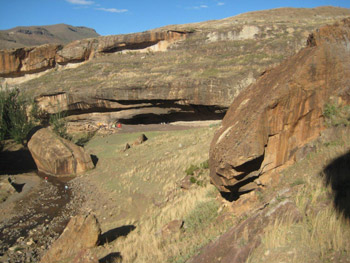
Sehonghong Shelter from the south-west. It is a key site in the archaeology and history of the Drakensberg-Maluti region.
Since the beginnings of serious academic research into southern African rock art in the 1970s, Orpen's article has become a canonical text. It is the only known source that records in some detail comments on the meanings of Bushman paintings given by a person who had an 'insider's' knowledge of the subject.
Over the years, the article has been used over and over again alongside texts recorded from |xam informants by Wilhelm Bleek and his sister-in-law,Lucy Lloyd, in the 1870s and '80s, and statements made by informants among Kalahari Bushman communities recorded by academic researchers since the 1950s, to shed light on the meanings carried by the rock art, not only of the Malutis, but of southern Africa as a whole.
Orpen's article has been subjected to numerous detailed readings, but it has so far been given little by way of the intensive critical scrutiny and historical contextualising that it needs if its strengths and limitations as an archival source are to be fully realised. Most scholars have tended to take it at face value, without giving much attention to the particular circumstances in which it was produced and which shaped the meanings which they see it as carrying.
The result is that the article is frequently raided for factual information on Bushman art and mythology in general, with little appreciation of the extent to which its content may be specific to time and place. We know what Orpen wrote, and therefore something of what Qing told him, but very little about why Orpen wrote as he did. By the same token, we know nothing of what he left out and why, virtually nothing about why Qing spoke as he did, and nothing about what he failed to tell Orpen, and why. Scholars like Pieter Jolly have gone some way towards raising these issues, and they now need specialised study from a variety of disciplinary perspectives.
This is where QOP comes in - the recently established 'Qing and Orpen Project'. It was,in the first instance,the brainchild of José M de Prada-Samper, who was until recently a research fellow in the Centre for Curating the Archive at the University of Cape Town, and is currently attached to the University of KwaZulu-Natal. He did postgraduate studies at Columbia University in English and comparative literature, a path which eventually led him into the field of folkloristics.
For some years,he has been researching the |xam texts recorded by Bleek and Lloyd, and has published in this field. Towards the end of 2010, he turned his attention to the Orpen article, which had previously been studied primarily by scholars of rock art. He soon came to feel that the article needed incisive textual deconstruction and extensive annotating if it was to become more readily accessible to a wider readership. He also learnt that the published text differed in a number of small but significant respects from the text which Orpen originally submitted.
From this grew his idea of republishing Orpen's text with a detailed commentary. In the course of 2011, as De Prada consulted with other scholars, this idea expanded into the notion of producing a full-length book of critical studies, written by several authors, and bringing different disciplinary perspectives to bear on the text.
So QOP came into being. As it stands at present, five authors will contribute to the envisaged book. De Prada-Samper will edit it, and, besides working up a detailed commentary, with annotations, to the text, will examine Qing's stories as stories. John Wright, a historian and researcher in the Rock Art Research Institute (RARI) at the University of the Witwatersrand, will write on the lives of Qing and Orpen up to the moment of their intersection in the high Malutis. Jill Weintroub, also of RARI, will examine how the text has been used in the literature since the time of its first publication.
Justine Wintjes, who lectures in the Department of Fine Art at the University of the Witwatersrand, will place Orpen's article in the context of southern African rock art studies, before and after its publication. Jeremy Hollmann, an archaeologist who has worked with rock paintings and with ethnographic texts on the |xam Bushmen, will write on the archaeological research that has been done at Melikane and Sehonghong, particularly as it relates to understanding the physical landscape. Three of the authors - De Prada-Samper, Weintroub and Wright - are all associates of the Archive and Public Culture Research Initiative.
The project is still in its early stages, but some of its members - De Prada-Samper, Wintjes and Wright - recently charged up their intellectual batteries on a fieldtrip to the Melikane-Sehonghong area. Organised primarily by de Prada-Samper, Wintjes and Hollmann, the trip drew in several other researchers with varied interests in the field.

Layers of history on the rock face at Matebeng Shelter. The graffiti (perhaps made by an over-zealous schoolteacher?) read, 'Pictures of the San (Bushmen). The San used bows and poisonous arrows to kill the animals.'
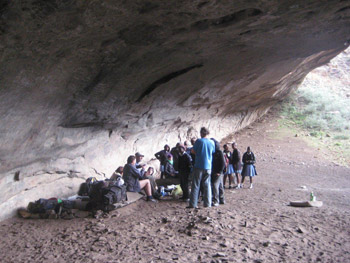
Swopping stories in Sehonghong Shelter. We were visited by numbers of curious schoolchildren from the nearby village of Khomo ea Mollo
Of these, Michael Wessels of the English Department at the University of KwaZulu-Natal in Pietermaritzburg has written critiques of the way in which the Bleek and Lloyd texts have been used ahistorically by some scholars. Helena Cuesta, who hails from Barcelona and Cape Town, is a professional storyteller with an interest in exploring how sharing one's own stories with people who are telling you theirs constitutes an essential form of human interaction.
Vicky Nardell, an archaeologist with the African Conservation Trust in Pietermaritzburg, has done energetic research into the rock art of the Drakensberg. Ethnobotanist Isolde Mellett has worked on cultural knowledge among people of Bushman descent. Kwanele Mbatha and Sifiso Shange are both trained surveyors with experience in working on rock art sites.
Kevin Crause, a photographer and interactive media designer based in Stellenbosch, is becoming widely known in rock art research circles in southern Africa for the stunningly powerful digital toolset that he has designed. Known as CPED (Capture, Process, Enhance, Display), it is revolutionising the recording of rock art in the region through its ability to capture images on the rock face that are now invisible to the human eye.
Participants in the trip rendezvoused with guide Matthew Wiggill in Underberg and drove over the Drakensberg via Sani Pass to Molumong near Mokhotlong. Another half-day's drive southward over roads good and bad brought us to Sehonghong Shelter. Here we spent three days photographing rock paintings, making a detailed metric survey of the cave, and examining the landscape round about.
Melikane Shelter is only two valleys further south, but there is no passable route even for four-wheel-drive vehicles through the gorges of the Senqu and its tributaries. Getting there took a full day's drive on a roundabout route towards the KwaZulu-Natal border and back again into the Senqu valley. After a day of photographing, surveying the cave, and walking the landscape, we returned home by way of Qacha's Nek and Matatiele.
For some members, the trip and its eight days of driving, working, and conversing were mainly about the place of rock art in the study of archaeology. For some, it was about the relationship between landscape and narrative. For some, it was about the interaction between colonialism (at its most repressive) and scientific endeavour. For all of us, in one way or another, it was about the unsuspected echoes though time and space of brief conversations held in the Maluti mountains nearly 140 years ago between a young Bushman and a colonial official.
Funding for the trip came mainly from the African Conservation Trust and from Wessels's NRF research grant on 'San Representation'. Mellett contributed a vehicle as far as Sehonghong. Work on the QOP project takes clearer shape. The next step, planned for the second quarter of 2013, is for the group of writers to meet and workshop draft contributions towards the proposed book.
· John Wright is based at the Rock Art Research Institute, University of the Witwatersrand, and José M de Prada-Samper at the University of KwaZulu-Natal.
Selected readings
Blundell, Geoffrey, Nqabayo's Nomansland: San Rock Art and the Somatic Past, Uppsala: Department of Archaeology and Ancient History, Uppsala University; and Johannesburg: Rock Art Research Institute (2004).
Challis, Sam, 'Creolisation on the nineteenth-century frontiers of southern Africa: a case-study of the AmaTola "Bushmen" in the Maloti-Drakensberg', Journal of Southern African Studies, 38 (2012), 265-80.
Hollmann, Jeremy, and Crause, Kevin, 'Digital imaging and the revelation of "hidden" rock art: Vaalekop Shelter, KwaZulu-Natal', Southern African Humanities, 23 (2011), 55-76.
Jolly, Pieter, 'Melikane and Upper Mangolong revisited: the possible effects on San art of symbiotic contact between south-eastern San and southern Sotho and Nguni communities', South African Archaeological Bulletin, 50 (1995), 68-80.
Leibhammer, Nessa, 'Originals and copies: a phenomenological difference', in Peter Mitchell and Benjamin Smith, eds., The Eland's People: New Perspectives in the Rock Art of the Maloti-Drakensberg Bushmen: Essays in Memory of Patricia Vinnicombe, Johannesburg: Wits University Press (2009), 43-51, 54-9.
Lewis-Williams, David, and Challis, Sam,Deciphering Ancient Minds: The Mystery of San Bushman Rock Art, London: Thames and Hudson (2011).
Mitchell, Peter, 'Gathering together a history of the People of the Eland: towards an archaeology of Maloti-Drakensberg hunter-gatherers', in Mitchell and Smith, eds., The Eland's People, 99-103, 108-36.
Mitchell, Peter, 'Making history at Sehonghong: Soai and the last Bushman occupants of his shelter', Southern African Humanities, 22 (2010), 149-68.
Mitchell, Peter, and Challis, Sam, 'A "first glimpse" into the Maloti mountains: the diary of James Murray Grant's expedition of 1873-74', Southern African Humanities, 20 (2008), 399-461.
Vinnicombe, Patricia, 'Basotho oral knowledge: The last known Bushman inhabitants of the Mashai District, Lesotho', in Mitchell and Smith, eds., The Eland's People', 165-9, 172-90.
Wessels, Michael, Bushman Letters: Interpreting |Xam Narrative, Johannesburg: Wits University Press (2010).
Wintjes, Justine, 'A pictorial genealogy: the rainmaking group from Sehonghong Shelter', Southern African Humanities, 23 (2011), 17-54.