
The road less travelled
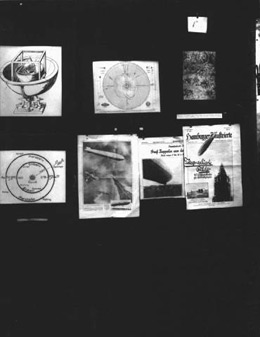
Aby Warburg, Mnemosyne Atlas, 1920-1929
Last year CLARE BUTCHER was invited by the Rietveld Academy in Amsterdam to lead a course of her own making in curatorial practice for art students at a first and third year level. She reflects, here, on some of the thinking that is shaping it
There's a funny anecdote, which a friend of mine mentioned once in an interview around the question of curatorial education, conducted with museum director, Charles Esche. The idea was basically that she'd seen a sign, one of those corny word-plays which, via textual layout, makes you rethink the meaning of phrase.
STAND
I DON'T
That's how it looked.
After thinking about it for some time, she finally figured out its significance. Stand, I don't. I don't stand. I don't placed underneath stand. I don't understand.
Such a simple line. So hard to admit - particularly in the framework of contemporary art where, to utter these words, means, so we think, to confess to some kind of philistinism. But if we know that we know that we know that so much of what we see in art makes us less certain of received information or the supposed 'master narratives' of our time - what's so bad about philistinism anyway?
I had to look that one up. 'Philistine'. What technically identifies a group inhabiting the area of Canaan around the Iron Age, is now used as an adjective describing something or someone who is uncultured, bourgeois, commercial, uneducated, or ignorant. Whether or not these traits must all be possessed by the person accused of philistinism, I am not sure. But surely ignorance, the not-understanding bit, is not the equivalent of uncultured or uneducated. Or is it?
I say this because some years ago I came across the story of Joseph Jacotot - a teacher in the 1800s, who needed to teach his Flemish students French (as well as a number of other subjects), without he himself being able to understand Flemish. Jacotot found a way to explicate, that is, to translate content without stultifying his students' own intelligence; their mutual non-understanding of one particular language lifted the 'veil of ignorance' usually preserving a teacher's superior knowledge of so-called master narratives; knowledge became a matter of will not a matter of fact. And it was contemporary theorist, Jacques Rancière, who accounted for this approach in his The Ignorant Schoolmaster: Five Lessons in Intellectual Emancipation (1981). Here, education is not a straight transmission of information from the enlightened to the non-enlightened, rather, it is a process of risky translation and the finding of chance equivalences. Leading forth and taking out: educo.
The word-play with which I began was particularly appropriate in relation to the question of curatorial education. As a fairly new field, the heated discussion taking place within it, is not so much concerned with how technical skills can be acquired for the management and mediation of museum collections, but rather about how a certain approach or mode of practice can be conveyed/explicated/led into. Only a few decades ago, more and more cultural organisers and artists working outside 'official' collecting or archival institutions began calling themselves curators.
And in these cases, their work was not so much concerned with pedagogy and preservation (as these are often the institutional mandate), but rather the chance meanings brought about by collaboration and the risky business of translating one thing into close proximity with something else thought to have been unrelated. I am of course simplifying the story. And the journey towards the point we are at today, where curatorial theory is a recognised academic endeavour promoted in the context of numerous curatorial training programmes worldwide, has been what we could, call 'philistine'.
Last year, I was invited by the Rietveld Academy in Amsterdam to lead a course of my own making in curatorial practice for art students at a 1st and 3rd year level. At the end of my Masters research - conducted in the framework of the Archive and Public Culture Research Initiative between 2011 and 2012 - any of my own insecurities were further compounded by my lack of education in the disciplines which accompany an artist's process (such as painting, sculpture, studio visits).
Having undergone various forms of curatorial training myself - as a collections assistant in a public museum; as a member of de Appel Curatorial Programme in Amsterdam (one of the first courses to be instigated in 1994); as an autodidact freelancer; and then as part of the Centre for Curating the Archive at Michaelis, UCT - I now find myself confronted with the surprising complexity of what political philosopher, Hannah Arendt, stated in her work on The Human Condition (1958):
What I propose, therefore, is very simple: it is nothing more than to think what we are doing.
Furthermore, I suppose, would be the questions of 'where do we stand?' and 'where are we going?'
This is the point of ignorance and the point from which I must depart: speaking a curatorial language to students who speak, well, many different ones. Currently, we're working on generating an atlas inspired by the research method of art historian, Aby Warburg, who in the 1920s arranged dozens of panels or 'storyboards' of patchworked visual materials (newspaper clippings, pamphlets, poems, maps, reproductions of artworks), each creating unorthodox equivalences to his ideas. This Mnemosyne Atlas marked the establishing of an entirely new terrain for thinking about the world and our risky translating of it. Perhaps our map will lead us further into unknown territory or perhaps towards Canaan, the promised land of the Philistines.