
Subtle Agency at !Khwa ttu
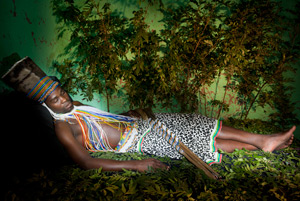
Mtambalala Sangoma and Maskandi star Thongo Tutsu, sleeping in a forest of Ilitha medicines. This 'dreaming medicine', which was divinely given to him at the age of nine, enhances his communication with Amadlozi.
PHOTO: NIKLAS ZIMMER (WITH JULIA RAYNHAM, BRADLOX VANS AND NONCEDO CHARMAINE)
By Alex Dodd
An exhibition of photographs by former APC research associate, Niklas Zimmer, opened in late January at !Khwa ttu San Cultural and Education Centre in Yzerfontein. Planting seeds to hunt the wind also features audio-visual recordings and a live plant installation, and is due to run for a year, before traveling internationally.
In keeping with the centre's mission to explore 'San culture, past and present, for a better future', this multiform exhibition attempts to convey something of the metaphysical experience of healing as it is practised by a diverse group of 'kruiedokters' or 'bossiedokters' who work with African indigenous plant medicines in the Western, Eastern and Northern Cape provinces, and whose practices reflect those of their hunter-gatherer forebears.
The images are the result of collaboration with the healers, community leaders and curators of medicinal gardens who appear in the images. Their shared intention is to open up conversation about people's relationships to indigenous plant medicines. Many of the healers who have participated in this project claim Khoi-khoi or San ancestral descent and argue for their right to benefit from the dissemination of indigenous knowledge systems. The landmark Hoodia case has seen San communities participating in a massive benefit-sharing deal involving the licensing of a patent to a traditional plant remedy.
The exhibition will be catalysed by a curated programme of events and discussions aimed at further exploring some of the ideas and provocations at play in the images. From a public encounter between San and Khoi-khoihealers, to a concert featuring Pops Mohamed? and Olufemi, and a San film festival in association with Encounters International Documentary Festival, the programme will be unfolding throughout 2013.
The archaeological record supports oral historical accounts that knowledge of plant medicines has been in circulation in Southern Africa for many millennia. Although they feature less prominently than animals, plants are represented as pictographs in numerous rock and cave paintings, evidencing the key role that they played in hunter-gatherer ritual practices. One of the highlights of the events programme will be a presentation by renowned archaeologist, author and rock art specialist Janette Deacon, who will be tracing the use and depiction of plants to way back before the advent of agricultural societies in Southern Africa.
Each image in the exhibition shows a healer in relation to a particular medicinal plant or natural curative substance of their choice. Although African healing practice draws on a broad-based body of collective knowledge about the therapeutic properties of each substance used for healing, a large element of it is also subjective and interpersonal. For this reason, each of the healers was asked to articulate which medicine he/she felt most closely connected to and why. Recordings of these discussions can be listened to as part of the audio-visual component of the show.
From Mary McCloud, a Khoi elder who has been a spirit workerfor over six decades, counselling and healing people in the neighbourhood of Lavender Hill on the Cape Flats, to Jean Pierre James, a Rastafarian medicinal herb purveyor who tends the Franschhoek Medicinal Garden, the images engage with a broad diversity of healing practices in contemporary communities.
In some instances, like the image of Chief Doctor Richard Kutela in an altered state of consciousness, the precise meaning or curative efficacy of the plant is invoked and in others, like the image of Sangoma Veronica Mhlazi at Ntufufu River mouth, the aim was to capture a more inherent state of grace or prayer associated with traditional healing practice.
Previously viewed as part of The Fringe of the 2012 Johannesburg Art Fair, this is the first iteration of an ongoing project that will include futurecollaborations in Swaziland, Lesotho, KwaZulu-Natal, Mpumalanga and beyond.
Subtle Agency is a heterodox group of artists from a variety of cultural backgrounds who have come together to explore these everyday San andKhoi-khoihealing practices in an open-ended visual way. 'Using artistic agency provides us with a way to represent people's knowledge and use of indigenous plant medicines in a way that is not inscribed within the Western scientific framework,' says Julia Raynham, who initiated the project. 'With images, we are able to suggest ideas around spirituality, cosmology, belief systems and metaphysical power that one can't as easily talk about by means of narrative language.'
Raynham's artistic practice melds composition, performance art, poetry, video, sound, and improvisation in a distinctly experimental vein. She has also been a practising sangoma for a decade, having trained extensively in divination and plant medicines, and forging links between the ancestral and human worlds.
The makers of the exhibition hope that it will go some way towards shifting limiting stereotypes around the way that African medicine is seen in South Africa today. 'Our ultimate goal is to get the images and catalogue into public libraries and schools across the country to share this knowledge in the public realm, so that people of all ages have some access to what is happening in the field.'