
Building a partnership with the Berlin Phonogramm-Archiv
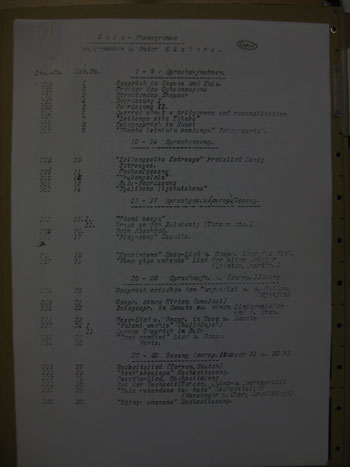
The Phonogramm-Archiv holds around 16 000 wax cylinders from all over the world, recorded in the first half of the 20th century. Around a third of this collection is comprised of recordings from Africa. For several years now, the archive has been digitizing these recordings, which makes them available for research abroad.
Looking into a collection of recordings from southern Mozambique, but also more generally, searching for early acoustic sources that speak of mining and migration, Hoffmann had come across a recording that was produced by a German missionary in the Transvaal in the 1920s. The translation, most probably provided by Meinulf Küsters himself, reads as follows:
Ask the Waganga [impudent/naughty ones], these one
They build the tracks
These Waganga
They work like Europeans
These Waganga
I am refusing this work
The moon shines already
In this night here
It goes to Europe, I come from there
They have something, these Waganga
Ask them!
[South Africa, 1923, IsiZulu, Küsters Collection]
Although this translation reads like a comment on the working conditions of building the railway line ('I am refusing this work, the moon shines already'), it might (also) gesture towards other topics and tropes, which are impossible to identify on the basis of a single recording. Further, a careful transcription and re-translation of the recordings is needed for the analysis of its content.
Küsters produced altogether 83 recordings in the Transvaal, which will be made available to work with in digitized form in the coming months. The recordings were produced by the Benedictine missionary, linguist and ethnologist - most probably at the mission station Inkamana in KZN, in the 1920s. Like many other missionaries, anthropologists, linguists, and travellers, Küsters was equipped with a portable phonograph by the Phonogramm-Archiv and delivered the delicate wax cylinders to the archive on return. Assigning travellers to do the recording was the politics of the Archive, which aimed to accumulate material for comparative musicology; in this way 350 collections on wax cylinders came to be held by the Archive.
Messagesor notes Poste restante is what our German colleague, Britta Lange, has called these recordings, with narratives, songs and stories frozen to muteness or unintelligibility, until they are made available through digitization, translation and research in the present. Since oral poetry or any other of the spoken, performed genres of the vast repertoire of orature speak in the present - and, at times, from the present to the past, these recordings, if they are translatable and understandable, may afford scholars glimpses into discourses of the 1920s.
In a comparable collection - that of Franz Mayr (from Pietermaritzburg of 1908) - one hears fragments of a discussion on the transformation of moral values - between Christian and non-Christian isiZulu speakers. The recorded songs seem to form a dialogue in which different positions towards - for instance - premarital relationships are voiced within an antiphonic form.
In another case, complaints on the working conditions under the apartheid regime in South West Africa were uttered in 1954 - to be translated in Basel for the first time in 2012. In this case the linguist, Ernst Dammann did not provide a translation from Setswana, which he probably did not understand.
In some cases, like with the recordings of the Spannaus/Stülpner collection from Southern Mozambique, a frustrating experience awaits the researcher: the quality of the recordings is so bad that translation is impossible.
Along with Küsters' collection of recordings are diaries, letters, photographs, and a collection of objects, since the missionary at times worked as a curator in the ethnographic museum in Munich, and published linguistic and ethnographic works.
The connection between the acoustic sources from the Transvaal at the Phonogramm-Archiv and the collection at the St Ottilien monastery in southern Germany was established by APC honorary research fellow Regina Sarreiter. The partnership with the Berlin archive will allow for research into these unique acoustic sources in South Africa.