
Moi University conference reviews Kenyan literature since Independence
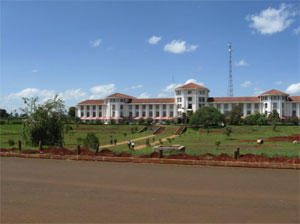
Last month, I travelled to Eldoret, Kenya to attend a conference hosted by the Department of Literature, Theatre and Film Studies at Moi University. The theme of the conference was Literature and the Production of Knowledge in Kenya, 1963 - 2013.
The purpose of the conference was to explore cultural activity and knowledge production in Kenya over the first 50 years of independence (1963-2013), a period that has been characterised by state failure and false starts towards democratisation. The conference was part of a series of events taking place in Kenyan universities, research institutions and diverse spheres of public life throughout 2013 to commemorate 50 years of independence and to take stock of research, publishing, politics, cultural production and other areas of Kenya's public life over this period.
About 70 people attended the conference, which took place at the Sirikwa Hotel, some having travelled from other countries in Africa, mainly South Africa. About 40 papers were presented to an audience of faculty and students of Moi University and other universities around Eldoret.
The conference offered an opportunity to reflect on the value, status and future of the Humanities and Social Sciences in Kenya in the context of an intense administrative purge that was particularly strongly felt at the height of political repression in Kenya up to the late 1990s. Based on the perception of the Humanities as a haven for dissent, this clampdown has arguably succeeded in undermining the merits of the Humanities in Kenyan public opinion.
A good part of the discussions also took stock of the current global debates on the value of the Humanities and the crisis caused by austerity programmes and reduced funding due to the current global financial crisis. This also offered insight into the marginalization and severe underfunding of the Humanities in Kenya.
Many of the papers focused on research and consumption of literature, theatre, popular culture, new media art, and multi-disciplinary research in the Humanities in Kenya, and knowledge production in these areas since independence. A few focused on areas such as digital technologies, social life and education, as well as digital literacy skills and research. Many of the presentations and discussions focused on the volatile political atmosphere in Kenya over the last 50 years culminating in the 2008 post-election ethnic violence and its economic consequences, which coincided with the wider 2008 global financial crisis. The austerity programmes put in place to manage the crisis only placed the Humanities under more profound siege.
Acting Deputy Vice Chancellor of Moi University, Prof Anne Nangulu, who opened the conference, also made her own presentation in which she reviewed the post-independence history of research and the impediments to research and publishing in Kenya.
This issue was also the focus of one of the keynote presentations by Tom Odhiambo of the University of Nairobi who dwelt on the contemporary lack of enthusiasm in publishing in the Humanities, especially in Literature, as the lingering consequence of the political repression of the 1970s - 1990s, which successfully intimidated publishers into giving a wide berth to publishing in Literature and Humanities, and the tertiary sector generally.
The hostility of the era coupled with the shift of focus in the Kenyan publishing industry to school textbooks severely undermined knowledge production and consumption in Kenya. One of the consequences is that most visible research and publication in the Humanities in Kenya is still done outside of the country. One of the matters agreed upon was redeployment of new energies into publication starting with the publication of papers from the conference.
There was a particularly enthusiastic response to presentations by postgraduate students at advanced stages of their research.
With issues of ethnicity taking up a large share of public life discourses in Kenya, many of the papers focused on the issue of ethnicity. Some focused on the 2008 post-election ethnic violence, particularly the specific modes of mutilation of bodies of victims on the basis of their ethnicity to suggest ways of reading the bodies as texts of Kenyan history. One paper used the work of performance theorists to understand the paradox of a number of Kenyans choosing to regularise the ethnic stereotypes against their communities through public service taxi stickers.
The central focus of the conference was around the archive. A number of papers scrutinised attempts by the post-independence administration to regulate national histories and diverse modes of public resistance. Others brought out archival issues, which are central to cutting edge research in countries like South Africa, but which have not yet captured scholarly imagination in Kenya.
My paper focused on knowledge production at the local level and new ways of mediating local histories. I present ways in which a local historian earns for himself the social position of an intellectual in a peasant society by influencing the process of production and consumption of community histories by reconstructing those histories to silence discourses that sideline him and his clan.
One keynote presentation by Dan Ojwang from the University of the Witwatersrand highlighted the issue of the unacknowledged role of missionaries in research and the writing of local community histories initially for use in local mission schools. In the wake of urban migration for the purpose of selling labour notions of fixed community territories became impossible because the migrants found themselves having to live outside ancestral spaces. Such radical transformations during the colonial era defined new and unintended roles for texts of missionary anthropology because these texts became a reference points for the new African urban dwellers who were anxious to instill in their offspring specific notions of peoplehood.
The paper pointed out the paradox of missionary ethnography forming the basis of postcolonial modes of ethnic belonging. Whereas such missionary anthropology is largely sidelined it is often the only record of numerous histories, which are no longer a part of everyday memory and have no place in school syllabuses. The focus of the paper reminded me of current research into the work of such missionaries such as Carl Hoffmann who worked among the Sotho and similarly produced a vast body of documents.
The paper pointed at the bigger issue surrounding the archives of Kenyan pasts, which are yet to be explored and which demand attention as the country enters the next 50 post-independence years. In this respect, there is a lot to emulate from on-going research in South Africa.