
Critical listening: Acoustic shards of the colonial archive
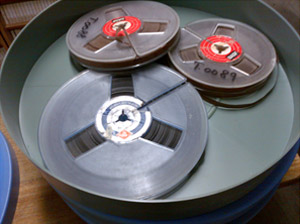
1/4 inch audio tape reels, National
Archives of Namibia, Windhoek
PHOTO: NIKLAS ZIMMER
On 10 October, APC senior researcher Anette Hoffmann presented a paper entitled Acoustic Fragments from Colonial Archives at the University of Denmark in Copenhagen. She was there at the invitation of Anne Folke Henningsen from the Saxo Institute at the Department of History, Ethnology, Greek and Latin, and Archaeology.
In recent years, Hoffmann has been working with collections of sound recordings that were produced in the early years of the 20th century. Recorded in colonised countries, mostly on wax cylinders, these early acoustic documents are the results of imperial knowledge production. Highly valued as incunabula by museums and archives, recordings on wax cylinders had to be handled gingerly. Their fragility, which precluded playing (!) or transporting them, made them inaccessible as acoustic sources to researchers as well as to the communities with whom they were originally produced.
In recent years, many of these collections have been digitized, which has 'mobilized' their audible content, allowing for translation and research abroad. The retrieval and altered interpretation of their textual content, together with a shift of auditive practices - in which the recordings are not merely linguistic samples or objects for musicological research, which was (mostly) the rationale of their production - demand a conceptualization of the potential and status of these acoustic documents.
Over the past few decades, the surge of scholarly, curatorial and artistic attention focused on visual sources, particularly photographic archives from formerly colonised countries, has given rise to the constitution of visual history as an emergent (sub)discipline or field of research. Along similar lines, the sonic archive has yet to be explored and theorised.
Vast acoustic collections and archives (for instance in Berlin, Vienna, London, Brussels, but also Copenhagen) hold substantial collections, which carry hitherto un-mined historical sources, especially with regard to so-called oral societies. The steady increase of interest in historical sound recordings - by historians, but also artists and curators - signals a change of paradigms in the understanding of the recordings. This, Hoffmann argues, marks a major shift in the scholarly assessment of collections of recorded voices: recordings that may have been perfect objects in relation to the purpose for which they were originally produced - for instance, as linguistic samples - become fragments of something else altogether when listeners shift their attention towards the recordings as carriers of meaningful words, and/or texts, performative utterances, or perhaps messages.
This change of focus allows for the surfacing of vast acoustic colonial archives from what were hitherto understood to be lexicographic and grammatical samples. But, since the recordings were produced according to the logic of disciplines - as phonographic samples - they are limited acoustic fragments which carry disturbing splinters of conversations, critical comments, accounts and the like. At times, speakers were asked to count, or sing specific songs. Recorded (mostly) for specific purposes, the potential for verbal expression, or the generic capacities of these recorded speech acts were, more often then not, constrained. All stories and songs were, for example, abbreviated to the length of a wax cylinder (2,5 minutes).
Listening to the recordings today is inevitably accompanied by a sense of lack. As acoustic shards, these recordings gesture towards bodies of 'texts' - as in performances, speech and song - that remain irretrievable. Yet, at the same time, some of the recordings speak directly to the very power relations that regulated their creation, or the imperial projects of knowledge production on 'exotic people' more generally.
The 'discovery' of their existence as carriers of meaningful texts, or textual snippets - for instance, the case of the hundreds of recordings with colonial prisoners of WWI that were recorded during their captivity in Germany, and have been kept at the Berlin Lautarchiv since then - may raise the expectation of a retrieval of 'stories untold'. Yet what one can hear now, often raises as many questions as it provides answers. Although not all recordings are necessarily accounts of the self, although not all of them have the weight of an intervention, some of them do.
Today, these acoustic fragments constitute a massive collection of sound carriers - resonating relics, one could say - in archives and deposits, mostly held in European metropolises. Bearing the mark of productive power, itemised as objects of the Colonial Archive, these fragments are not entirely made of that which marked or produced them. Itemised, stabilised, and thus, in a way, snatched from the ephemeral quality of voice into the realm of concrete, yet sounding, objects, the acoustic documents enter a potentially endless loop of repeatability, reverberation.
As fragments of bodies of orature, or snippets of discourse, these documents demand a double reading, one that attempts to grasp the processes of production, which were always itemisations, but also performances (however constrained), recitations, announcements, critical interventions, songs, or accounts.
Moreover, as acoustic documents rather than transcriptions the recordings carry excess information - for instance, a chanting voice gestures towards a specific genre enabling the listener to understand the acoustic shard as a splinter of a larger generic pattern.
In Copenhagen, Hoffmann's presentation offered a reading of the counterpoints encoded into the recordings: their genre and content, as well as their intimate relation to the practices of recordings, which formed, or de-formed them. Although the files in the sound archives themselves may not address the rationale of the practices of recording, many of the scholars who were involved in the generation of those collections did speak or write on the conceptual framework that informed projects of recording. The writings of the linguists Carl Meinhof and Wilhelm Doegen, and the anthropologist Felix von Luschan, for instance, speak of the worries of salvage ethnography, and the assumptions on the connection of language as the carrier and performative agens of the 'soul of peoples'.
Considering these often contradictory aspects of the recordings, Hoffmann suggests that one is left with symptomatic listenings. To engage with voice recordings, more often than not, means to listen, seek to translate and make sense of fragments, which may or may not speak by themselves, or of themselves, which do or do not carry an account of the speaker(s), and which often direct our reading in unexpected directions.