
Out-of-the-box actions critique Berlin's resuscitated Humboldt-Forum
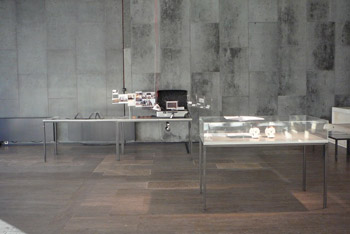
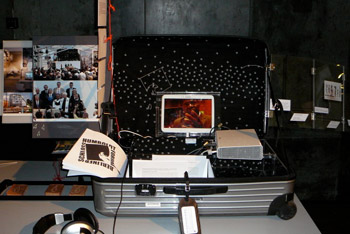
This campaign was launched by a number of anti-racist activists and initiatives to halt the reconstruction of Berlin's city castle and the housing of the Humboldt-Forum in this building. The Anti-Humboldt-Box was conceived of as a mobile exhibition space - inspired by Marcel Duchamp's boîte-en-valise (box in a suitcase) - to distribute and transport the criticism as well as to trigger discussion about the Humboldt-Forum beyond Berlin.
Both the special issue and the Anti-Humboldt-Box, emanate from Artefakte//anti-humboldt's critical examination of the project of re-building the castle, and housing the Humboldt Forum in it. In 2000, the German Parliament approved the reconstruction of the destroyed former Prussian castle in Berlin's centre as part of the Museum Island complex of state museums. The plan is for the reconstructed castle to house the Humboldt Forum's collection of ethnographic artefacts.
'Not only can one trace a direct line between the much-vaunted cabinet of curiosities in the Berlin Palace and the former German fortress of Großfriedrichsburg (in present-day Ghana) and the triangular trade with Brandenburg-Prussia,' say the Artefakte//anti-humboldt collective. 'We even dare to predict that the linking of the Humboldt-Forum with the five institutions of the already existing Museum Island, which represent and present national and European art and culture, will exacerbate the existing polarisation between those artefacts which are already accommodated in Berlin Mitte and the artefacts of a cultural history that is qualified as non-European.
'The existing ensemble of museums is thought to be enriched and 'enlightened' by a cosmopolitan vision of German Nationhood entwined with postcolonial jargon, which, in our view, ignores the problematic absence of any confrontation with the colonial history of Germany; a history that is mostly considered as having been short and without any further consequences,' they say.
To attack this reactionary move by the German government and the city of Berlin, a group of artists, scholars, activists and cultural workers who are opposed to the project, organised the event Der Anti-Humboldt in 2009. The event comprised a critical panoramic view around the Schlossplatz, which, by that time, has already been voided of the Palast der Republik. The demolition of the former GDR site of parliament, which created the space for the planned re-building of the Prussian castle, raised a series of questions around matters of national branding, cultural politics and urban cultural transformation, that lie at the foundation of the Humboldt-Forum.
Since 2010, Artefakte//anti-humboldt has been working with films that engage with the re-surrection of mummies, including The Mummy (USA, 1930) by Karl Freund, Belphegor (France, 2001) by Jean-Paul Salomon, Al-Mumyia (Egypt, 1969) by Shadi Abd al-Salam). 'We understand the recurrent trope of the mummy in films as a cinematographic chronotopos, in which the figure of the mummy engages with the liminality of the concept of "artefact",' they say. 'The mummy has been appropriated as an object by colonial archaeology and "Egyptomania" - by means of grave-robbery and illegitimate de-contextualisation.
'As a consequence he/she/it opens up a field of attraction, especially spawned by late-19th/early 20th century "Egyptomania" in Europe, and conflict between subject (human) and object (non-human); death and life; nature and culture; art and religion or rite; display and performance. In the films, the mummy takes revenge for the desecration of the tomb and often seeks vengeance for a violent end to his or her life back in ancient times.'
By presenting a film lecture on the site of the to-be-built castle in Berlin and at Musée du Quai Branly in Paris, as well as a multimedia installation at the exhibition, Animism, at the House of World Cultures in Berlin, the collective engaged with the figure of the mummy as the activated and revolting object in the museum.
For the special issue 'Afterlives' of the journal darkmatter the installation was transformed into a video and made available online.The issue also features contributions by Susanne Leeb, Lotte Arndt, Friedrich von Bose and Larissa Förster, with conversations with Jean-Gabriel Leturcq, Françoise Vergès, Boris Wastiau, Edouard Planche, Alice Creischer, Andreas Siekmann, and Max Jorge Hinderer Cruz. With this issue Artefakte//anti-humboldt aim to open up and bring together threads of their ongoing examinations into the realm of ethnographic collections and the status of objects.
APC Honorary Research fellow Katharina Schramm and Stefan Nowotny, a philosopher at the Department of Visual Culture at Goldsmiths (University of London) and member of the Vienna based European Institute for Progressive Cultural Policies (eipcp) were invited to speak at the well-attended launch of the special edition.
At the end of December, the Anti-Humboldt-Box will travel to Munich, where it will be shown as part of the project, Decolonize München, at the Stadtmuseum. Artefakte//anti-humboldt will travel to South Africa in the end of January, visiting Cape Town in early February.