
Kindling sparks at the pre-Colonial Catalytic History Conference
John Wright
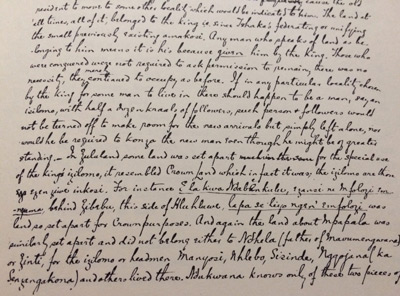
Extract from the expanded version of the rough notes taken down by James Stuart of a discussion with Ndukwana kaMbengwana in Ladysmith on 20 October 1900. (File 73, pp.124-5, Stuart Papers, Killie Campbell Africana Library), reproduced as a frontispiece of the fourth published volume of The James Stuart Archive, edited by C de B Webb and JB Wright, 1986
In recent years, the national education authorities have been investing time and money in working to get a number of 'catalytic' research projects off the ground in various educational institutions around the country. These projects are aimed at releasing new energies in research in fields of knowledge-making that go beyond conventional modes of thinking rooted in colonialism and apartheid.
One of the 11 fields that have been earmarked for catalytic research is the pre-colonial history of South Africa. The original idea was for new research to focus on the period from the 11th century to the 16th century; subsequently the period was extended to the end of the pre-colonial era, which occurred at different times in different places.
Prime responsibility for energizing new research in pre-colonial history has been allocated to the Centre for African Studies at the University of Cape Town, headed by Dr Lungisile Ntsebeza. The first of what he and his co-organisers hope will be a series of catalytic conferences was held in the Centre on 28 and 29 March.
The 25 people who attended were mostly from UCT and the Cape Town region, with a sprinkling from the University of the Witwatersrand, one from Fort Hare University in the Eastern Cape and another from McGregor Museum in Kimberley. Conspicuous by their absence were representatives of institutions in KwaZulu-Natal.
Over a day and half, the conference-goers discussed inputs from 15 speakers. The focus was primarily on the archaeology and history of the Western Cape and Karoo, and on issues relating to Khoisan heritage and identity. Other papers had to do with ethnicity and gender in pre-colonial Ndebele society; priorities for archaeological research in the Eastern Cape; and ideas for establishing an online research portal to facilitate new ways of thinking about the pre-colonial archive over the last 500 years.
The Five Hundred Year Archive (FYA) project was presented by the NRF Chair in Archive & Public Culture, Carolyn Hamilton. This project builds on a resurgence of research interest in the history of Southern Africa in the five-hundred-year period before the advent of colonialism. Much of the material concerning the Southern Africa pre-colonial past is misidentified, lost or dispersed in institutions across the world, or held in settings that are largely inaccessible and/or not recognisably archival. The primary aim of the FYA project is to create an accessible online research portal capable of virtually convening visual, textual and sonic archival objects and texts pertinent to the last 500 years of Southern Africa's pre-colonial past.
Given the relatively narrow focus of the conference, participants did not find it easy to come up with the clear suggestions the organisers were seeking for the next phase of the Pre-colonial Catalytic Project. It was finally agreed that five 'fields' and six 'processes' needed to be given priority. The fields relate to issues of identity-making, knowledge-making, gender analysis, rights in land, and the nature of pre-colonial political structures. The processes relate to making archives accessible; producing books accessible to a popular readership; disseminating source-material more widely; co-operation between academics and organic intellectuals; co-operation between academics in South Africa and neighbouring countries; and finding funding for new research. These ideas were to be incorporated into a report due to be made by the head of the African Studies Centre to the National Research Foundation in early April.
At least in some official educational circles, the hope is that the catalytic projects in the humanities and social sciences will help to generate alternatives to widespread market-, engineering-, and business-oriented models of research. How far this can happen when powerful elements in government are committed to developmentalist ways of thinking remains to be seen.
John Wright is an honorary senior research fellow at the Rock Art Research Institute, University of the Witwatersrand.