
Archives of the Non-Racial: Cape Town discomforts

Carolyn Hamilton
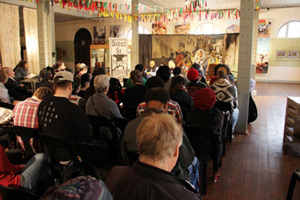
The crowd gathered at the District Six Homecoming Centre in Cape Town for the final discussion session of
the JWTC mobile workshop
In July 2014, the Johannesburg Workshop in Theory and Criticism, in collaboration with the University of California's Seminar in Experimental Critical Theory, hosted a mobile workshop on the theme 'Archives of the Non-Racial'. The workshop, which started in Johannesburg and ended almost two weeks later in Cape Town, sought to 'assess the possibilities and limits of the "non-racial" in terms of the politics of the modern world and its core values: democracy, freedom, dignity, equality, the human, universality, justice'.
The Cape Town leg of the workshop (9, 10, 11 July), which I attended, encompassed a variety of events, including a public lecture by Angela Davis, and dynamic contributions by the performance artist and musician, Neo Muyanga. Deborah Thomas gave a public lecture on 'The Limits of the Counter-Archive' and I chaired the final panel, 'A Dead Archive? Non-Racialism's Demise in Cape Town'.
As an attendee of only the final leg of the workshop, my impression is both itself curtailed and, in many respects, secondhand. By the time I caught up with them, the participants were clearly exhausted. The final day saw many of them in summative frames of mindand I capitalized on this, chatting to as many of them as possible. This note on the tail end of workshop cannot purport to do justice to their experiences and I believe that we can expect a variety of outcomes in addition to the blogs and notes they themselves produced in the course of the workshop. These can be found at http://jwtc.org.za/the_workshop/session_2014.htm and http://jhbwtc.blogspot.com/.
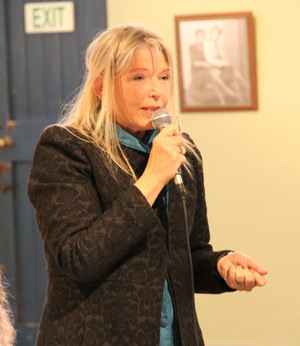
Carolyn Hamilton chaired the session, 'A Dead Archive?
Non-Racialism's Demise in Cape Town'
However, one point stood out for me, as a tail-ender participant: the limited extent, on the final day, to which the participants reflected or handled the central concepts 'non-racial' and 'archives'. I assume that they had been discussed extensively over the previous ten days. Be that as it may, the discussion on the final day begged for more substantial critical engagement with the notion of 'archive'.
Deborah Thomas's wide-ranging talk on the limits of the counter archive invited consideration of what difference it makes if archives are conceptualized and organized transnationally rather than nationally, what it means to give attention to archives of violence, thereby both witnessing and exploring the relationship between sovereignty and racialism and much more besides. Thoroughly stimulated by her ideas, I nonetheless missed any attempt in the talk and in the ensuing discussions to specify the limits of the term 'archive'.
Are all memorialisations or films - the two things most discussed by Thomas - already archives, or must something happen for them to acquire that aspect? I have no doubt that, if not all, then at least many things can become archives, but under what conditions? Can we specify, productively, what happens, conceptually and theoretically, when something is constituted as archive?
To cast the films made by Thomas as archives is, in my view, to imagine that they have potential 'users', rather than the 'audiences' to whom she referred. Audiences, we all know, are not passive receivers, they are themselves authors of what they see, hear, experience and otherwise take from a work. Yet the user of an archive is not co-terminous with the viewer of a film. The attribution of the term 'archive' implies the possibility of this more active user. It gestures to the future. The conditions under which the status of archives attaches to some things, and not to others, is of central importance in understanding what work archives do and do not do, what their reach is and indeed, what their limits are.
The evening panel that I chaired, 'A Dead Archive? Non-Racialism's Demise in Cape Town', was endowed with contributions from Premesh Lalu, Zimitri Erasmus, and Ciraj Rassool. We were left with no doubt about the richness of Cape Town's non-racial heritage, which only underscored the panel's question about the contemporary absence of recourse to its archive. Time was against us and the matter was left without the discussion that it demands.
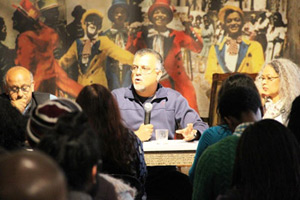
Ciraj Rassool, centre, flanked by fellow panellists
Premesh Lalu and Zimitri Erasmus
Why this heritage is not mobilised in contemporary processes of deliberation, consideration, critique and so on remains a pressing question. One part of the answer must surely lie in the relevant archive's own ambivalent nature. The organisations and the politics discussed by the panellists were not clean-cut exemplars of non-racialism. The archives that were brought into view in the course of the panel are complex, sometimes ambivalent, archives of the non-racial.
This, surely, is to be expected and does not compromise them. But there is perhaps a (peculiarly Cape Town?) legacy of purity of principle that is not wholly comfortable with the idea that they might be faulty, yet potentially powerful. To an internal immigrant like myself there also seems to be a form of specifically Cape Town contemporary politics concerning who inherits which local archive, marked out by a legacy of intellectual positions and inherited mantels, which introduces a form of gatekeeping in relation to the archives of the non-racial.
Finally, I was left wondering about the proposition 'A Dead Archive?' At first glance, archives may well seem to be sepulchres where the past is buried. But it is in the very nature of archive that the promise of recovery is always present. In declaring as its focus the 'Archives of the Non-Racial', I understood the workshop to be an exercise in naming their existence, challenging their dormancy and activating their potentialities. What does it take, I wonder, to build on this initiative? Presumably further, persistent unsettling!