
June Bam-Hutchison responds to Lynn Thomas on skin lighteners
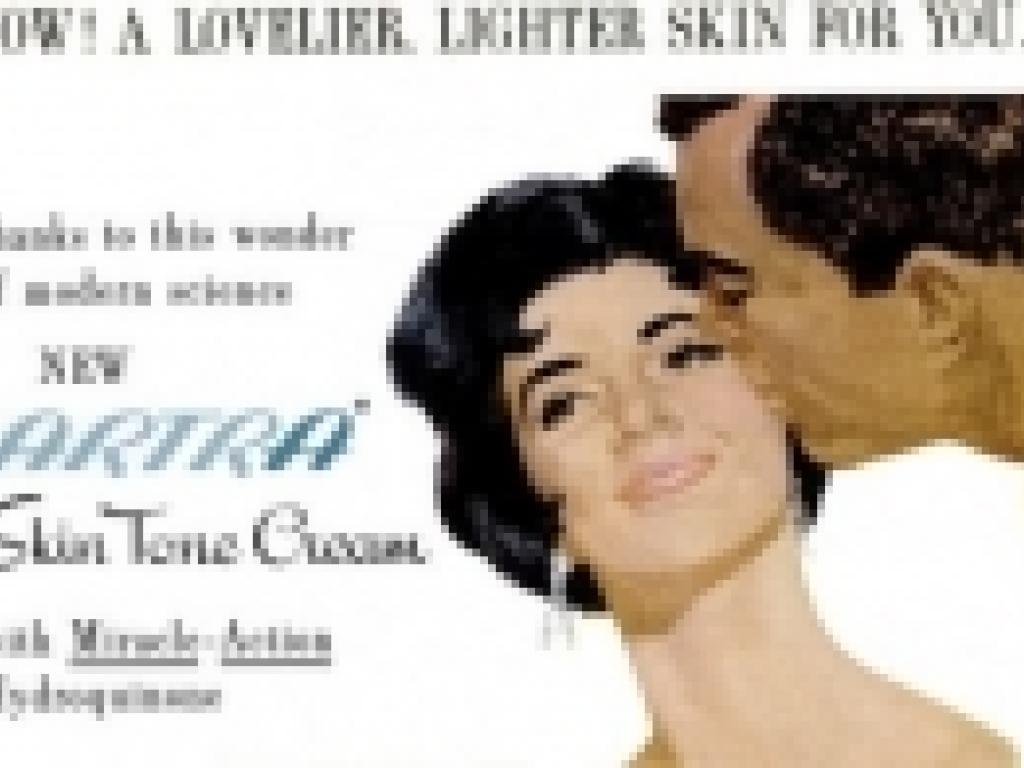
Apartheid allowed only a handful of medical doctors to become specialists. South Africa’s first black female dermatologist qualified only after 1994. Hence, while critical awareness about race was strong within black communities, awareness of the medical harmfulness of skin lightening creams was limited to a small minority of black medical practitioners. Today, as Professor Emeritus Mercy Olumide of the University of Lagos notes, skin lightening is one of the most common forms of potentially harmful body modification practices in the world, and African women are among some of the most widely represented users of skin lightening products.
In March this year the University of Cape Town’s Department of Social Anthropology held a workshop, attended by leading scholars on the subject, to explore this theme. This piece documents June Bam-Hutchison’s response to the presentation by Professor Lynn Thomas, of the Department of History at the University of Washington, entitled “Entangled Bodily Discourses: Black Consciousness and Biomedical Opposition to Skin Lighteners in Apartheid South Africa and Beyond”.
Untapped archives and untold stories
Lynn Thomas’ paper provides scholarly insight into the entanglement of bodily discourses in the transnational conversations of the 1970s/'80s (within the Black Consciousness Movement) about the harmful effects of skin lightening creams. Drawing on her personal experiences of the use of these creams when she was growing up as a “coloured girl” under apartheid, June Bam-Hutchison noted in her response to Thomas’ paper that the deep, life-long psychological impact of having lived through apartheid as a black female child and teenager is not often read or spoken about in post-apartheid South Africa. She stressed that the link between skin lighteners and reclassification during apartheid is still a largely unexplored area of research and scholarship, possibly because so little has been written on the social experience of living under apartheid. More writing by black women themselves, on the apartheid experience of the body is needed, not via the voices of others who do not have those experiences or memories to draw upon. Bam-Hutchison’s semi-biographical novel, Peeping through the Reeds (2010) is one of only a handful of such “socio-historical biographies” in South African historiography. Bam-Hutchison writes about "Ambi and that thing", "Ambi" referring here to a skin lightening cream and "that thing" to the sexualisation of the "coloured" child's body during apartheid.
The apartheid archive exists in dispersed forms in many institutions and in millions of untapped memories and there is, for example, much opportunity for black people themselves who have lived through the psychological and physiological experience of apartheid to work on the research of scholars such as Chabani Manganyi, and to write their own stories. This is where we are in terms of South Africa, trauma and memory: so many millions of stories are still untold, Bam-Hutchison noted. Much of what happened and how it happened is still not known with absolute certainty, nor perhaps ever fully accessible. The psychological shame of the apartheid experience is known but not shared in depth beyond what is “skin deep”.
Bam-Hutchison contended that of particular interest are women’s stories, especially the experience of the black female body and its entanglement with others within the context of a crime against humanity. Our post-apartheid scholarship in trauma, voice and self-identity with victims writing their own stories is still largely lacking. What is its link to domestic violence in psychologically brutalised apartheid-defined communities such as within the Western Cape, for example?
Discursive black bodies and the quotidian
In her response to the global black body discourse, Bam-Hutchison reflected on the transnational conversations, in London in 2007, on the transatlantic slave trade and its lasting legacy for minds and bodies. The discourse on skin lightening creams and hair is not only confined to the black experience as discussed in Jessie Cohen’s “Facing up to Jewfro” in a recent Mail and Guardian article. The discourse extends beyond black essentialism. We need to ask new questions about the long lasting impact and presence of Eugenics ideas and the medical collaboration against the black body in their various forms in daily social relations in contemporary post-apartheid South Africa. What was the nature of the intimacy of violence between bodies and minds during apartheid and in which new and invisible ways do they carry on? The "Rhodes Must Fall" campaign shocked many into the ongoing reality of apartheid as perceived as an ongoing social relationship practice in daily life; it was an attempt by a new generation of young South Africans (in their inclusivity – a point not often noted in the media) to break this silence. Paul Connerton1 speaks about the notion of “humiliated silence” and memory within communities as a form of forgetting. There is, for instance, a long tradition on problematising the myth of race in black oppositional writing; often forgotten and not always acknowledged in their role in raising critical awareness about the body.
Conclusion
Bam-Hutchison contended that the work of Thomas (and scholars like Olumide) is crucial, as binary conceptual understandings of black bodies are no longer very useful in a post-apartheid consumerist global order increasingly shaped by economics and profits. A deeper understanding of skin lightening creams, their psychological and physiological damage on the body and mind (increasingly now across race and gender boundaries), may be attained by attending more fully to the range of complex life stories located in different places and spaces which may be accessible through ongoing transnational conversations. Thomas’ paper was enlightening and challenged us to think of new ways in which these conversations can bring about global awareness and, subsequently, social change.
---
1Connerton, Paul. 2008. "Seven Types of Forgetting". Memory Studies Vol.1 (1) 59-71. Sage Publications. doi: 10.1177/1750698007083889