In our year-end overviews, the APC typically reviews the general research and public engagement highlights of the year. In this missive, however, we attend more directly to the ways in which the agenda of the APC has been fuelled by the current wave of university and other protests, and to what the APC has to offer in these changing circumstances. It is our view that the university and policy makers for whom APC research is relevant are now under pressure to listen more keenly to the concerns of an initiative like the APC, and to pay attention to the implications of the kinds of research that we undertake. We seek now to amplify our concerns.
As APC research associate Professor Njabulo Ndebele notes, reproduced as the banner line on our website, “There can be no transformation of the curriculum, or indeed of knowledge itself, without an interrogation of archive.” We might add that substantial changes or new directions in public discourse, public culture, public museums and in the attainment of social justice also require an interrogation of archive. Such an interrogation involves not only the critical engagement of existing archives and the developments of counter-archives, but also an examination of the concept of archive itself and of the work that the concept does, epistemologically and politically.
In 2015, the APC realised significant gains on three fronts in relation to university and curriculum transformation. For the first time, at least to our knowledge, a course was offered at tertiary level in a South African history department that drew on current research involved in the critical engagement of archives of the kind that the APC fosters, or, as the history course handout put it, “organised around the notion of ‘archives’, which we understand in many different registers, both as an institutionalised order of evidence and as shorthand for an entire epistemological complex.” (History Department, UCT, Course Outline, HST4021H 2015, Advanced Historical Methods and Approaches.)
The course was designed and run by APC Research Associate and Senior Lecturer in History, Bhodisattva Kar. APC researchers Mbongiseni Buthelezi, Carolyn Hamilton and Hedley Twidle (based in the English department) taught on the course. This means that there are now at least three graduate courses at UCT that engage critically with archive/s, the others being the MA course, “Archive and Public Culture”, offered in African Studies by APC Research Associate and Professor in African Studies, Nick Shepherd, and the Honours programme in Curatorship at the Michaelis School of Art.
The second front concerns research into the operations of archive within the academy, and in relation to the production of academic knowledge. The APC seeks to focus a lens of critical enquiry on universities, and our home institution in particular, to interrogate taken-for-granted practices. This takes the form of both student research and institutional advocacy.
One of the APC PhD projects in this area that was concluded this year is that of Fine Art student, Joanne Bloch. Bloch develops a set of oblique strategies to respond to a marginalised set of objects tucked away among the documents of the Archives and Manuscripts collection at UCT, an assemblage at odds with the collecting and taxonomical conventions governing both the archive as well as the various discipline-based collections in the institution.
Where work with these archival collections is usually associated with text-based methods of research, Bloch uses art strategies focused on these archival objects to expose the archive in new ways. She tests out the proposition that, precisely because of this object collection’s incongruity, enabling its activation has the capacity to reveal much that is taken for granted, and thus largely invisible, about the archive upon which knowledge production at the university is based.
Her findings encompass, amongst other things, the affective aspects of archive, the actancy of archival objects and the blurring of the epistemological boundaries understood to exist between library, archive and museum at the university.
Bloch’s work is explicitly situated in the context of the calls for the decolonisation of education. Noting that these calls incorporate a critique of the ‘... Eurocentric canon that attributes truth only to the Western way of knowledge production...[and]... disregards other epistemic traditions’ (Mbembe, 2015:9), Bloch argues that her use of counter- hegemonic forms of research may enable an expanded sense of knowledge production, incorporating ways of understanding not usually engaged with in conventional, evidentiary archival research. The fact that very similar collections exist in the archives of various other South African universities gives this question a broader significance, as these archives, too, might be revealed in new ways in response to creative interventions.
Earlier in 2015, APC student Jessica van Rensburg graduated with her Master’s degree for a dissertation on UCT’s Permanent Works of Art Collection. Noting how contestation – in a number of forms – over the works of art displayed on campus has escalated in recent years, van Rensburg draws attention to the failure of the university to engage critically with the collection’s role in the institution.
She notes that the current strategy of dispersed and largely uncurated displays across the campus, including the poor mediation between artworks and the university communities, has a negative bearing not only upon the perception of fine art as an academic discipline within the institution, but also upon the apprehension of the art objects. Despite the university’s claims to the collection being a ‘living’ or ‘open gallery’, she argues, the twin curatorial activities of ‘conservation’ and ‘exhibition’ remain almost entirely absent.
It is no wonder then that shortly after the submission of her thesis, and as part of the #RhodesMustFall movement, active student protests erupted against the way in which black people are represented on campus via the artworks. This has resulted in the establishment of a special University Task Team constituted by Council to deal with matters regarding statues, plaques and artworks on the UCT campus. The NRF Chair in Archive and Public Culture, Carolyn Hamilton, has been appointed a member of this Task Team.
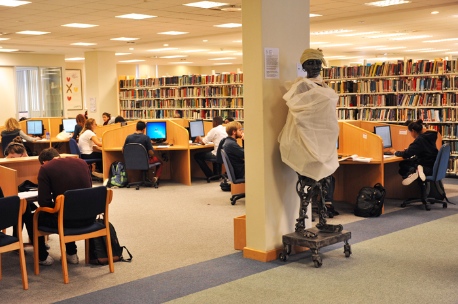
Willie Bester's tribute to Saartjie Baartman in UCT’s Chancellor Oppenheimer Library, cloaked by protesting students. Image source: UCT Newsroom.
The student protests also added impetus to another University Task Team that the APC and the CCA have spent over two years lobbying actively to establish, until recently without effect, viz. a Collections and Stewardship Policy Task Team. This Task Team was finally convened in April this year – like the Artworks Task team, probably stimulated by developments around #RhodesMustFall.
In relation to this exercise, the APC argued that the wider university archive (embracing everything from documentary archives through to collections of medical specimens) can no longer be treated as though it is simply a storehouse of neutral source material. Rather, the APC argues, it is a body of material laid down over an extended period in a manner shaped by the knowledge conventions, practices, and socio-cultural values that prevailed at the various moments of acquisition and preservation.
Recognition of this point within the university places a premium on critical consideration of the orientations, biases, omissions and gaps in the collections, the purpose for which each was formed, how collections have changed over time, as well as of the nature of their curation at the university. This focuses a lens on the ways in which disciplines make their archives and how their archives, in turn, give shape to the disciplines. Such an approach offers insights into the constitution of knowledge, and inspiration for efforts to decolonise the curriculum.
Also in 2015, APC History student, Rehana Odendaal, commenced her Masters research on the role of the university in public life and the meaning of its identification as “public”. Odendaal proposes to historicise the role of the South African university, examining the evolving physical, symbolic and epistemological landscapes of the university and looking at protest as a measure of interaction between university structures and agents. The thesis promises to make a timely contribution to the shifting university landscape in South Africa. The theses of Bloch, van Rensburg and Odendaal are but examples of a larger body of work being undertaken by our students that reflects on university practices, and indeed, on a host of practices involving archive beyond the academy.
The third front on which the APC experienced significant gains in relation to university and curriculum transformation concerns research into the much neglected past before European colonialism. In the course of the call for substantial curriculum changes that accompanied the #RhodesMustFall campaign, students demanded more “pre-colonial history” (see, for example, the lead article, “Curriculum Transformation” by Aisha A. Karim in Varsity, 12 May 2015). In 2011, this was identified by the APC as an area urgently in need of attention. Since then, the APC has invested in a range of projects designed to stimulate research into the long southern African past before European colonialism.
These include the Five Hundred Year Archive project launched in mid-2013, and dedicated to demonstrating that it is possible to develop an archive for this period of history, a period for so long deemed to be archiveless. This project has negotiated multiple institutional partnerships, digitised an exciting range of materials and is now entering the final phase of making all of this material available in the form of an online archival exemplar. We anticipate that this will give a tremendous boost to both the academic study of and lay enquiry into the past before European colonialism, and hopefully inspire and enable further archiving.
In July 2015, in an effort to stimulate research and enquiry into the long past, the APC, together with Dr. Bodhisattva Kar (History, UCT), organised a colloquium with the title “IZITHUNGUTHU: Southern African Pasts before the Colonial Era, Their Archives and Their Ongoing Present/ Presence.” The colloquium set itself the challenge of responding to the fundamental dilemma captured by the term pre-colonial: the idea that the deeper past makes sense only in relation to the colonial, can only be viewed through the lenses first provided by colonial knowledge practices, and that it is condemned to be understood only in terms of its putative opposition to and irreconcilability with the colonial.
Participants were encouraged to reflect critically and self-consciously on the history and geopolitics of their methods, on the limits and possibilities of their disciplinary inheritances, and on the contingency and ethical horizons of their analytical techniques. The long past emerged in the colloquium as an ongoing, contested and collective process of production, which involves professional as well as popular skills, which responds to, but also involves more than the claims of the contemporary.
Rather than being a gathering of specialists of one period or place seeking to establish with authority what happened in the past, the aim of the colloquium was to think carefully about what might be done now to make it possible for future generations to conduct productive scholarly research into the past as well as to undertake general public enquiry, and to engage with this past’s legacies in the present.
The colloquium laid the groundwork for a new era of investigation into the long past. In 2016 the APC will seek to promote and extend research in this area.
2015 also saw the launch of volume six of one of the most important bodies of source material pertinent to the late independent period, The James Stuart Archive of Recorded Oral Evidence Relating to the History of the Zulu and Neighbouring Peoples, (Pietermaritzburg: University of KwaZulu-Natal Press, 2014), translated, edited and annotated by APC research associate, John Wright. Wright and APC researcher Mbongiseni Buthelezi further commenced work this year on volume seven, devoted to the praise poetry recorded by Stuart.
Another major project by the APC in this area, the large volume (21 essays) Tribing and Untribing the Archive: Critical Enquiries into the Constituting and Conceptualising of the Material Record of Late Independent and Early Colonial Southern KwaZulu-Natal, edited by Carolyn Hamilton and Nessa Leibhammer, was finally put to bed with the publisher, the University of KwaZulu-Natal Press, and is due for publication in the very near future.
Throughout the year, APC researchers presented further papers on a variety of topics relevant to the past before European colonialism, signalling thus the extent of the renewal of research energies in this long neglected area.
Beyond the university, the kind of activism that the APC fosters gained increased traction in the rapidly changing and fluid political conditions of 2015.
A landmark public intervention was the weighty State of the Archive Report, launched this year by the Archival Platform, a joint APC-Nelson Mandela Foundation project. This report, a ringing indictment of the collapsing National Archival System, has received a great deal of media and professional attention, and its findings have been actively taken up by the relevant parliamentary portfolio committee.
The Archival Platform has also commenced work on a companion volume, the State of Archival Activism Report. Between them, the two reports set out the case for the role of the archive in contemporary South African public and political life. The Platform has further conducted a number of Dialogue Forums across the country on matters pertinent to archives, records and the operation of democracy and social justice, as well as on the implications of the State of the Archive Report.
APC researcher Mbongiseni Buthelezi also participated centrally in the Mandela Dialogues on Transitional Justice and Memory Work, travelling to Germany, Bosnia and Croatia to discuss questions of the ongoing presences of the past in public life in those places. Back in South Africa, Buthelezi’s direct contributions have focused the ways in which ideas about the pre-colonial past are mobilised in contemporary situations, notably in land and chiefship claims.
In all of these areas, APC work is geared to the long term and to serious scholarly investment in alternative methods, new theories and radical reconceptualisations. The work undertaken focuses centrally and crucially on the mutual constitution and reconstitution, across time, of archives and academic, political and public practices and discourses. It finds multiple points of connection into contemporary academic and political debates, such that the papers prepared for the APC’s regular twice-yearly research development workshops this year spoke directly to tumultuous events unfolding around them.