
Doctoral researchers Thokozani Mhlambi and Susana Molinas Lliteras graduate
The APC extends warmest congratulations to APC doctoral student, Thokozani Mhlambi, and APC research fellow, Susana Molinas Lliteras, on the successful award of their PhDs.
The impulse for Thokozani Mhlambi’s thesis, “Early Radio Broadcasting in South Africa: Culture, Modernity and Technology” came from a childhood fascination: the sounds of radio in Zulu pouring out of his mother’s bedroom window or from taxis passing by as he played outside.
The thesis tells the story of how radio broadcasting came about in South Africa, and how broadcasting was extended to include black audiences during the Second World War. The segregated state in South Africa used radio to reach black people for recruitment in the war.
But radio became more than just that. Mhlambi shows how it inspired creative genres of izibongo (praise poetry) and boosted the recording of African voices in song and music. Radio became the main driver of local public culture in indigenous languages. Mhlambi shows the contributions of black South Africans made to early communication technology as well as in shaping a South African ‘modern’ past. As he notes, “The ability to tell our own stories and to own them can lift the haze of apartheid that tried to define the totality of that reality.”
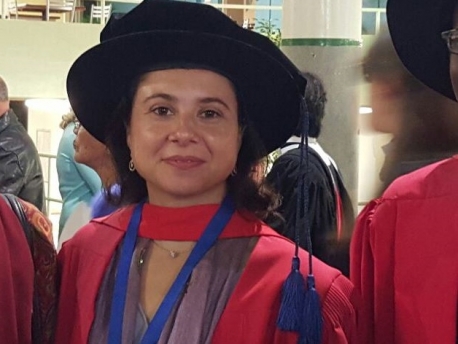
Susana Molinas Lliteras at graduation
Susana Molinas Lliteras’ thesis, “’Africa starts in the Pyrenees:’ The Fondo Kati, between al-Andalus and Timbuktu,” presents a biography of the Fondo Kati archive. One of the many private family libraries that have surfaced in Timbuktu in recent years, this archive has positioned itself apart from other libraries due to its claim to a unique historical heritage linked to al-Andalus.
Analysing both oral material, but especially the written marginalia found on the manuscripts of the collection—up to now unavailable and unstudied by scholars—her study treats the Fondo Kati itself as a historical subject, examining both its conditions of production as well as how its existence has in turn affected the context in which it finds itself.
The Fondo Kati archive as it currently stands was fashioned according to the vision of its director, Ismael Diadié Haidara. It is built upon two cornerstones: the genealogical project—the claim to uninterrupted “originally” Spanish or Visigothic ancestry for the Kati family—and the project of the marginalia—the archive as a family collection, built by generations of family members, each adding manuscripts and marginalia to the collection.
The fundamental imbrication of the oral and the written in the Fondo Kati, represented by the repeated appeal to the genealogy of the Kati family as a source of differentiation and its marginalia as written “evidence,” are also the central features of the Fondo Kati that propelled the successful reception and circulation of the collection in present-day Spain.
The dissertation also raises questions around the authenticity of the marginalia, in terms of their dates of production and authorship. It concludes that, ultimately, these concerns in the Fondo Kati are about historical evidence, about providing textual, written proofs of a past, that may or may not have had existed, or existed only in oral family traditions. The Fondo Kati is a perfect example of how knowledge is constructed, of a researcher’s intrinsically partial access to the past. In the final instance, the very act of construction of the Kati collection is an active intervention in the production of history.