
Concepts from the Global South
John Wright and Cynthia Kros
This was the title of a conference organized by the Centre for Indian Studies in Africa (CISA), University of the Witwatersrand, and held at the Johannesburg Institute for Advanced Study on 21-23 October 2016. Cynthia Kros (History Workshop, University of the Witwatersrand) and John Wright (a research associate in the APC) give their views.
Words in motion
Professor Dilip Menon, Director of CISA, is a historian with a driving interest in challenging Western modes of thinking about the world, past and present, by confronting them with modes of thinking rooted in the experiences of people who live, or have lived, in Asia, Africa, and Latin America. His specific purpose in holding this conference was to address issues of knowledgemaking that lie at the heart of current debates about ‘decolonisation’ in South Africa. To this end, potential participants were invited to choose a specific word or a specific concept, and engage with its historically-made meanings in a way that would facilitate more general theorizing about what it might mean to think about ‘concepts from the global south’. Two professional musicians were also invited with the aim of providing conference-goers with the opportunity to engage with the idea of performance as knowledge-making.
In the event, 17 individuals made 16 presentations. Papers had not been pre-circulated; each was presented and discussed in an hour-long session. Seven of the participants were academics/ performers from abroad, another seven were academics from abroad working in South Africa, and three were academics/performers from South Africa. Four others, including three from South Africa, were on the programme but were ultimately unable to participate. Eight of the academics present were historians, three were anthropologists, two were political scientists, and one each a philosopher and an artist. Six of the presentations focussed on topics dealing with facets of making knowledges in India, three with South Africa, and one each with Africa in general, West Africa, East Africa, China, the Caribbean, and Europe.
We are writing this report while mindful of the APC’s fundamental notion of the archive, that is, a collection of materials deemed to be about the past, as always being in a process of change, and of the recent glimpses that we, as historians, have caught of how much may be yielded by embracing this idea. The ‘Concepts of the Global South’ conference encouraged us to consider some of the recesses of the archive where historians commonly do not go, and to engage more fully with its recalcitrant and coded stories in ways that we are beginning to adopt in our own work. Our coverage of this conference cannot be comprehensive; we have chosen to discuss those presentations that seemed to offer access to the kind of new knowledge-making suggested by the title and by the logo of a Chinese compass on the conference poster, which provocatively reorient attention away from ‘global concepts’ shaped in the ‘North’ to those shaped in the ‘South’. They were presentations that we felt added to our notions of what we are trying to do in our own work, and which made us feel that we have company in our endeavour.
In opening the conference, Professor Menon explained that one of the scheduled speakers, Magid Shihade from Birzeit University in Palestine, had been unable to catch his scheduled departure flight after being delayed at three separate checkpoints. Invoking the rubric of ‘Words in motion’ from the title of the book, edited by Carol Gluck and Anna Tsing, Words in Motion: Toward a Global Lexicon (Duke University Press, 2009), Menon suggested that the notion of ‘checkpoint’ might be adopted as the conference metaphor. What is it, he asked, that enables some words and concepts—like ‘sublime’ or ‘security’—to travel across time and space, while others are held up at a checkpoint and are prevented from travelling? It seems that even the ‘southern’ words that are granted the right to travel, like ‘ubuntu’, ‘jihad’ or ‘fatwa’, owe their mobility to the ease with which they can be made to encapsulate Western racial stereotypes.
This idea of words having to make their way through checkpoints suggests the bifurcation of the world into Global North and South. But at the same time Menon and some of the other participants were at pains to remind us that this conception of the world is an artificial one that owes its current formulation to the end of the Cold War. Menon warned against thinking that the Global South was a place. Through the deliberate choice of a word associated with a transgressive assault on purity, he emphasized
that ours is a ‘miscegenated’ world. We are still grappling with how to avoid reproducing the binaries of North and South.
The keynote presentation was made by Peter Park (University of Texas, Dallas) on the topic ‘The transatlantic trade in racist ideas: How West Indian planters underwrote Kantian historiography of philosophy’. He aimed to show up the lineages of racist thinking among European philosophers in the late 18th century, when Kant’s notion of philosophy as a rational science of quintessences was being actively disseminated by his acolytes. The idea of reason was more and more being defined as what distinguished European thought from the thinking of people in other regions of the world. In this period European philosophers for the first time began to argue that, while Asians and Africans might have religion, they did not have what could be called philosophy because their ways of knowing were contaminated with passion or spirituality or other kinds of sentimental impediments. Thus the Europeans denied traditions of Asian and African thinking that had previously travelled widely in European intellectual circles.
This shift tied in with the development of theories of racial hierarchies among European intellectuals. They were drawing in part on ideas articulated by earlier philosophers like David Hume (1711–1776), and in part on the ideas of writers like Edward Long (1734–1813), who came from a family of Jamaican slave-owners. Park’s argument was that in this sphere colonial-made ideas were much more influential in Europe than has generally been recognized, particularly through the work of Kantian philosophers. From this perspective, the colonies themselves can be seen as metropoles of thinking about race.
Raj and Naam
‘Raj’ is a Hindi word, William Pinch (Wesleyan University) told us in his (untitled) presentation, that has travelled extensively into contemporary popular understandings of colonial India. It is the root of numerous north Indian terms relating to politics—raj (realm, kingdom), raja (king), rajas (sovereignty), rajasi (imperial, majestic)—and is also associated with several virtues or vices that might be ascribed to the characters of rulers or successive regimes, for example, ‘harmony’, or, alternatively ‘lethargy’ and ‘disorder’. Pinch took us along part of the convoluted path this word has taken through texts that might appear to be wildly disparate, such as Gandhi’s famous disquisition on self-rule, Hind Swaraj, and Rudyard Kipling’s novel Kim, which ends with the eponymous protagonist having to choose between a career in the British civil service and the way of the ascetic priest whom he has come to revere.
‘Raj’ seems to have passed through a number of Western-made checkpoints and to have entered the European canon of concepts with ease. It is one of the Hindi tropes in Kim which were already familiar to British readers. ‘Raj’ is a word that has been on the move for a very long time; in the past it was associated with rebellion and resistance to forms of foreign control, often through the figure of the ascetic warrior. The relationship between the self-renunciation demanded by asceticism and political (or military) power is one that was frequently explored in Indian literature, perhaps resurfacing in Hind Swaraj.
What does the notion of ‘raj’ offer us as scholars? Here Pinch urged caution for we run the risk of thinking that we have found the ‘native concept’, in this case, of political/military asceticism that can explain Indian behaviour. He made a subtle but vital distinction between this essentializing orientalist approach and a more productive one that regards ‘raj’ as a tool that helps us better understand works of Indian literature and Indian political movements.
Also dealing with the qualities associated with ruling groups was the presentation given by Amy Niang (CISA) on ‘Naam: Mossi political ontology and the mediation of legitimacy’. Naam was the ideology that justified the rule of the Mossi who, as Niang sees it, were able to spread their authority across what is now Burkina Faso through cloning their model of the state. Naam, she told us, was a ‘technology of power’, but it connoted an essence possessed only by Mossi, and resists analysis through the categories and explanations of conventional (‘Western’) political science. Its primary objective was to control Tenga, the realm of ‘first settlers’. Every Mossi ruler was obliged to go on an annual ritual journey to obtain the permission of the Tenga earth divinity to retain his sovereign position. Ironically, Niang noted, Mossi rule depended on their acceptance of, and deference to, the gods of
their subjects. Thus, we may conclude, the Mossi were obliged to borrow spiritual resources from Tenga to assert fundamental ideas about what the Mossi identity was about.
Kavya and poonjivaad
Shonaleeka Kaul (Jawaharlal Nehru University, New Delhi), spoke on ‘Kavi/kavya: The poetcreator and history in early India’. Kavya is a highly aesthetic form of poetry and prose that was composed, mostly in Sanskrit, in the courts of Indian kings in the first millennium CE. Influenced by Rankean positivist notions of what history is, and by 19th-century imperialist notions that Indian people did not have a sense of history, most Western scholars have seen it as ‘literature’ rather than as ‘history’. Kaul argues by contrast that the kavi, or Sanskrit poets, ‘may have conceived of kavya as in fact the ideal vehicle for composing history’. Invoking Hayden White’s ideas of history as a form of literary writing, she sees the vision of history found in the kavya as set forth not in empirical statements but in the figurative devices of rhetoric, myth, and didacticism. The kavi is the one with intuitive vision who sees the realities of the world. His (were any composers women?) vision is not merely metaphysical but strongly political, even if it is articulated in highly figurative and ornate language. His work is to create an observable past through which to instruct the present. He has usually been described as a court poet, but it is more useful to see him as an intellectual who invokes an ornamented past to say things that society, including the king, may not want to hear.
Another form of history-as-art or art-as-history that draws on complex lineages of ideas was discussed by David Szanton (CISA) in his presentation ‘Poonjivaad: Muthila paintings from Bihar and visual sources of theory from the global south’. Since at least the 14th century, women in Bihar in north-eastern India have painted Hindu gods and goddesses on the interior walls of their houses in the enactment of social rituals, especially the rituals of marriage. Most of these paintings, it seems, did not survive for more than a few seasons of monsoon rains. This form of art first came to wider public notice in the 1930s through the photography of a civil servant named William Archer. In recent times, growing numbers of women in villages in the Mithila region have been drawing on these art forms to make paintings that raise penetrating questions about present-day patriarchy, gender relations, and the still deeply constrained position of rural women in India. Since the 1960s, paintings of this kind have increasingly become objects of desire in both Indian and international markets, and have in many ways changed in response. Szanton’s focus was on highly original paintings of the main Hindu deities that are being made by a young artist called Shalinee Kumari of the Indian Institute of Technology in Hyderabad, who is billed as co-author of the paper which he discussed. She is making these paintings to mount a sharp critique of capitalism (poonjivaad) in India today. The images that she produces are shaped in part by her viewing of surviving wall paintings and in part by ideas about the present which come from her own experiences as a young woman, from conversations with friends, and from listening to the BBC.
Creolization and fusion
Notions of ‘cultural mixing’ were critically discussed by Aaron Kamugisha (University of the West Indies) in a presentation titled ‘Creolization: the complicity of culture and elite domination in the Caribbean’. The notion of creolization, in his view, has emerged as the most significant single concept to have come out of Caribbean cultural thought. As a loose theory of multiculturalism, it has framed debates about race and racism in the Caribbean over the last 40 years. In Kamugisha’s view it is an advance on earlier ideas of the Caribbean as a place of ‘cultural pluralism’, but is unsatisfactory for its focus on ‘blacks’ and ‘whites’ as the primary actors in the region’s history, and racial and cultural ‘mixing’ as its prime theme. It is at bottom a bourgeois notion that is unable to engage with the changing class positions of social groups or explain continuing domination of society by colonial-produced elites. In addition, the notion of creolization leads to the position where historians of all shades write the indigenous people of the Caribbean out of history because they don’t fit into its racial and cultural categories. Kamugisha’s approach is to work to dismantle the notion rather than trying to think it further.
Coming at the notion of cultural mixing from a very different starting-point was Rahul Ram’s contribution, titled ‘Folk/cosmopolitan: genre and performance from the global South’. Ram (who has a PhD in toxicology) has played bass guitar and sung since 1991 in a widely-famed band called ‘Indian Ocean’. The article on the band in Wikipedia describes its music as ‘fusion rock’ and ‘jazz fusion’, but the notion of ‘fusion’, in Ram’s view, is an essentially Western one that he rejects as so wide as to be meaningless. In a thoughtful spoken presentation, interspersed with clips of stunningly beautiful compositions by the band, he discussed the group’s journey through different genres that have combined Indian folk music, non-religious spiritual music, and songs of protest in a notably cosmopolitan style. As he put it, ‘conventional labels like “fusion” and “world music” fail to do justice to the cumulative cosmopolitanism of contemporary Indian music, the fact that it is at home in the world on its own terms’, even if, as he acknowledged, his band cannot escape the push and pull of Westerncentred market forces.
Words from Africa
Focusing on the journey of a single word, Edgar Taylor (CISA) spoke on the Luganda notion of eddembe, broadly meaning ‘freedom’, which became a popular slogan among supporters of the Buganda-based Uganda National Movement (UNM) in the late 1950s. The thrust of his presentation, simple titled ‘Eddembe’ was that the word carried different meanings for different groupings within the movement. Its leaders, aspiring as they were to play a role in postdecolonization national politics, portrayed it as meaning freedom from colonial rule. Many rankand-file supporters, on the other hand, saw it as meaning the restoration of the Buganda monarch (deposed by the British colonial government in 1953) and of the monarchy’s networks of patronage. The word became ‘a terrain of struggle over power and norms of urban sociality’ and what the political future should look like.
Our own presentation, titled ‘Isithunguthu— one who knows but is made to forget’, sought to give wider academic publicity to the littleknown isiZulu word isithunguthu, meaning a knowledgeable person whose knowledge is broken down and effaced in processes of cross-examination by authority figures. The word came to JW’s notice in 2013 when he was reading notes made in 1903 by Natal colonial official James Stuart of a conversation on the past with one of his interlocutors, an 89-year-old man named Thununu kaNonjiya. It was widely enough known at the time to make its way into the fourth edition of Colenso’s Zulu-English Dictionary, published in 1905, but afterwards seems to have sunk out of sight. It does not appear in later isiZulu dictionaries and is not known today among isiZulu-speaking academics whom we have consulted.
In our paper we describe how, in 2013-15, the word was rediscovered and launched into academic circulation. We then go on to discuss how a close reading of the published text of Stuart’s notes enables us to understand more of the precise discursive context in which the word came to be uttered and recorded, and hence to understand something of its resonances at the time.
The conference has enabled us to think about our paper from new angles. It has encouraged us to think of isithunguthu as a word in motion, travelling in time and space. We think of the track that it followed, and of what checkpoints it might have encountered, checkpoints which ultimately seem to have blocked its journey for a long while. Now that it has been rediscovered, will it resume its journey, and where will it go? Or is it journeys in the plural, that of the spoken word and that of the written word, perhaps intertwined?
The conference has also encouraged us to think further about the idea of how the archive of the past grows and changes—and perhaps reveals parts of itself that we have not seen before as we try to follow the paths taken by words like isithunguthu. While participants in the conference seemed generally attuned to the notion of words and concepts in motion, they were less attuned to the idea of the archive in motion. Thus, in place of critical historical analysis of pertinent lineages of ideas about the past, loaded Western terms like ‘traditional’ and ‘ancient’ continued to do duty in some of the presentations made to the conference. The danger is that words of this kind can be mobilized to serve at checkpoints which obstruct the movement of words and concepts deemed by the ‘authorities’ to be unwelcome immigrants.
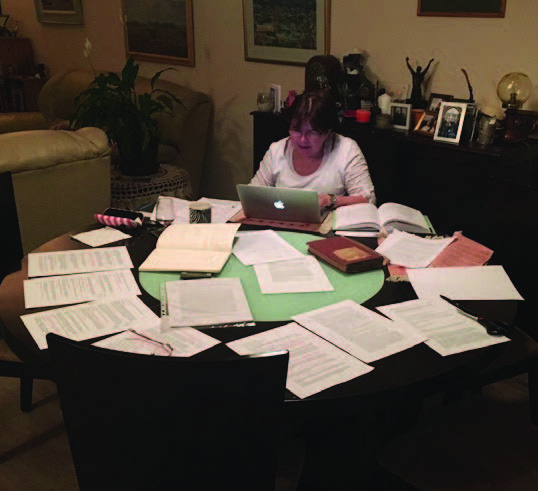
Historian in full cry. Cynthia Kros at work on her and
John Wright’s paper on Isithunguthu.
Photo: Alan Mabin
*
Presentations not addressed in this report are listed below. All of them gave rise to lively discussion at the conference.
Manuela Ciotti (University of Aarhus), ‘Biennale: Looking for the Global South at the KochiMuziris Biennale’
Edwin Etieyibo (Wits), ‘The “relativity” of logic’
Raimi Gbadamosi (University of Pretoria), ‘Art in the Global South: What do we need to see?’
Neo Muyanga (independent musician), ‘Revolting mass—a programme note’
Saul Thomas (University of Chicago), ‘Minzu: The concept of “nation” and its transformations in twentieth century China’
Kaveh Yazdani (CISA), ‘Dadani: Indian vs. European forms of organizing economic production’