
Duane Jethro’s Research Tour to Buenos Aires

ESMA
APC post-doctoral fellow Duane Jethro went on a short research tour to Buenos Aires Argentina in late August 2016, visiting sites of memory associated with the military dictatorship between 1976 and 1983. During this time, an estimated thirty thousand students, activists, intellectuals, labourers and ordinary citizens were kidnapped, tortured and then disposed of through death flights over the Atlantic Ocean or mass graves. These victims are known as the desaparicidos or the disappeared. Clandestine centres such as the ESMA have been turned into sites of memory. Today because of the repeals of what are known as impunity laws granted in the late 1980’s, charges have been brought against military, police and navy personnel who were involved in these crimes. Evidence gathered at these sites of memory are used to support the testimony of survivors to break the junta’s code of silence and secure justice. The sites visited during this visited were some of the major ones clustered in and around Buenos Aires.
Parque de la Memoria
The Parque de la Memoria remembrance park came about as a result of the agitation of human rights organisations and relatives of the disappeared like the Madres de Plaza de Mayo Escuela de Mecanica de la Armada. Photo: Duane Jethro for a symbolic place of memory. A public space on the bank of the Rio de la Plata River at the edge of Buenos Aires, the Parque de La Memoria is comprised of three elements: a sculpture park, an exhibition centre and a wall of names. Around ten of the planned series of sculptures have been installed on the site. All have been conceived by individual artists with a vested interest in, and who reflect upon, questions of human rights violation, truth, justice, violence and memory.
The main element of the park is the Wall of Names. Angular, cast in stark stone, the Wall of Names tracks a jagged path up a green embankment between sculpture works. The Wall of Names documents the names of the roughly thirty thousand victims of state terror. The names are chronologically ordered and alphabetized, with blank panels dotted in between, indicating the still nameless victims of state terror. Cutting across the park embankment at awkward angles, the Wall of Names is meant to symbolise an open wound in the national body politic.
What is particularly striking about the park is its setting. The lapping brown water of the Rio de La Plata makes for an eerie shifting backdrop that unceasingly recalls the watery grave of many of the disappeared. Situated near the Newberry International airport, the sight of commercial airplanes coming in, engines screaming for landing are a further reminder of this traumatic history. This mis-en-scene creates an unsettling sense-scape of trauma, of unfinishedness, that greatly amplifies the symbolism of the site.
The third element of the Park is the meeting and exhibition space. It plays host to a series of temporary exhibitions, which, at the time, showcased the work of Lola Rojas. Featuring a video art exhibit where Argentinians affected by state policies read out

Parque de la Memoria.
Photo: Duane Jethro
emergency presidential speeches, but also revolutionary karaoke booth where visitors are invited to sing along to lyrics of protest songs sung by human rights groups, the work was punctuated by parody, humour and fun.
Ex-ESMA
During the period of forced repression, the Navy Petty-Officer’s School of Mechanics, or exESMA, was a major site of clandestine detention and torture. Situated in a busy part of uptown Buenos Aires this sprawling training ground for non-commissioned officers doubled as a centre of detention and torture of activists and intellectuals suspected of being enemies of the junta. The officers’ quarters were modified to accommodate the detention of illegally apprehended activists. The conventional business of the building was conducted on the ground, first and second floors, while the clandestine work was conducted in the attic, the main hall, and the basement. The basement of the building housed the torture and interrogation rooms, while the attic was converted into a holding station for activists brought in for interrogation.
According to the testimony of naval officer, Adolfo Francisco Scilingo, activists were loaded on to trucks every Wednesday from 1977 to 1978, for the transfer—code for death and disposal. They were driven to the nearby Newbury airport, given a sedative shot by a naval doctor, flown out either over the Atlantic Ocean or the Rio de la Plata River, stripped and pushed out of the plane.
After the fall of the junta, the training grounds were eventually abandoned by the navy and the plot ceded back to the Buenos Aires City authorities. At one point president Carlos Menem proposed to demolish the campus and turn it into a peace park of sorts, which was roundly rejected by Human Rights Groups who wanted the violations investigated. In 2004 the campus was reclaimed by the Argentine state, renamed the Space for Memory and for the Promotion and Defence of Human Rights, and ceded over to human rights groups for use in defending human rights. Some of the buildings like the officers’ house, have been converted into a museum for telling the story of the disappeared. It is important to note that this building, and other sites of memory like it, are sites of ongoing Parque de la Memoria. Photo: Duane Jethro investigation as evidence gathered here is used in the trials against for naval officers accused of being involved in human rights violations.
Club Atlético
I was very lucky to engage with the researchers Ricardo Andreu and Silvina Durán, members of the interdisciplinary work team of the Site of Memory “Club Atlético”. They took time to meet with me and explain the significance of the site, and their research to me. Most of my understanding of this site of memory is pieced together from the bits I read before online and the account these researchers provided.
At the edge of San Telmo, a famous historic quarter of Buenos Aires, is an ongoing site of archaeological investigation. For a period of ten months in 1977, a police administration building known then as Club Atlético, which was code for Centre for Anti-Subservient Suppression, operated as a clandestine site of torture and detention run by the Argentine police under the command of the Army. The site was abandoned on 28th December of 1977 to make way for the 25 May Highway. Ironically the roadway is named after the May 1810 revolution of independence. The building was bulldozed and the highway built over it, leaving the cityscape bereft of any visible trace of human rights violations. Today, the site is a crossing point for about ten lanes of traffic overhead and at the street level, making it an unusually smoky, noisy, urban setting for a powerful site of memory.
Survivors of the site pieced together their memories, drew a memory map of the place they had been held at and eventually worked out the location of the building. In the late 1990’s they gathered to mark out the place where they had been tortured and where their companeros had been detained and killed. They mounted cut out silhouettes of figures on one of the overpass pillars as a symbol of those who had been disappeared. The construction would be known as the totem, a beam of silhouettes marking out the place and the people who had been disappeared and who were now recognised as having been disappeared. That task of visibilization was made together with human rights and neighbourhood organizations. They argued for the excavation of the site.
In 2002, Buenos Aires authorities initiated the archaeological excavation of the site as part of a local investigation into state terror. Archaeologists were brought to the site and working with a memory map drawn by survivors, excavation of the site began. The dig continues to this day. Archaeological material culture recovered here by forensic archaeologists is used to support the testimony of survivors in trials against former police officers.
Later an information point and memorial were constructed on the other side of the highway underpass, making the Club Atlético a heritage complex.
At the present moment, the team working at the site have a small exhibition space where some of this material is displayed. As they meticulously explained to me, from gravestones, ping-pong balls, to items of clothing and printing blocks, the smallest pieces of material culture were used to support and corroborate the testimony of survivors and the pursuit of justice. With ongoing excavation of memory and archaeological material brings greater hope that sooner rather than later justice will be served.
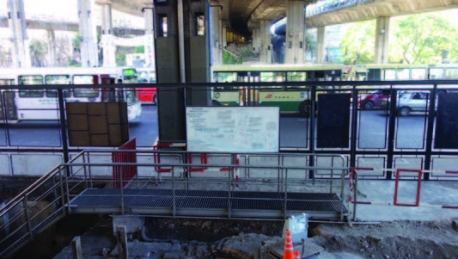
Club Atlético.
Photo: Duane Jethro