
Posted on February 14, 2011
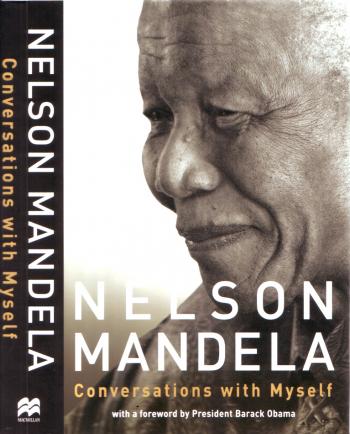
Conversations with Myself is divided into four parts each carrying a title drawn from classical modes, forms and genres - pastoral, dramatic, epic and tragicomic. In the first part, documenting his childhood and early school days, he discusses how his interest in indigenous history and belief in collective effort were shaped by his rural Xhosa background. He recalls the childish games he used to play as a young boy with other boys as they herded sheep and calves, taunting young girls who passed by. His rebellious nature, which he claims coloured much of his youth, guided him to abandon a position of chieftaincy in his native Thembuland in order to escape a forced marriage. In a letter to Fatima Meer, describing himself as 'a mediocre man in the proper sense of the term,'(7) his humility emerges as a trait which was performed instead of adopted as an empty posture of modesty.
The second part, titled 'Drama', explores a tumultuous period of freedom in his life, during which he joined the ANC, fell in love and got sentenced to life in prison at the Rivonia trial. This episode of his life, marked by economic hardship, was alleviated by the wide company of friends he enjoyed. He remembers telling Ruth First 'to go to hell'(55) in an argument and apologising later because he respected her opinion and brilliance. In a discussion with his biographer, Richard Stengel, he talks of how 'he never wished to play the role of martyr but was ready to do so if I had to'(124). The heroics of this statement take an honest turn when he later talks of how his desire to live remained. 'Epic' is the title of the third book and it reads like prison literature, with his personal notes and letters to wife and children tinged with grief and guilt over his putting the struggle before their well-being. In Long Walk to Freedom, he briefly described how his youngest daughter, Zindzi, accused him of being a father to a nation but not hers. In Conversations With Myself he writes of the invisible wound his decision to put the welfare of millions before his own family caused. This pain was intensified by the death of his mother and his son from his first marriage to Evelyn Mase. His release and the victory of the ANC in the final book, titled 'Tragicomedy' plunged his note-making into long lists documenting his political and economic plans to alleviate the burden of the oppressed masses. Mandela appears in this part of life, to assume the position of diplomat with his own peculiar mixture of surprise and humbleness at meeting masses who admired him and his cause.
Throughout the explorations of his life recounted in all four books, we are reminded that underneath his very public history of victory over oppression, hope over fear, is weakness; a condition common to all of humanity, a condition highlighting the ordinariness of the person behind the myth. This realization is heightened when we consider that these recollections were not kept with the public in mind but rather formed part of his life. In a draft of his unpublished sequel to his autobiography, Mandela describes how he falls below 'the earthly definition of a saint as a sinner who keeps on trying.'Â This statement is the keystone to the project of personalising Mandela and distancing him from his identity as a saint, yet it achieves precisely what it negates. Mandela's affirmation of his humanity and weakness only serves to highlight the unusual nature of his sacrifice and forgiveness; they mark him as a contemporary Messiah who was prone to the mood swings of humanity but overcame these in the right moments in order to put the well being of others before him. Whether this autobiography succeeds or fails to defrock Mandela of his sainthood is secondary to its ability to focus a wider lens on the self of Mandela, leaving the reader to decide if to judge him human or divine.
Nelson Mandela, Conversations With Myself was published by Macmillan, an imprint of Pan Macmillan in 2010
Busi Mnguni is a postgraduate student in the Department of Philosophy at the University of Cape Town.