

100UP is a UCT initiative addressing the problem of demographic under-representation in higher education by targeting school learners from disadvantaged backgrounds and coaching them towards university access. The holistic programme strives to build intellectual, social and cultural capital. Learners are prepared and coached over a period of three years by staff and students across the university, working off the key belief that opportunity needs to be made more equal and inclusive.

The pilot project started in 2011 in Khayelitsha, with five Grade 10 learners identified from each of the 20 high schools in the area, i.e. 5 x 20 = 100UP. The project soon ran at capacity, with a total of 300 learners (100 per Grades 10 – 12) per year, enrolled in the programme.
The 100UP Impact Report 2025

UCT’S 100UP PROGRAMME impacts communities and families, one student at a time. To bridge the gap between underrepresented communities and higher education, the University of Cape Town (UCT) launched the 100UP programme.
The programme emerged from a realisation that despite being close to UCT, many Khayelitsha schools had little to no representation at the institution. “UCT has been keenly aware for many years now that its footprint in local communities is very, very narrow,” explained Ferial Parker, project manager of the 100UP programme. “Because Khayelitsha is a geographically contained community, it seemed like a good place to pilot this initiative.” Designed to support academically promising students from Khayelitsha, Mitchell’s Plain, and Philipi, this pioneering initiative has successfully guided more than 1,000 learners towards higher education.
The 100UP programme began as a pilot project in 2011, identifying five academically strong Grade 10 learners from each of the 20 high schools in Khayelitsha - hence the name, 100UP. The programme quickly reached capacity, supporting 300 learners annually across Grades 10 to 12. To further expand its reach, an additional group of Grade 12 learners, branded the GILL NET group, is onboarded after June each year, extending further support to matric learners from all 20 Khayelitsha schools, as well as from the 16 schools in Mitchell’s Plain. In 2020, 100UP expanded to Philippi, including top-performing matriculants from five high schools in this underserved community.
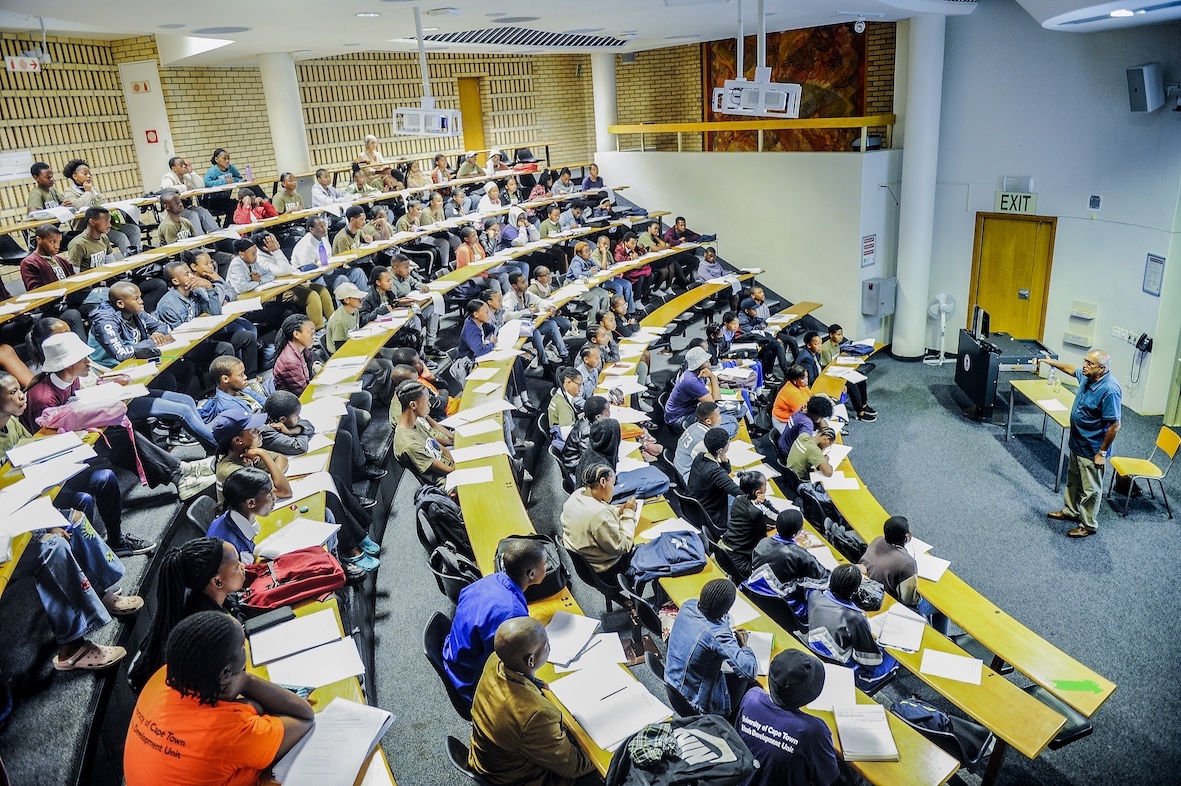
The programme includes residential camps, exposure to UCT activities through its enrichment component, and a weekly Saturday school which focuses on mathematics, sciences and language.
An additional group of ‘university potential’ Grade 12 learners, branded the GILL NET group, is brought on board after June each year in order to extend our reach as broadly as possible across the 20 Khayelitsha schools, as well as, from the16 high schools in Mitchell’s Plain. By 2020, the project has expanded to Philippi, including academically strong learners from the 5 high schools in this under-served community.
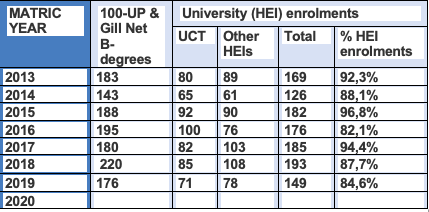
Since then, in excess of 1000 learners have participated in the programme. Their performance in the project demonstrates the success of this pioneering UCT intervention. More than 85% of project learners have obtained B-degree passes and over 80% have secured access and are completing studies at a Higher Educational Institution (statistics at end of 2020). Matriculants are encouraged to pursue degrees in all fields of study at UCT or at any other university in South Africa. A longer-term objective is to use 100UP to build institutional knowledge and experience that can better inform the university’s bridging programmes and school-based interventions.
In addition to 100UP, the SDU has launched 100UP+(PLUS), which provides ongoing support to 100UP students who are accepted into UCT. This support is critical for ensuring students succeed at their studies and have a positive learning experience. 100UP+ students at UCT participate actively in mentoring their high school counterparts and have proven to be an invaluable source to the project.
The success of the project can be ascribed to the productive collaboration between the SDU project team, UCT faculties and departmental staff, and UCT student bodies that are committed about redress and transformation.
Project Impact

100Up is only possible with the help given by:
- All 6 faculties at UCT
- UCT Careers Services
- UCT undergraduate financial aid
- UCT accommodation office