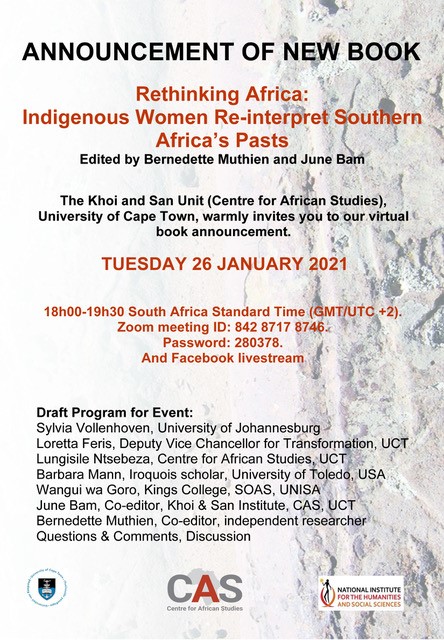
The book, funded by the NIHSS, is now available for pre-order via Jacana Media.
About the Book:
This book critically opens new pathways for de-colonial scholarship and the reclamation of indigenous self-definition by women scholars. Indigenous peoples around the world are often socially and gender egalitarian, matricentric, matrifocal, matrilineal, less violent, beyond-heteronormative, ecologically sensitive, with feminine or two-gender deities or spirits, and more. Several studies have been published internationally about various such indigenous societies on all continents, with individual authors or as collections of authors. Muthien has contributed to several of these publications over many years and Bam has made numerous key contributions in the field of rethinking and rewriting the African past more generally. Only this century have mainstream publishers begun publishing indigenous men on the southern African past with their particular phallogocentrism (male centredness), often ignoring the conditions and contributions of indigenous women through history. Thus it is long overdue that as indigenous women we write our own herstory, define our own contemporary cultural and socio-economic conditions, and ideate future visions based on our lived realities, which are socially and gender egalitarian, matricentric, beyond-heteronormative, based on nonviolence or peace, ecologically responsible, and goddess-loving (for those fond of indigenous deities or spirits). All chapters herstoricise the accepted ‘histories’ and theories of how we came to understand the African past in the way that we do, how to problematise and rethink that discourse, and provide new and different ‘herstorical’ lenses, philosophies, epistemologies, methodologies and interpretations. It is the first of its kind in Africa and the world, a book written by, with and for indigenous southern African women from matricentric societies. We hope it will be a widely sought-after reference locally and abroad, now and for generations to still come.
Book Contents:
Poem: I’ve come to take you home – A tribute to Sarah Baartman - Diana Ferrus
Foreword: Lungisile Ntsebeza
Introduction: June Bam and Bernedette Muthien
Chapter 1: Writing ourselves back into history: The liberating narrative of who we are - Sylvia Vollenhoven
Chapter 2: Rematriation: Reclaiming indigenous matricentric egalitarianism - Bernedette Muthien
Poem: green kalahari - Bernedette Muthien
Chapter 3: Gendering social science: Ukubuyiswa of maternal legacies of knowledge in sociology, South Africa - Babalwa Magoqwana
Chapter 4: Feminism-cide and epistemicide of Cape herstoriography - June Bam
Poem: The bones - Diana Ferrus
Poem: Camissa – Khadija Tracey Carmelita Heeger
Poem: call to art - Shelley Barry
Chapter 5: Pandemics past and present, valuing the increased and invisible workload of indigenous women – Sharon Groenmeyer
Chapter 6: Decolonising the representation of indigenous women at the Cape during Covid-19 - June Bam and Robyn Humphreys
Chapter 7. Repositioning !Uiki Ilnaosa/aia/!uiki - Gertrude Fester-Wicomb
Chapter 8: Ancestral letter to unborn descendants - Sarah Henkeman
Chapter 9: The falling sky: Some notes about originary peoples in Brazil - Ana Lígia Leite e Aguiar
Poem: one & many - Bernedette Muthien
Conclusion: June Bam and Bernedette Muthien