About | Background, Vision and Mission | Research Projects and Collaborations | Teaching Collaborations | Erased Indigenous Languages Programmes | Creative Arts | Funding | Students and Bursaries | News | Conferences and Webinars
About
#oaba #ans (Knowing on the Wind)
San and Khoi Unit-#oaba #ans(Knowing on the Wind)
The establishment of the San and Khoi Studies Unit has its genesis in the past 7 years with the establishment of the National Institute of Human and Social Sciences’ Pre-colonial Catalytic Project under the NRF Chair and former Director of CAS in 2013. The NRF Chair (Professor Lungisile Ntsebeza) convened three catalytic conferences sponsored by the NIHSS as part of this programme. These were held at CAS in March 2014 and January 2020, and at Mandela University in March 2017. The first conference of 2014 attracted archaeologists and historians nationally - predominantly white scholars - and it was clear then that a radical paradigm shift was required especially after the Rhodes Must Fall Movement that was ignited at UCT in March 2015.
The 2017 conference at Mandela University was decisively different and signaled decoloniality in practice through its very interdisciplinary, and largely indigenous representation which included San and Khoi activist leaders from the Eastern Cape. The message at this conference was clear, as captured in Bam, J., Ntsebeza, L., & Zinn, A. (Eds.). (2018). Whose History Counts: Decolonising African Pre-colonial Historiography (Vol. 3). African Sun Media., that the way forward for a relevant scholarly programme could not be business as usual and that interdisciplinarity as methodology through indigenous community knowledge partnerships was crucial to decolonizing higher education curricula and their broader context. This decolonial context gave impetus to the developments in 2016 – 2017 to transform the university in its ‘deep architecture’ impacting specifically on the Naming of Buildings Committee under the DVC Transformation (Professor Feris).
It was within this context that the DVC Transformation participated in the CAS annual Neville Alexander Commemoration event in August 2017 which promoted the use of indigenous languages and associated indigenous knowledge of plants as part of transforming the ‘deep architecture’ through fostering community partnerships with CAS. Of the current San and Khoi traditional structures activists and a number of civic activists as ‘organic intellectuals’ engaged in the Neville Alexander event.
Towards the end of 2017, the DVC Transformation and the Chair of the NOBC approached CAS (through the NIHSS Precolonial Project) to lead on the renaming of Memorial Hall to Sarah Baartmann through getting buy-in from the traditional structures and self-identified Khoi and San descendant communities. This process involved huge numbers of participants (well over 100 nationally, which included traditional structures and civic activists) in early 2018 and developed through various highly contested community consultation processes over a period of nine months (10th March to 10th November), culminating eventually in a consensus in late 2018. The strategic consolidation led to the establishment of the A/Xarra as a co-design Restorative Justice Forum at CAS by October 2018. As the core group that emanated from this national process during this highly contested and intense dialogical process, it led strategically in the successful endorsement of the renaming of Memorial Hall as Sarah Baartmann Hall in late 2018. Right from the start and specifically at the March 10th gathering in 2018, it has been clear that this support for the renaming is conditional and should be linked to curriculum and research transformation.
Our Khoi ancestor Sara Baartman has brought us here. We need to honour that journey that has brought us to this particular point. The mandate is not about any organisation. We are here to restore our nation but also to be the beacon for South Africa and the world. Healing comes from the heart.
(Chief Krotoa Smith, A/Xarra Plenary for renaming of Memorial Hall, 10 November 2018). This meeting with traditional structures and community representatives was attended by the DVC Transformation, Council members (Buyane Zwane and Norman Arendse), the SRC and CAS colleagues.
Background, Vision and Mission
The establishment of the San and Khoi Studies Unit has its genesis in the past 7 years with the establishment of the National Institute of Human and Social Sciences’ Pre-colonial Catalytic Project under the NRF Chair and former Director of CAS in 2013. The NRF Chair (Professor Lungisile Ntsebeza) convened three catalytic conferences sponsored by the NIHSS as part of this programme. These were held at CAS in March 2014 and January 2020, and at Mandela University in March 2017. The first conference of 2014 attracted archaeologists and historians nationally - predominantly white scholars - and it was clear then that a radical paradigm shift was required especially after the Rhodes Must Fall Movement that was ignited at UCT in March 2015.
The 2017 conference at Mandela University was decisively different and signaled decoloniality in practice through its very interdisciplinary, and largely indigenous representation which included San and Khoi activist leaders from the Eastern Cape. The message at this conference was clear, as captured in Bam, J., Ntsebeza, L., & Zinn, A. (Eds.). (2018). Whose History Counts: Decolonising African Pre-colonial Historiography (Vol. 3). African Sun Media., that the way forward for a relevant scholarly programme could not be business as usual and that interdisciplinarity as methodology through indigenous community knowledge partnerships was crucial to decolonizing higher education curricula and their broader context. This decolonial context gave impetus to the developments in 2016 – 2017 to transform the university in its ‘deep architecture’ impacting specifically on the Naming of Buildings Committee under the DVC Transformation (Professor Feris).
It was within this context that the DVC Transformation participated in the CAS annual Neville Alexander Commemoration event in August 2017 which promoted the use of indigenous languages and associated indigenous knowledge of plants as part of transforming the ‘deep architecture’ through fostering community partnerships with CAS. Of the current San and Khoi traditional structures activists and a number of civic activists as ‘organic intellectuals’ engaged in the Neville Alexander event.
Towards the end of 2017, the DVC Transformation and the Chair of the NOBC approached CAS (through the NIHSS Precolonial Project) to lead on the renaming of Memorial Hall to Sarah Baartmann through getting buy-in from the traditional structures and self-identified Khoi and San descendant communities. This process involved huge numbers of participants (well over 100 nationally, which included traditional structures and civic activists) in early 2018 and developed through various highly contested community consultation processes over a period of nine months (10th March to 10th November), culminating eventually in a consensus in late 2018. The strategic consolidation led to the establishment of the A/Xarra as a co-design Restorative Justice Forum at CAS by October 2018. As the core group that emanated from this national process during this highly contested and intense dialogical process, it led strategically in the successful endorsement of the renaming of Memorial Hall as Sarah Baartmann Hall in late 2018. Right from the start and specifically at the March 10th gathering in 2018, it has been clear that this support for the renaming is conditional and should be linked to curriculum and research transformation.
Our Khoi ancestor Sara Baartman has brought us here. We need to honour that journey that has brought us to this particular point. The mandate is not about any organisation. We are here to restore our nation but also to be the beacon for South Africa and the world. Healing comes from the heart.
(Chief Krotoa Smith, A/Xarra Plenary for renaming of Memorial Hall, 10 November 2018). This meeting with traditional structures and community representatives was attended by the DVC Transformation, Council members (Buyane Zwane and Norman Arendse), the SRC and CAS colleagues.
The Vision and Mission of the Unit are:
- to become a leading unit of its kind at one the leading higher education research-intensive universities in Africa through innovative socially engaged research partnerships in Khoi and San studies;
- to produce in partnership with the A/Xarra Restorative Justice Forum and other community and local, regional and global stakeholders, research output in support of and in alignment with the interdisciplinary CAS intellectual project on developing African endogenous philosophies and epistemologies in the southern African region and in the global south;
- to develop capacity building strategies in research partnerships with organic intellectuals and communities to produce new and relevant knowledge;
- to support research and writing skills development in deficient research areas through strengthening endogenous research methods and the establishment and ongoing development of a San and Khoi heritage archive based on southern African minoritized languages and their entanglement; embracing terminology and Indigenous Knowledge as diverse in interpretations and as part of ongoing socially engaged research contestation and necessary debate;
- to commit to producing regular knowledge and research outputs of international standing and scholarly rigour within the current Higher Education Framework within UCT as a ‘Research Intensive’ institution.
- to be guided by IKS Law and associated responsibilities on data protection.
- to develop a decolonial African philosophy on research methodology (e.g. the importance of deep listening to the oral tradition of knowledge) and research ethics in a co-design process with communities towards the establishment of an informed and relevant Ethical Research Methods Framework.
- to host regular cultural events, exhibitions, webinars, conferences and seminars
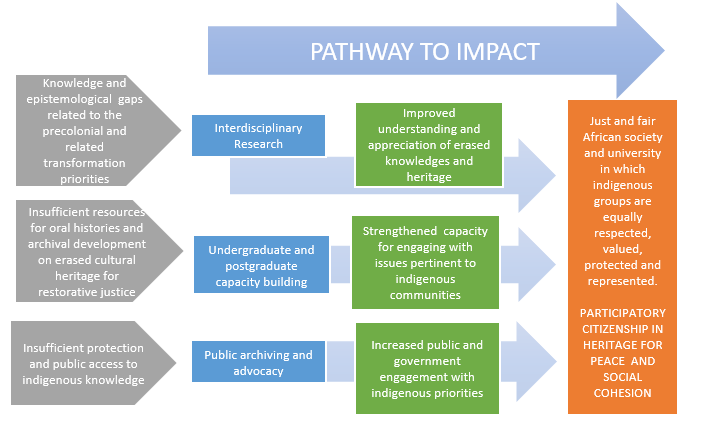
Research Projects and Collaborations
Endangered South African Languages Application and Digital Archive
Funded by the Department of Arts and Culture
The United Nations declared 2019 the International Year of Indigenous Languages for the promotion of language development, peace and reconciliation. One of the stated aims of the awareness campaign is the integration of indigenous languages into standard settings, bringing about empowerment through capacity building and through the elaboration of new knowledge. Khoekhoegowab and N!uu are two of the first languages spoken by inhabitants of the present day Western Cape and more broadly in the region. These languages are associated with well documented extermination in the early colonial era and concomitant cultural genocide. They are endangered African languages that face extinction, which would result in the loss of a rich and diverse heritage which was once endemic to South Africa. The South African National Heritage Resources Act (1999) foregrounds the protection of living heritage through indigenous knowledge systems as linked to language and memory through documentation. Such provision is also covered by the legally related South African National Archives Act of 1996. The South African National Heritage Resources Act (1999) makes it explicitly clear that every generation has the moral responsibility to protect the heritage of the nation for succeeding generations to promote reconciliation, understanding and respect through heritage to be researched and documented, preventing loss and thereby contributing to economic and social development of communities. The Pan South African Language Board (PANSALB) established within the rights of South Africans as enshrined within the 1996 Constitution of South Africa is in this regard tasked with the creation of conditions for the development and use of official languages such as the endangered Khoe and San languages and to thereby promote the fundamental rights to multilingualism in a diverse South Africa. A new higher education national language policy is currently being reviewed which will have implications for higher education transformation in South Africa, with undoubtedly direct implications for communities who have suffered indigenous cultural loss. This archive hopes to make a direct contribution to policy development and implement to the benefit of South Africa’s diverse language communities.
Global Indigenous Knowledges Archive
!Gâ re – Rangatirangtanga – Dadirri :Decolonizing the 'capture of knowledge'. This is a global collaboration on the creation of a digital indigenous knowledge archive with the Universities of Alberta, Bristol, Ghana, Massachusetts Amherst, Namibia, Auckland, Sydney, Western Australia, York, and Zheijiang.
Indigenous Knowledge exists as understandings, skills, and philosophies gathered over centuries by communities as original inhabitants of land. It may be considered a cluster of epistemologies, or ways of knowing, about our social and natural worlds. Colonization has, however, suppressed and invisibilized such knowledge and this has led to an imbalance in the way we conduct research and produce new knowledge. Indigenous Knowledge has remained geographically trapped within Indigenous community spaces, further marginalized through erased and endangered languages, and located outside universities. This project is an emancipatory initiative where knowledge will be reclaimed and new knowledge generated. Centred in knowledge restoration and responding to the marginalization of Indigenous knowledges, languages and cultural practice, it will undertake the challenge of increasing cultural understanding and setting a new research agenda of collaborative learning. The development and application of new Indigenous research concepts is critical in establishing meaningful partnerships between academia and Indigenous communities to support the decolonizing of knowledge production. Such a collaboration has not been established before, and will address new research problems in Africa, Europe, the Americas, and the Pacific as it puts into practice the process of decolonization as contesting and reframing narratives about Indigenous communities. Such processes will be catalytic in freeing research methods and research ethics from its knowledge capture. This will be facilitated through a comparative research concept development workshop with partner universities and their community representatives. The outcome will be a draft Indigenous concept database for further development and ownership by both communities and scholars, supported by their own local funding streams. This will lead to the development of a larger conference within two years with the aim of developing a co-authored and peer-reviewed digital archive for international Indigenous concepts that students can use in their research, and scholars can use in their teaching.
This project falls firmly within the WUN Global Challenge of Understanding Cultures through Decolonization. Many countries such as Canada, Australia, New Zealand, Ghana, and the Americas have advanced quite far in addressing the process of restoring ab-Original Indigenous knowledge as mainstream knowledge. Within South Africa, this is still new with the formulation of the San 2017 Code of Ethics*, a first step in Africa by an Indigenous community to signal the importance of ethics when conducting research involving Indigenous communities. Universities in South Africa have thus far worked, and still largely continue to work, in isolation from communities that hold cultural knowledge through endangered languages. There is a tendency for university researchers to merely put out requests for ethical observation from communities rather than to engage with them as co-designers and co-producers of knowledge and research ethics. To this extent the project also addresses the WUN Global Challenge of Global Higher Education and Research in terms of critically examining/enabling global and local mobilities of people, ideas, programmes, knowledges in higher education. The comparative nature of the project enables us to learn from different environments in the process of bringing new invisibilized knowledge concepts for new research methods to the surface. It therefore also strengthens the legitimacy and authority of the university in a changing world through new decolonial knowledge-producing partnerships. The task of workshopping, compiling, and sharing a comparative Indigenous concept database will deepen the understanding of cultures on a global level. This restorative process will enable the use of new decolonial research methods and teaching practice. The research is conducted with universities across the globe, but also in unison with the Indigenous communities that hold this knowledge. Understanding cultures therefore takes place through a practical, actively engaged, and decolonized scholarly language framework.
* online link: http://www.globalcodeofconduct.org/wp-content/uploads/2018/04/San-Code-of-RESEARCH-Ethics-Booklet_English.pdf
Teaching Collaborations
AXL 3200F – AFRICAN POLITICAL ECONOMY
This third year level course aims to introduce students to critical debates in the political economy of Africa, with specific reference to Sub-Saharan Africa. See link below to read more about the course offering.
Engagement with the A/Xarra Restorative Justice Forum
http://www.africanstudies.uct.ac.za/axarra-restorative-justice-forum
Partnership with A/Xarra on
Socially Engaged & Responsive Teaching
2019 - 2020
A Brief background:
This teaching collaboration worked towards creating African philosophies and new theories on research ethics and knowledge production processes aimed at addressing material inequalities. It also set out to answer questions regarding the role of organic and public intellectuals in knowledge production in an African university context – what are the new emerging research questions and teaching and learning imperatives? What are the limitations of theory? Students were expected to develop and demonstrate a grasp of Afrocentric approaches to knowledge production and theories, and begin to formulate such approaches themselves through social engagement. Focus group discussion held on 31 January 2020 comprised of students and A/Xarra members who participated in the course. Prospective students asked to join the dialogue as they were interested in the course and the community engagement aspects.

The aims of the Focus group:
- To develop and improve the course in terms of social engagement towards a just and fair society
- To develop theory and to establish networks for their own activism on pertinent social issues.
Further developments:
A small cohort was admitted to Honours in 2020 and they took the research themes and questions into their mini thesis – focusing on research methodologies and issues of political economy. A/Xarra members who engaged developed their own research questions around land, custodianship and political leadership in their local contexts.A A/Xarra Covid-19 Research commission was established in May 2020 through a critical engagement with the ‘Strandfontein camp for the Homeless’ – historicizing disease and the importation of European lockdown models and anti-poverty strategies. Engaged students and tutors of the 2019 (second semester) and 2020 (first semester) classes gave WhatsApp feedback during Covid.
Erased Indigenous Languages Programmes
The community-driven Khoekhoegowab teaching programme was initiated by A/Xarra with CAS in engaged community, traditional structures and civic structures over the past 3 years. It has since been operationalised through an implementation collaboration of A/Xarra and CAS with EMS since last year. In 2019, over 70 students received certification through EMS for the course; the majority of these students were community members who completed the course for free.
In 2020, under Covid-19 conditions, this was the first online foundational certificated Khoekhoegowab course offered in higher education in South Africa, based on the CILT Lockdown blended teaching and learning model experience at UCT over the past 9 months. It has not been easy as the students come from the most deprived areas on the Cape Flats and there are immense challenges with resources in a 'social distancing' teaching context. The huge costs of data and technical support in a Covid-context are a significant challenge and we hope to attract more funding in this regard to sustain this important project for the community.
Since the Programme has rolled out its third intake since last year June, we have already built up a considerable waiting list of interested applicants countrywide. A strong contingent of the participants are active community workers involved in democracy education projects, intergenerational indigenous trauma counselling, and in the creative arts as artists, teachers, musicians. The course has also attracted consistent interest from community leaders and activists, including members of the clergy and customary council members.
One of the key issues that confronts transformation and decoloniality at UCT is multilingualism in African Languages which is now a legislative imperative through the new national Language Policy Framework Policy of 2020. Universities now have the task to develop capacities for marginalised African languages, including Khoi and San languages. This work is therefore of great significance the future. Foundational certification will remain important because that is where a language gets restored in the everyday over the long term. To develop beyond Foundational Khoekhoegowab, the Khoi and San Centre will explore and establish further teaching and learning partnerships with the Language Development Education colleagues at UCT, and colleagues in African Languages and Linguistics.
For me information on this course or to also provide funding support, please contact: admin.khoiandsanunit@uct.ac.za
Snapshots of students completing the course
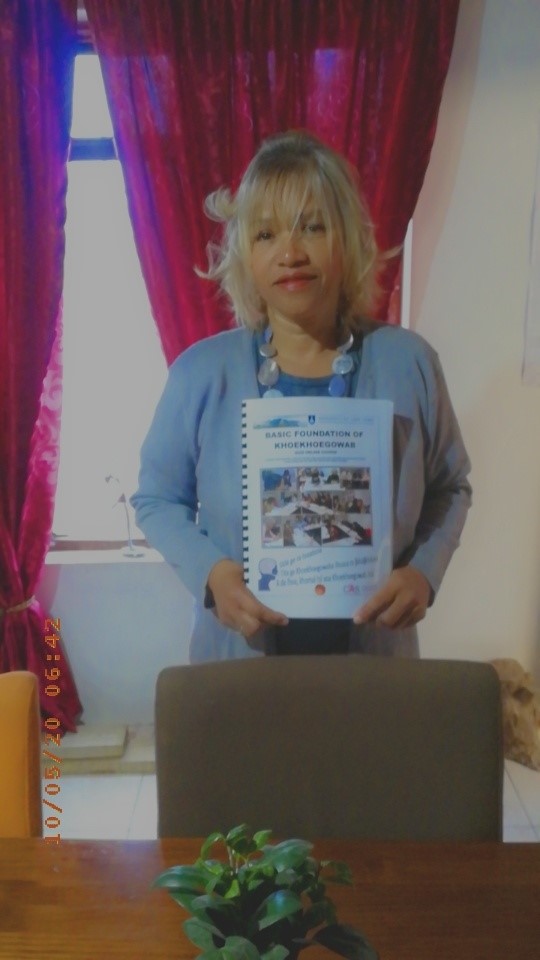
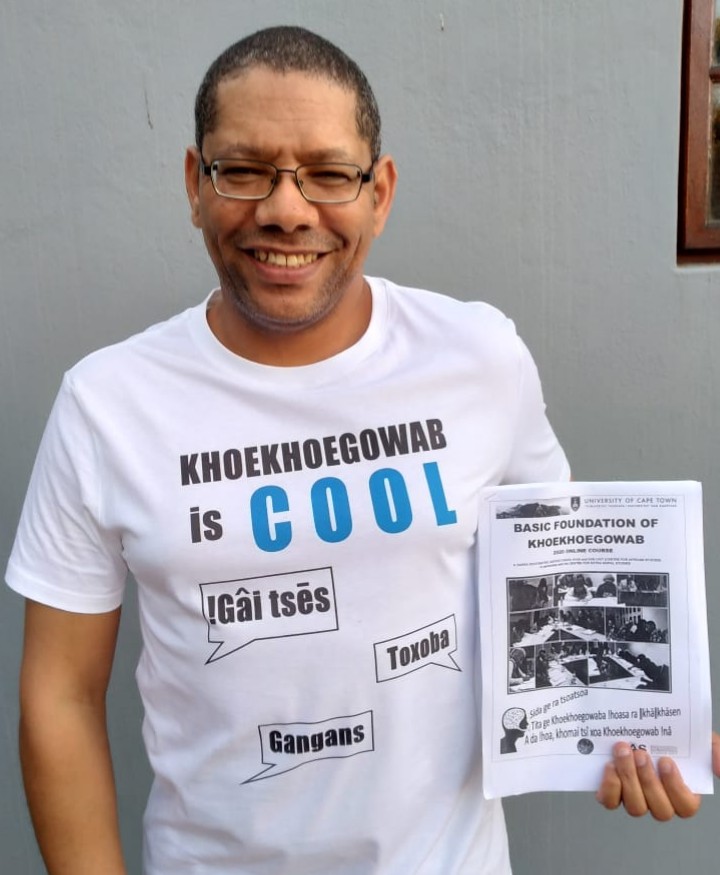
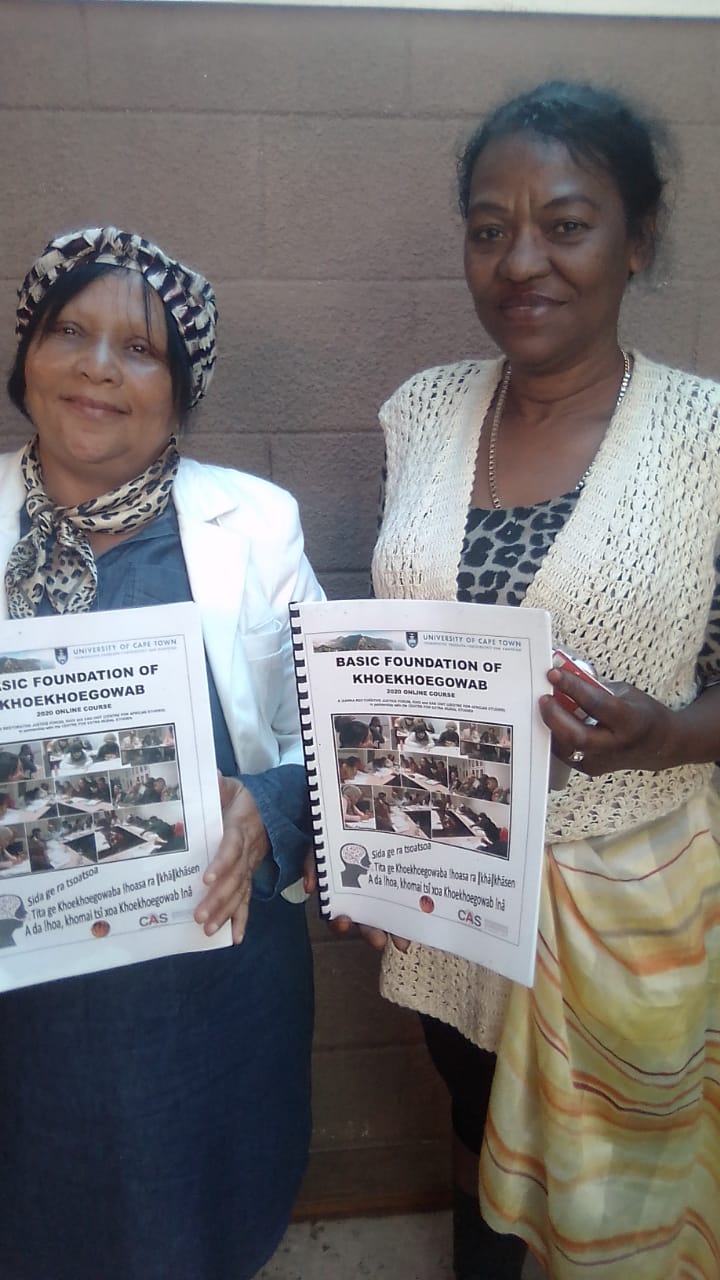
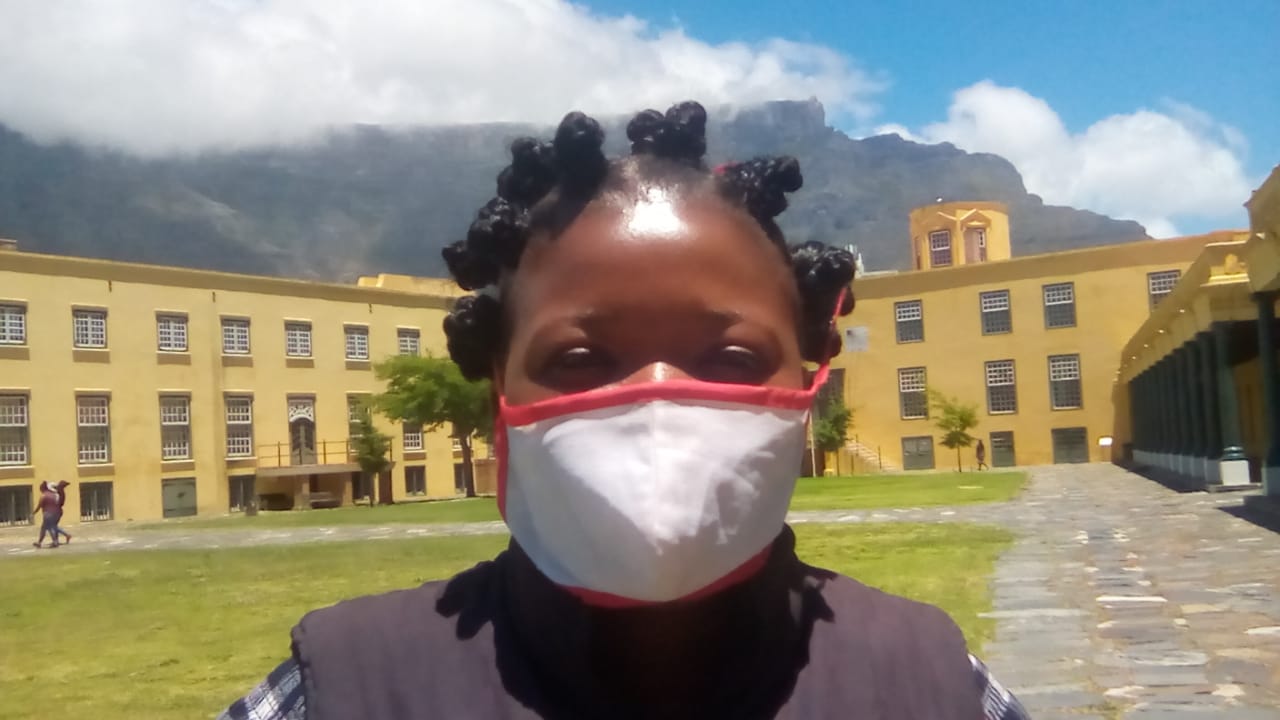
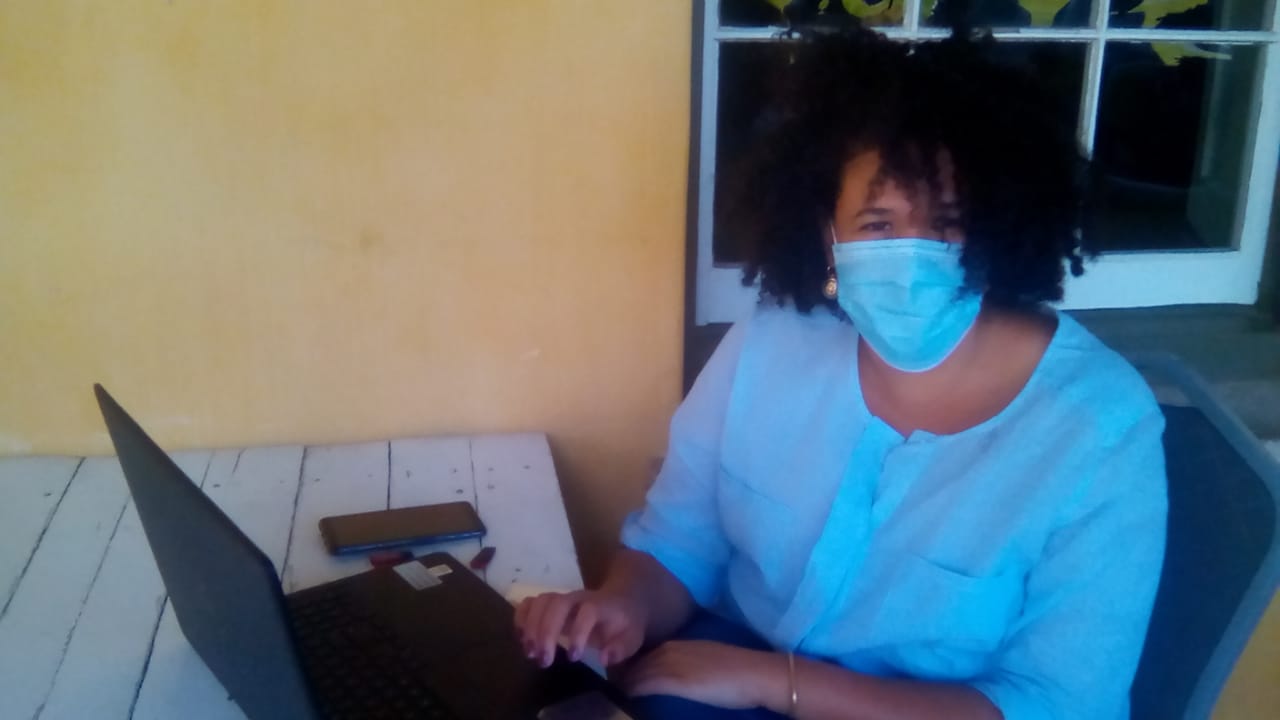
Below: A/Xarra Youth Commission Chair, Robyn Humphreys, assisting with the administration of the Khoekhoegowab course at the Cape of Good Hope Castle during Covid-19.
Creative Arts
Poems and cultural performances for the San & Khoi Unit
Our inaugural feature is our new Honours student in the Khoi and San Centre, Zoe Fortuin. See below:
Die Berge Onthou
- Zoe Fortuin
In die Paarl, tussen die berge, langs die rivier,
staan my hart.
Die berge wat ‘n duisend jaar se stories kan vertel.
Van dié van die Khoekhoe af, tot dié van my ouma se dood.
Ek staan hier nou,
En ek voel dit, ek hoor dit.
Ek hoor hoe die berge sing – liedjies van triomf, liedjies van hartseer,
en dan, liedjies van hoop
Hoop dat eendag, hierdie land waar die berge oor my lyf kyk,
sal myne wees
En duur my, my voorvader s’n wees.
No longer will the Taal Monument (built on all its colonial lies) stand tall.
The mountains foretell the story of when it will be mine,
of when it will be ours.
Die land, die taal, ons taal…
Ons siele, op God se naam!
Die berge gee vir jou ‘n waarskuwing.
Die berge onthou.
Our second feature is a poem titled: “I am true. I am me. I am them.”- Zoe Fortuin
This poem is featured in video format on our youtube page to emphasise the orality in which African knowledge can exist and the value of its existence in that form.
click link below for the video:
“I am true. I am me. I am them.” by Zoe Fortuin
*Video credits
Music by Nkosenathi Koela
Video editing by Sam Fortuin
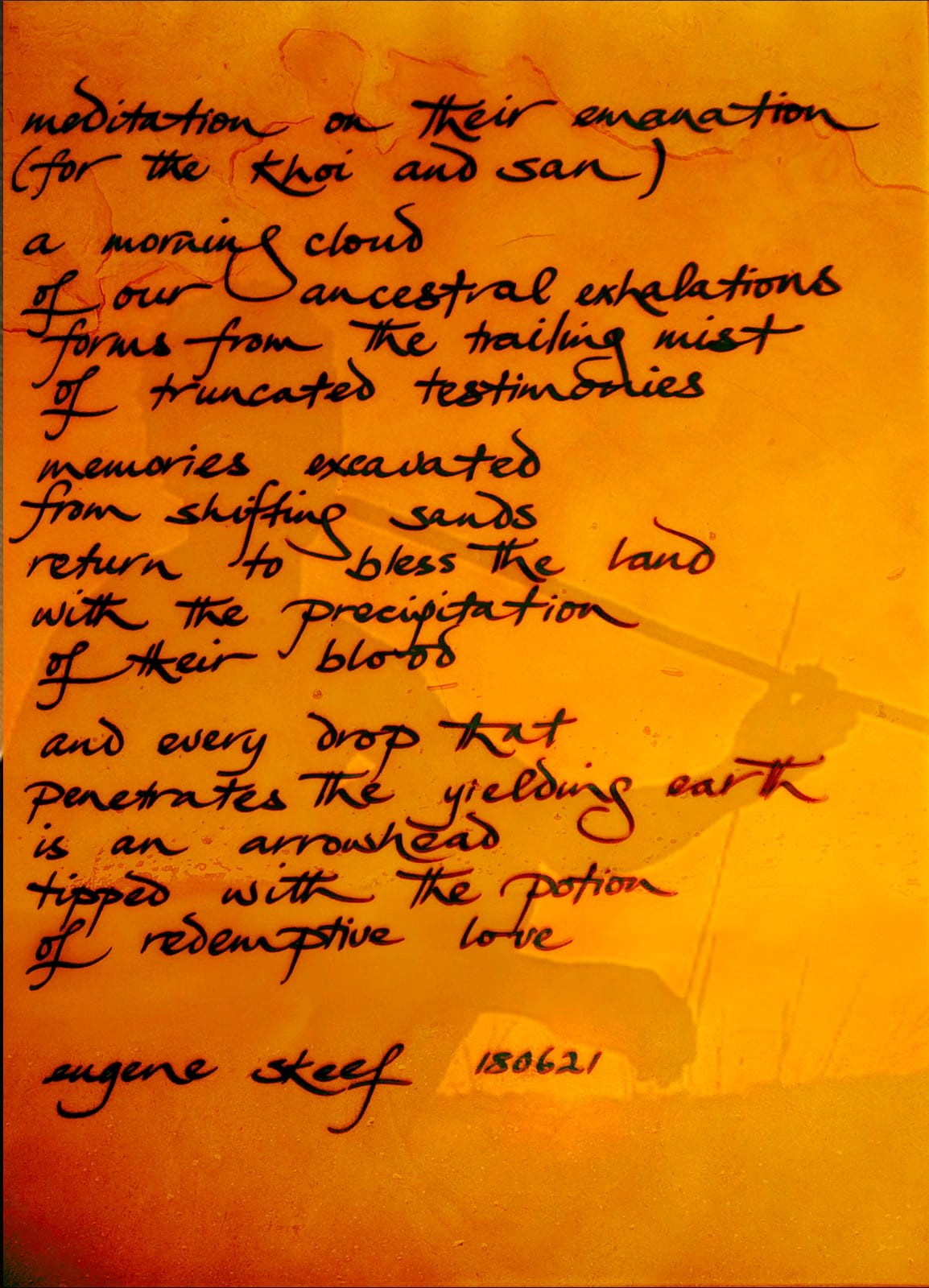
Internationally renowned Eugene Skeef dedicates poem to the San and Khoi Centre
Students and Bursaries
Call for Applications
Community Chest Khoekhoegowab Foundational Course Bursaries
Deadline for Applications: 11 November 2020
We welcome applications for 25 Community Chest bursaries to complete this course which will be offered online from mid-November 2020.
The course, aimed at youth, will run over a period of 8 weeks with 24 sessions of online instruction and preparation work. The bursary covers the tuition fees and mentorship development support as part of the programme. The course involves a formal weekly continuous assessment. On completion of the course, candidates receive a UCT certificate.
This course is offered by the Khoi and San Unit as a collaboration with Community Chest, the A/Xarra Restorative Justice Forum (community, civic and traditional structures) and Extra-Mural Studies (Summer School).
Applicants must meet the following criteria:
1) Be aged between 18 – 35 years
2) Be unemployed
3) Live in an impoverished community in the Cape Metropole area
4) Be active in the community in a leadership role amongst youth (provide a referral letter)
5) Have literacy in reading and writing
6) Have the full commitment and time to complete the course uninterrupted to serve as a future mentor to impart the language skills and knowledge in their respective community
Those who do not show satisfactory progress and commitment during the course will forfeit the bursary.
Send application letters with supporting documentation (ID, referral letter, school or other certificates) via email to:
admin.khoiandsanunit@uct.ac.za
For more information about the course, send text message / WhatsApp message to: 0849618794.
News
IN THE MEDIA Section:
African Union and United Nations panel discussion
http://www.africanstudies.uct.ac.za/news/african-union-and-united-nations-panel-discussion
The Launch of the Unit
https://www.youtube.com/watch?v=yJwD5Z-vBMo
https://www.news.uct.ac.za/article/-2020-09-23-uct-launches-milestone-khoi-and-san-centre
Title: Finding Khoisan connections on the Cape Flats
URL: https://www.news.uct.ac.za/article/-2019-01-16-finding-khoisan-connections-on-the-cape-flats
Title: Rewriting a piece of history
URL: https://www.news.uct.ac.za/article/-2019-11-04-rewriting-a-piece-of-history
Worldwide University Network
Khoekhoegowab classes
Title: Warm welcome for historic KhoeKhoegowab language course
Title: UCT adds KhoeKhoegowab to its language courses
URL: https://www.news.uct.ac.za/article/-2019-05-23-uct-adds-KhoeKhoegowab-to-its-language-courses
Title: Warm welcome for historic Khoekhoegowab language course
Sutherland Human Remains repatriation
Title: ‘We knew their names’
Title: Sutherland project will shape historic reburials policy
URL: https://www.news.uct.ac.za/article/-2019-11-04-we-knew-their-names
Conferences and Webinars
Protecting Human Rights Defenders in Islam The experience of having a legacy of defending human rights
Speakers include:
Fatima Noordien An Educator and Social Activist
Arshaad Fredericks
A Lawyer, Corporate Governance Specialist and a
Champion of Universal Justice
Session Moderator:
Tauriq Jenkins
Founder Member and Chair of the A/Xarra Restorative
Justice Forum
Session Chair:
Robyn Humpfreys
History Lecturer, UWC and A/Xarra Restorative Justice Forum Representative
Event Details:
Date 13 September 2022
Time 17:00 - 18:30
Venue CAS Gallery, 2nd Floor, Harry Oppenheimer Building, Upper
Campus, UCT
To RSVP please email shamila.abrahams@uct.ac.za
Indenturedness Interrupted’: Emancipation from Mental Slavery Event on 1 December 2021
The San and Khoi Centre hosted a public virtual event commemorating emancipation from slavery in the former Cape colony slave community on 1 December 1838.The seminar presented a unique blend of community and academic perspectives on the theme of identity formation as a consequence of the South African slave heritage. The event was organised and structured to collectively begin to discover new pathways on how we as a society could rethink emancipation, social entanglement and language in South Africa. Speakers tackled the epistemological challenge of unpacking identity development in South African society in a manner that undoes the destructive ongoing divide and rule legacy of colonial power.
The community perspective was represented by Nadia van Dyck’s story and the San and Khoi Centre’s Khoekhoegowab language teacher and activist Danab Bradley van Sitters. Nadia could not attend due to illness but requested that her life story be presented by current Director of the centre, Dr June Bam-Hutchison. Nadia’s story quintessentially represents the conundrum experienced by many people with mixed heritage at the Cape – a region, due to its long colonial and segregation history, still significantly burdened by the colonial legacies of race. Though Nadia’s present cultural identity is as a Cape Muslim woman, her family story is one of strong ties to the San community through her father who taught his children the rieldans and San language around the fire at night where they grew up in the Karoo. The latter aspect of her identity is often invisibilised due to the limiting lens of both social and scholarly perceptions based on assumptions of who is entitled to claim ‘Khoi’ or ‘San’ identity and indigenous language rights.
Danab van Sitters further explored the implication of having mixed heritage and how this lived reality goes against the social constructs of assumed ‘pure races’ and the fixity of races and how through the study of languages, we may be able to deconstruct such exclusive Verwoerdian claims as misnomers.
Dr Rashied Omar. Credit: muslim.co.za
Dr Rashied Omar, also known as the Imam of the Claremont Mosque, led the academic responses to Nadia’s story by speaking about the troubling colonial racist terminology the South African society has inherited. This should be recognised as an ongoing destructive legacy of othering and naming. One such term is the construct of being “Cape Malay” – in itself ahistorical and misleading which disavows Muslims from an African identity. This ‘de-Africanisation’ of people is cogently illustrated in the enforced racial classification of “Coloured” as an Apartheid-designated demographic group. Dr Omar mentioned that emancipation from the inherited mental slavery entails embracing our African-ness and all the aspects of our heritage that make up who we are today in our cultural diversity. This is possible as identity development is not a static process, not fixed. In going forward, we need to construct an identity without violence towards the other and avoid furthering the process of colonial and Apartheid “othering”.
Dr Justin Brown, a socio-linguist, described the reality of having mixed heritage as a default of being human. Yet perversely the descriptive lens we remain faithful to are defined by categorisation, physical appearances, and genetics. The lived reality of mixed heritage disrupts these assumptions and stereotypes as so cogently reflected in Nadia’s story. Such powerful stories are often hidden in the academic archive through its glaring absence.
Dr Zuleiga Adams Credit: https://www.liferighting.com
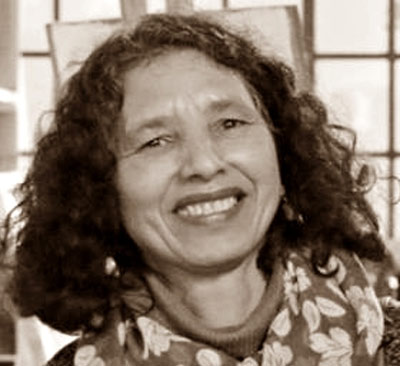
Dr Zuleiga Adams, a historian, rounded off the academic responses to the community voices. She argued that we have inherited distorted perceptions of South Africa’s past and have unproblematically embraced human identification mechanisms which have collectively destroyed our sense of cultural entanglement and hybridity. A case in point is the Apartheid construct of “Cape Malay” as noted by Dr Omar. Dr Adams asserted that instead of pursuing questions of origins and purity in historical analyses, we should be pursuing various points of ‘beginning’. She further supported the notion to not romanticise the past out of an acknowledgment that people have made certain cultural choices based on survival, such as about language. We either opt to stay congruent to our mother tongue or we choose to adopt language proficiency in the socially dominant language of the power governing the society we exist within – as in the case of hegemonic English.
The event was organised by the centre’s digital curator and researcher Shamila Abrahams, and chaired by community engagement strategist Tauriq Jenkins. Well-attended by both scholars and community members, further discerning insights were offered at the event on the political economy of identity and language by veteran activist Vanessa Ludwig who made the point that language claims are intrinsically part of indigenous identity and rightful claims to land – and should therefore not be treated as decontextualised from material conditions. Similar points were echoed in a response by veteran Khoe historian Dr Yvette Abrahams, who called for a series of related public events in the future to explore these vexing questions of our times. The event itself forms part of the San and Khoi Centre’s commitment to restore social justice to indigenous communities through education and debate as part of the Centre for African Studies’ commitment to ‘rethink’ Africa.
HEALING THE PAST FOR THE FUTURE: A SURVIVOR'S VIEW OF DAMARA/HERERO/NAMA GENOCIDE OF1904-1905 seminar by Yvette Abrahams will take place on Tuesday 10th August at 4pm(SAST). The Zoom details are below. For more information see the poster.
The event will take place on Zoom:
Login details:
Meeting ID: 893 0600 1166
Passcode: 160145
see video recording below:
WOMEN'S DAY SEMINAR BY DR YVETTE ABRAHAMS : HEALING THE PAST FOR THE FUTURE - A SURVIVOR'S VIEW
Dr Carrine Zaayman will launch the San and Khoi Centres's annual Krotoa month lecture series chaired by Dr Yvette Abrahams with a seminar titled: (UN)Learning From The Ashes: Following Krotoa Into The Anarchive on Tuesday 13th July 4pm(SAST)
To register and find more details of the event please see details below and PDF poster to the event:
When: Tuesday 13th July 2021
Time: 4pm (SAT)
Where: Zoom https://us02web.zoom.us/j/84169883241?pwd=NDdwbXlIcHVabXhwUG9sY1cwZmZ6UT09
Meeting ID: 841 6988 3241
Passcode: 485552
To register go to: https://forms.gle/ywirDwka6yovEYvV7
Details of speaker:
Carine Zaayman is an artist, curator and scholar committed to critical engagement with colonial archives and collections, specifically those holding strands of Khoekhoe pasts. Bringing intangible and neglected histories into view is a key motivation for her work. Her research aims to contribute to a radical reconsideration of colonial archives and museum collections, especially by assisting in finding ways to release their hold over our imaginations when we narrate the past, as well as how we might shape futures from it. She obtained a PhD in Fine Art from the University of Cape Town where she also worked at the Michaelis School of Fine Art and the Centre for Curating the Archive.At present, Zaayman is a postdoctoral fellow at the Vrije Universiteit, Amsterdam, as a team member in the NWO Worlding Public Cultures project, as well as a research associate at the Research Centre for Material Culture (www.materialculture.nl). Zaayman is the Curator of UnderCover of Darkness, an exhibition and project concerned with the history of women in servitude,especially slavery, in Cape Town (www.undercoverofdarkness.co.za).
See video recording below:
(UN)Learning From The Ashes: Following Krotoa Into The Anarchive
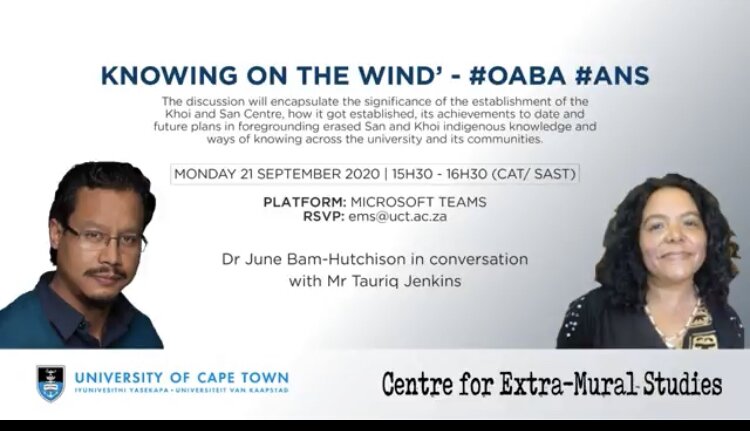
'Knowing on the wind' - #oaba #ans' by Dr June Bam-Hutchison and Mr Tauriq Jenkins which took place on 21 September.
!Gâ re – Rangatiratanga– Dadirri: Decolonizing the 'capture of knowledge'
29 July 2020
'Decolonising Knowledge Capture: Indigenous Threshold Concepts' Room 1
'Decolonising Knowledge Capture: Indigenous Threshold Concepts' Room 3
Plenary Session Group Photo
Third ‘Rethinking Africa’ Catalytic Pre-colonial Conference
CAS in collaboration with A/Xarra Restorative Justice Forum
Venue: CAS gallery
University of Cape Town
23-24 January 2020
Funded by: National Institute for Humanities and Social Sciences
"What is an African Philosophy? Contemporary challenges and imperatives for political and economic policies in southern Africa."
The identified conference themes therefore flow from this scholarship trajectory as we go into the future:
- Human Remains, repatriation philosophies and land
- Indigeneity, migrations and non-racialism (the land question)
- Indigenous languages, philosophies and endogenous knowledge
- Land, belonging and philosophies
- Organic intellectuals, philosophies and knowledge partnerships (case studies in southern Africa and the global south)
- Research Ethics and Philosophies (emerging frameworks for epistemological justice)
- The ritual archive, philosophies and entanglement
- The Traditional ‘Khoisan’ Bill and Communities: emerging new national questions
See the poster here and the programme here
The co-design knowledge partnership led to the establishment of the Khoi and San Unit which will develop into an Institute.